


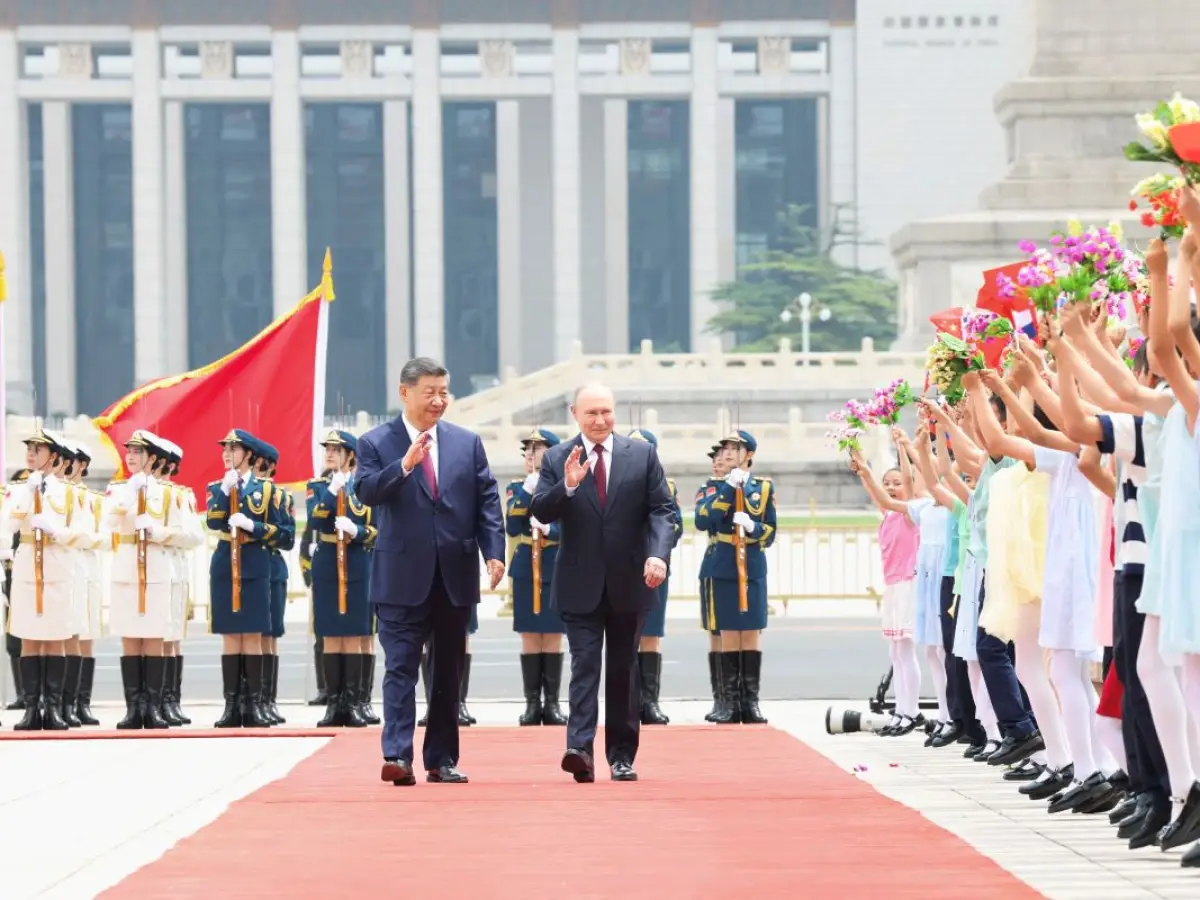

The timing couldn’t have been better. Although Vladimir Putin’s visit to China had been planned for some time, the fact that it took place on May 20, just six days after Donald Trump’s visit, works clearly in Beijing’s favor. In the last months, besides Trump, the Chinese capital has witnessed a steady stream of prime ministers received by Xi Jinping (including France, the United Kingdom, Canada, Germany, Spain). As the Global Times wrote on the eve of the Russian president’s arrival, Beijing can now present itself “as a focal point of global diplomacy”.
While the visit itself carried high political significance, attention was also focused on more concrete issues, such as energy. Amidst the crises in the Middle East and Ukraine, tariffs, and oil supplies at risk, there was one outstanding outcome that Putin hoped to secure. For now, however, it will remain just a promise: the green light for the Power of Siberia 2 gas pipeline.
One day, three autumns
A parade of cheerful children waving little flags, a red-carpet walkway in Tiananmen Square, a photo-shooting on the steps of the Great Hall of the People. The ceremony for welcoming Vladimir Putin was almost identical to the one held for Trump the week before. The message about the importance Beijing attaches to the visit of the two leaders is more for the US president than for the Russian one.
However, with Putin the atmosphere was, so to speak, more “intimate”. The talks were held in the Fujian Hall, which is less opulent and imposing than the Great Hall where Trump had been received, as if to suggest that the Russian president is “one of the family”. This is indeed Putin’s twenty-fifth official visit to the People’s Republic and – as Xi pointed out – it coincides with the 25th anniversary of the Treaty of Good-Neighborliness and Friendly Cooperation between Russia and China and the 30th year of the strategic partnership between the two countries.
The two leaders did not spare on mutual cordiality. Xi called Putin “a dear friend”, noting how relations between the two powers have withstood “countless trials”. Putin replied that “a day without seeing each other is as long as three autumns”, using a typically Chinese saying that, for the record, is part of the language of love.
Putin and Xi remain aligned
Besides the pleasantries, the Russian president reiterated that Russia-China cooperation is “one of the stabilizing factors on the global stage”. He added that “a very complex process is currently underway to build a multipolar world that takes into account the interests of all its members”. Doing so, he echoed what has now become the mantra of the Chinese leadership. The renewal of the cooperation treaty between the two countries signed in 2001, moves precisely in this direction.
In the joint statement, Xi and Putin reaffirmed the alignment of their positions on various contentious issues in global geopolitics. First, they declared that the military attacks by the United States and Israel against Iran violate international law and destabilize the Middle East. Then, they jointly opposed economic sanctions against North Korea, expressed concern over Japan’s accelerated rearmament, and criticized external interference (namely, from the US) in the internal affairs of South American countries. Finally, Xi Jinping called for a complete ceasefire in Gaza and warned against a global return to the “law of the jungle.”
On Energy, China is in no hurry
On economic matters, the summit in Beijing led to the signing of 21 cooperation agreements in several fields. These include the expansion of railway lines between the two countries, space research, and the study of military applications for artificial intelligence (which sounds anything but reassuring). The hottest topic undoubtedly remains that of energy supplies.
Putin arrived in Beijing with a pressing need to strengthen long-term energy agreements with China, which is now the main buyer of Russian oil and gas. The war in Iran and the crisis in the Strait of Hormuz have increased the flow of Russian oil to China, which grew by 35% in the first quarter of 2026. Yet, the real stake lies in gas supplies. After the invasion of Ukraine, Russia saw its gas exports to Europe plummeting due to sanctions: the state-owned company Gazprom, for example, recorded a 44% drop in exports last year, reaching the lowest levels in decades.
Economic dependence on Beijing is becoming increasingly pronounced. Therefore, Moscow would like to secure this commercial partnership by finally launching, in cooperation with Beijing, the construction of the Arctic gas pipeline “Power of Siberia 2”. This mega-project has been in the planning stages for years and it would complement the already existing Power of Siberia 1. It involves a 2,600-kilometer pipeline capable of transporting 50 billion cubic meters of gas per year from the Yamal gas fields in the Russian Arctic to China passing through Mongolia. The key issue, however, is pricing. In recent months, Beijing has been buying Russian gas at discounted prices and now wants to secure favorable terms for the new pipeline. In this view, it demanded a rate equivalent to Russia’s domestic price of about $120–130 per 1,000 cubic meters (half the price proposed by Moscow).
The problem for Putin is that Xi Jinping sits at the negotiating table with a clear advantage: in recent years, Beijing has significantly diversified its energy supplies. Even though the crisis in the Strait of Hormuz remains a concern, China benefits from its coal reserves and, above all, rapidly expanding renewable energy sources.
Ultimately, the summit ended without any breakthrough: The two countries signed a memorandum of understanding, committing them to move forward, sooner or later, with the construction of the multibillion-dollar gas pipeline, but the project remains effectively stalled. While Russia is in a hurry, China can afford to take its time to wait.
Cover: Putin and Xi photographed by da Huang Jingwen, Xinhua/ABACA/Agenzia IPA