


Rotterdam - “If the port is doing well, our economy is also doing well,” said Ursula von der Leyen in September 2022, discussing the port of Rotterdam in the Netherlands. At the time, Europe was in the midst of recovery and resilience plans, coming out of the pandemic and seeking to rebalance its energy systems.
With the outbreak of conflict in Iran bringing the rhetoric of austerity back to Brussels, looking at Europe's largest port remains essential for understanding the risks facing the European economy, particularly when viewed through the lens of non-oil raw materials. Beyond volumes that may appear marginal compared to crude oil – at the heart of the new narrative that approximately 20% of global oil flows pass through the Strait of Hormuz – lies a complex and strategic network: fertilisers, chemicals, metals. This is where the submerged part of the “Hormuz iceberg” takes shape – the part that could affect agriculture, healthcare and the high-tech industry well beyond the most visible dimension of the energy crisis.
The energy crisis
For the EU, Rotterdam is one of the main entry points, and surely not the crux of the problem. “The Strait of Hormuz is the world's most important energy supply channel,” comments Sjaak Poppe, spokesperson for the Port of Rotterdam Authority, to Renewable Matter. “Closure of the Strait leads to disruption of exports, particularly of oil and oil products from the Gulf region, uncertainty, and consequently rising energy and/or transport prices. Rotterdam is Europe's largest energy port: 13% of all energy consumed by the EU passes through it.”
Poppe quantifies the port’s immediate exposure by explaining that around 10% of crude oil and 14% of petroleum products imported via Rotterdam pass through the Strait of Hormuz. In particular, this includes oil from Iraq and Saudi Arabia, jet fuel from Kuwait, and diesel from Saudi Arabia and Qatar. Furthermore, exports of Saudi crude oil and petroleum products mainly take place via terminals in the Persian Gulf, whereas those in the Red Sea are still not frequently used for shipments bound for Europe.
As for gas, however, the Port of Rotterdam’s direct dependence on the Gulf is lower than other European hubs. “LNG from Qatar does not arrive in Rotterdam,” the spokesperson explains. “European LNG imports from the Gulf mainly go to Italy, France and Belgium. Qatar supplies Europe with around 10–12 million tonnes (22.2–26.6 million m³) of LNG per year, out of a total import of nearly 70 million tonnes (150 million m³) in 2025. About two-thirds of the LNG transhipped in Rotterdam comes from the United States.”
Beyond oil: from bulk cargo to containers
Commonly, the Strait of Hormuz is mainly considered an oil bottleneck. Yet the most accurate description is that of a multi-commodity industrial corridor, in which crude oil is just one of the flows. For instance, “Closure of the Strait of Hormuz also disrupts container logistics,” explains Poppe. “In total, 19 million tons (4.7%) of Rotterdam's total transshipment is transported to and from countries in the Persian Gulf, Jebel Ali and Khalifa Port in the United Arab Emirates. Of this, 16 million tons are inbound and 3 million tons are outbound. There are three services to the Middle East that call at these ports. Two go to ECT Delta and one to RWG. [both terminals at the Port of Rotterdam, ed.]. Altogether, this amounts to approximately 120,000 TEU per year and in terms of tonnage about 1.2% of Rotterdam's container throughput.”
In the event of a prolonged blockade, the spokesperson adds, “containers destined for and from the Gulf region cannot be loaded or unloaded and remain in hubs or must reach the region via other destinations (such as Sohar). If this happens, it could also mean that cargo remains on board. This can cause logistical disruptions in the global container supply chain.” Fertilisers also contribute to these flows: while most are transported in bulk (i.e., unpackaged, directly in the holds of ships, as is the case with grain or minerals), a growing proportion – particularly packaged products – is transported via containerised freight.
LPG, naphtha and chemicals: the supply chains that hold together plastics and manufacturing
The World Economic Forum has identified key commodities (apart from oil) that are directly exposed to the risks of a blockade of the Strait, among them liquefied natural gas (LNG), liquefied petroleum gas (LPG), naphtha, ammonia, urea, sulphur, aluminium and helium. The Middle East represents about 20% of global LPG production, and a prolonged closure could compromise a significant share of global supply.
For naphtha, a by-product of oil refining and a raw material for plastics production, the vulnerabilities are equally significant. According to an ICIS analysis, Middle Eastern suppliers (the United Arab Emirates, Qatar, Kuwait, Saudi Arabia, Oman, and Bahrain) supply 54% of all naphtha imports to the Asian petrochemical sector. In the event of a blockade, the impact on Asian supply chains could be particularly severe, with knock-on effects on plastics, solvents, resins and synthetic fibres.
For Europe, this means not only pressure on energy prices but also greater volatility in the costs of industrial raw materials. The value chains for plastics, the automotive sector, household appliances and construction are vulnerable to disruptions and price increases at a time when the availability and price of virgin materials can influence both investment decisions and the speed of the transition towards more circular models.
In particular, as noted by the ECCO think tank, Italy is the world’s sixth-largest importer of plastics and plastic products, in addition to being among the European countries with the highest consumption. Some industrial operators have already reported increases in plastic prices as high as 30% in response to tensions in the Middle East.
Fertilisers, a third of the world is hanging on to Hormuz
The Persian Gulf is one of the world’s main hubs for ammonia and urea due to its low-cost gas and proximity to Asian markets. Five key producers (Iran, Qatar, Saudi Arabia, the UAE and Bahrain) accounted for approximately 23% of global ammonia trade and 34% of urea trade in 2024, as reported in an open letter from the International Fertilizer Association. Including Iraq, Oman and Kuwait, this total amounts to “roughly 43% of seaborne urea exports, about 44% of seaborne sulphur trade, and over a quarter of global ammonia exports,” based on March data from the Centre for Agricultural Policy and Trade Studies at North Dakota State University (NDSU).
A physical blockade of the Strait threatens to halt these exports, leaving limited options for rerouting ships. The impact is certainly global yet uneven. According to NDSU, India is the country most dependent on fertiliser imports from the Gulf, with around 10 million tonnes in 2024, accounting for 54% of its total imports, primarily due to its heavy reliance on ammonia and urea from the Persian Gulf. Brazil and Australia also show a high dependence on urea: the former imports around 40% of its urea from the Gulf, whereas the latter imports almost 68%. Finally, around 12% of urea consumption in the United States passes through the Strait of Hormuz, mainly supplied by Qatar and Saudi Arabia.
In practical terms, this means that Europe is not among the markets most affected in terms of physical volumes, but it nevertheless suffers the pricing effects of a crisis affecting up to 30% of the global fertiliser trade.
Helium, the Hormuz Strait crisis hits the healthcare sector
The other non-oil raw material at the heart of the crisis is helium. The Ras Laffan complex in Qatar has long been described as the world’s largest facility dedicated to helium exports. Qatar is the world’s second-largest producer of helium, accounting for around 33% of global production, equivalent to 63 million cubic metres in 2025. According to The Korea Times, Seoul imported 64.7% of its helium from Qatar in 2025, and South Korea’s domestic chip manufacturers currently have enough helium stocks to last for around six months.
The liquefaction of natural gas closely links to helium production. Therefore, the attacks in March 2026 that struck Ras Laffan also disrupted part of LNG production, affecting prices and availability, with consequences for advanced manufacturing and healthcare. The most exposed sectors include food, pharmaceuticals and electronics, while medical analyses highlight direct risks to MRI-based diagnostic activities and semiconductor production, both of which are highly dependent on helium.
Aluminium: will Europe have to tap into its reserves?
Another critical issue concerns light metals. According to data from the International Aluminium Institute reported by Fastmarkets, the Gulf Cooperation Council countries collectively produce around 6.16 million tonnes of primary aluminium (approximately 8.35% of global production), a significant proportion of which is destined for export.
Europe is particularly exposed: around 20% of imported primary aluminium comes from the Middle East. Fastmarkets notes that any disruptions to flows through Hormuz could cause immediate supply shocks, reducing availability for Europe, the United States and Asia and rapidly increasing premiums on international markets, with observable effects on hubs such as Rotterdam, the US Midwest and Japan. Once again, the critical issue is not just the price, but the continuity of supplies to key sectors such as the automotive, construction, packaging and electronics industries, where aluminium is a strategic material in global value chains and in technological and energy transition processes.
From Rotterdam’s perspective, Poppe offers a clear overview of the future outlook: “The countries in the Persian Gulf are large producers of aluminium due to the availability of cheap gas in the region. They produce 10% of global production. Because exports cannot take place, trade effects will also occur in this market that are not normally seen (if the closure of Hormuz lasts a long time). Extra shipments could then be made from stock in Europe.”
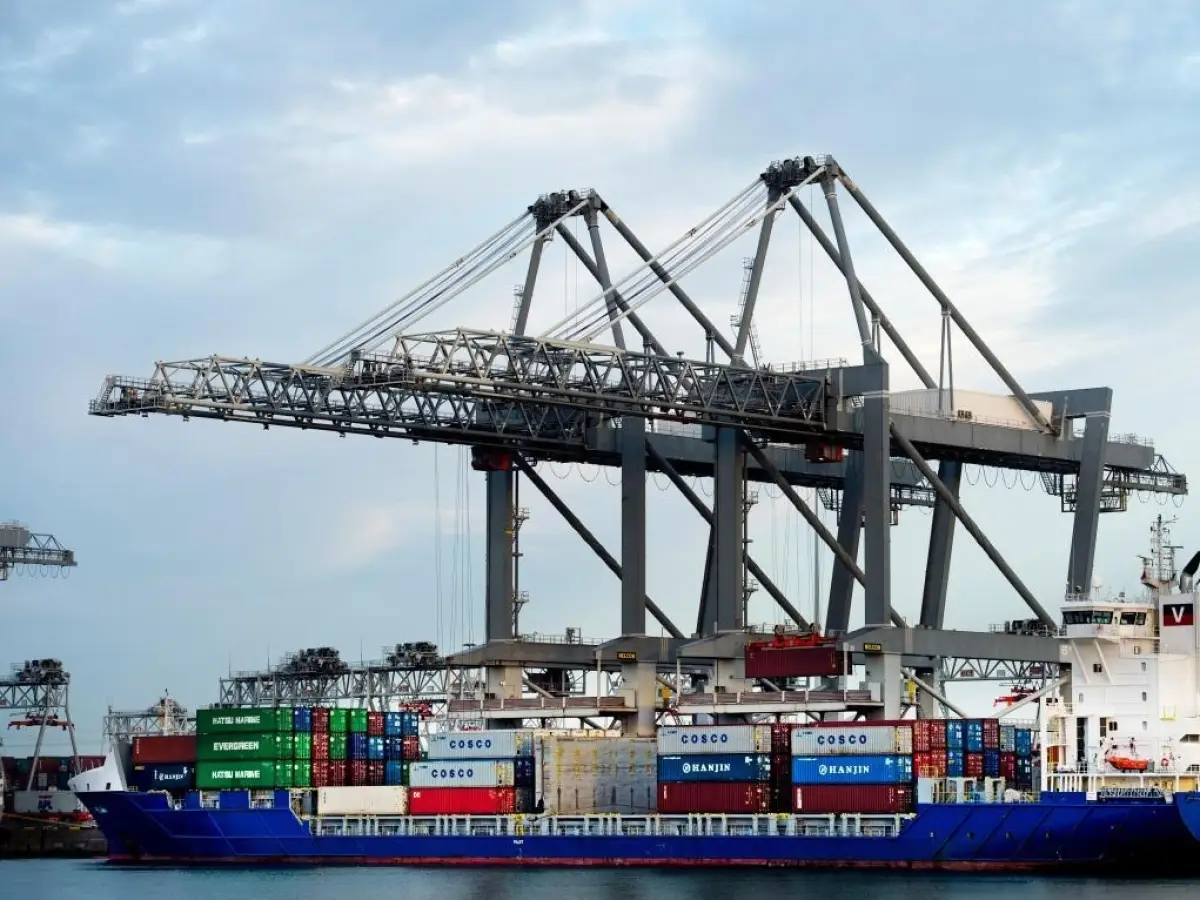
Cover: Container loading and unloading operations from ships at the docks of the ECT Delta terminal in Rotterdam, photo by Robin Utrecht © European Union, 2012