



The decision by the United Arab Emirates to leave the Organization of the Petroleum Exporting Countries (OPEC) after nearly six decades marks a structural turning point in global energy governance. Announced in a context of geopolitical instability linked to the Iran conflict, the move reflects a combination of economic strategy and political realignment that could have long-term consequences for oil markets, price formation mechanisms and regional power balances. According to Reuters, the UAE will formally exit the organization on May 1, ending its membership that began in 1967.
OPEC, founded in 1960 to coordinate production among major oil-exporting countries, has historically controlled a significant share of global supply, influencing prices through quota systems. According to BBC, prior to the UAE’s departure, the organization accounted for approximately 44% of global oil output, a figure that had already declined from 48% due to disruptions linked to the Iran war. The exit of one of its most flexible and compliant producers, representing roughly 15% of the group’s capacity, is therefore expected to weaken its ability to stabilise markets and manage price volatility.
Energy strategy and production expansion
At the core of the UAE’s decision lies a long-term economic calculation. Freed from OPEC quotas, the country aims to maximise its production capacity and respond more rapidly to global demand dynamics. The state-owned Abu Dhabi National Oil Company has announced plans to increase output from approximately 3.4 million barrels per day before the Iran conflict to 5 million barrels per day by 2027, positioning the UAE as a more assertive and independent actor in global energy markets.
This strategy is supported by structural advantages. According to industry experts cited by the BBC, the UAE has one of the lowest break-even costs among major producers, nearly half that of Saudi Arabia. This enables the country to maintain profitability even in lower-price environments, reinforcing its incentive to prioritise volume over price control. The UAE is less concerned with maintaining high oil prices and more focused on expanding market share.
However, short-term constraints remain significant. The closure of the Strait of Hormuz, a critical chokepoint through which around 20% of global oil and liquefied natural gas flows, has disrupted exports and reduced UAE production by up to 44% in March, according to Reuters. Despite these limitations, the country’s long-term investment strategy suggests a strong commitment to scaling output once logistical conditions normalise.
Geopolitical tensions and Gulf fragmentation
Beyond economic considerations, the UAE’s exit reflects deepening geopolitical fractures within the Gulf region. Relations with Saudi Arabia, OPEC’s de facto leader, have been strained by longstanding disagreements over production quotas and broader regional policies. The decision to withdraw unilaterally, without prior consultation, underscores a shift from collective coordination to national autonomy.
The timing of the announcement, coinciding with an emergency meeting of the Gulf Cooperation Council, highlights the interplay between energy policy and security concerns. The ongoing conflict with Iran has exacerbated divisions among Gulf states, particularly regarding the appropriate response to escalating military tensions. According to The Guardian, the UAE has been among the most exposed countries, facing over 2,200 drone and missile attacks, which has intensified its push for a more assertive regional strategy.
This geopolitical repositioning is also closely linked to the UAE’s relationship with the United States. The exit from OPEC is widely interpreted as a move to strengthen ties with Donald Trump, a long-time critic of the cartel. Analysts suggest that closer alignment with Washington could translate into increased investment flows and enhanced security cooperation, reinforcing the UAE’s role as a key strategic partner in the region.
Market impacts and future outlook
The immediate impact of the UAE’s departure on global oil supply is expected to be limited due to ongoing logistical constraints. However, the long-term implications could be substantial. The World Bank has warned that the Iran conflict has already triggered the largest oil supply shock on record, with global prices rising by approximately 25% and reaching $113 per barrel, compared to $73 before the war.
In this context, the UAE’s strategy of increasing production could contribute to downward pressure on prices over time, while simultaneously increasing market volatility. According to analysts cited by Reuters, the country’s ability to add significant volumes to the market raises questions about the sustainability of OPEC’s traditional role as a price stabiliser. The potential for other members to follow suit further amplifies this uncertainty, suggesting a possible fragmentation of the cartel.
The International Energy Agency’s decision to release 400 million barrels of oil in response to the crisis underscores the scale of current disruptions and the need for coordinated interventions. Yet, as regulatory frameworks remain fragmented and geopolitical risks persist, the balance between supply security, affordability and decarbonisation objectives becomes increasingly complex.
From an environmental economics perspective, the UAE’s exit highlights a broader tension between short-term energy security and long-term climate goals. While increased oil production may stabilise markets in the near term, it also raises concerns about the trajectory of global emissions and the pace of the energy transition. As litigation over climate claims and regulatory scrutiny intensify worldwide, the governance of fossil fuel markets remains a critical issue at the intersection of economics, geopolitics and sustainability.
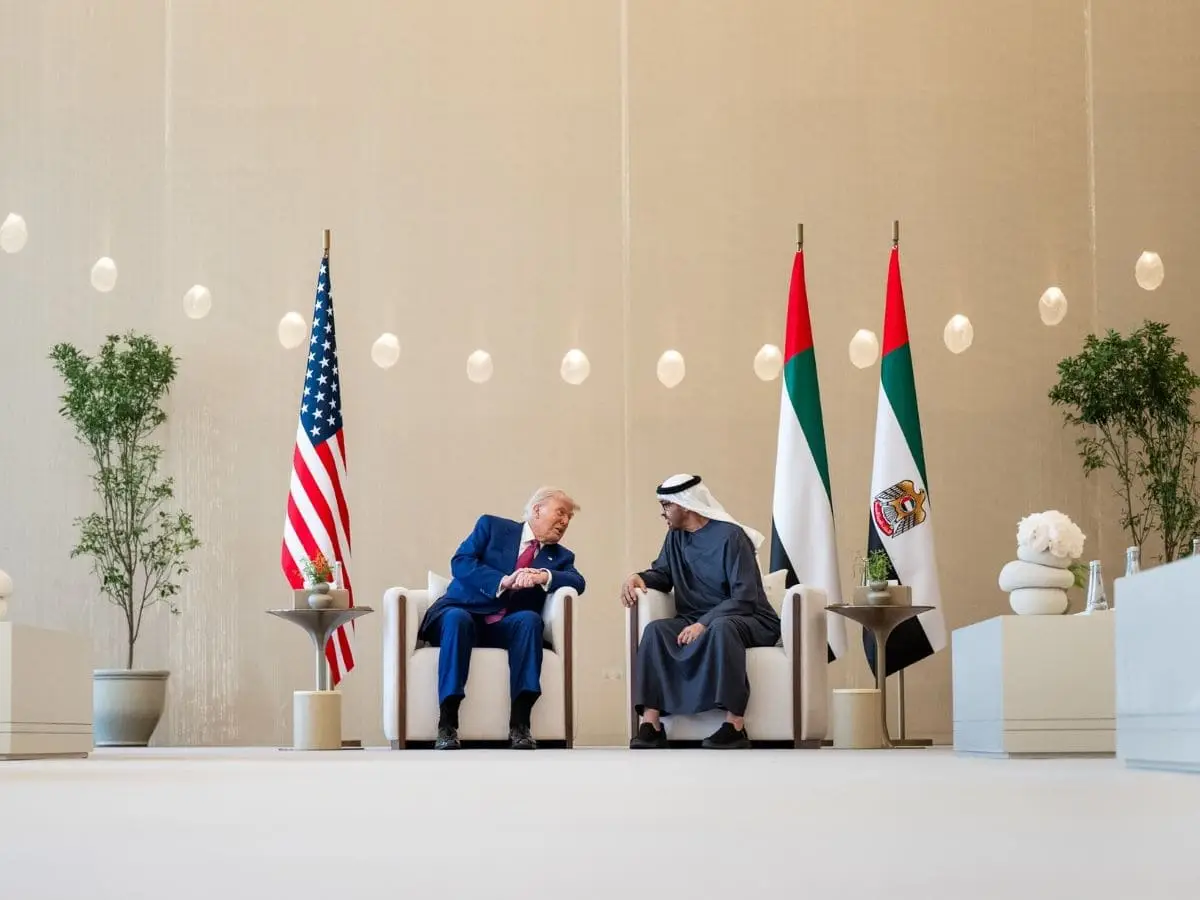
Cover: UAE President, Mohammed bin Zayed Al Nahyan, receives Donald Trump, in Abu Dhabi, UAE, on May 15, 2025. Official White House Photo by Molly Riley, via Flickr