

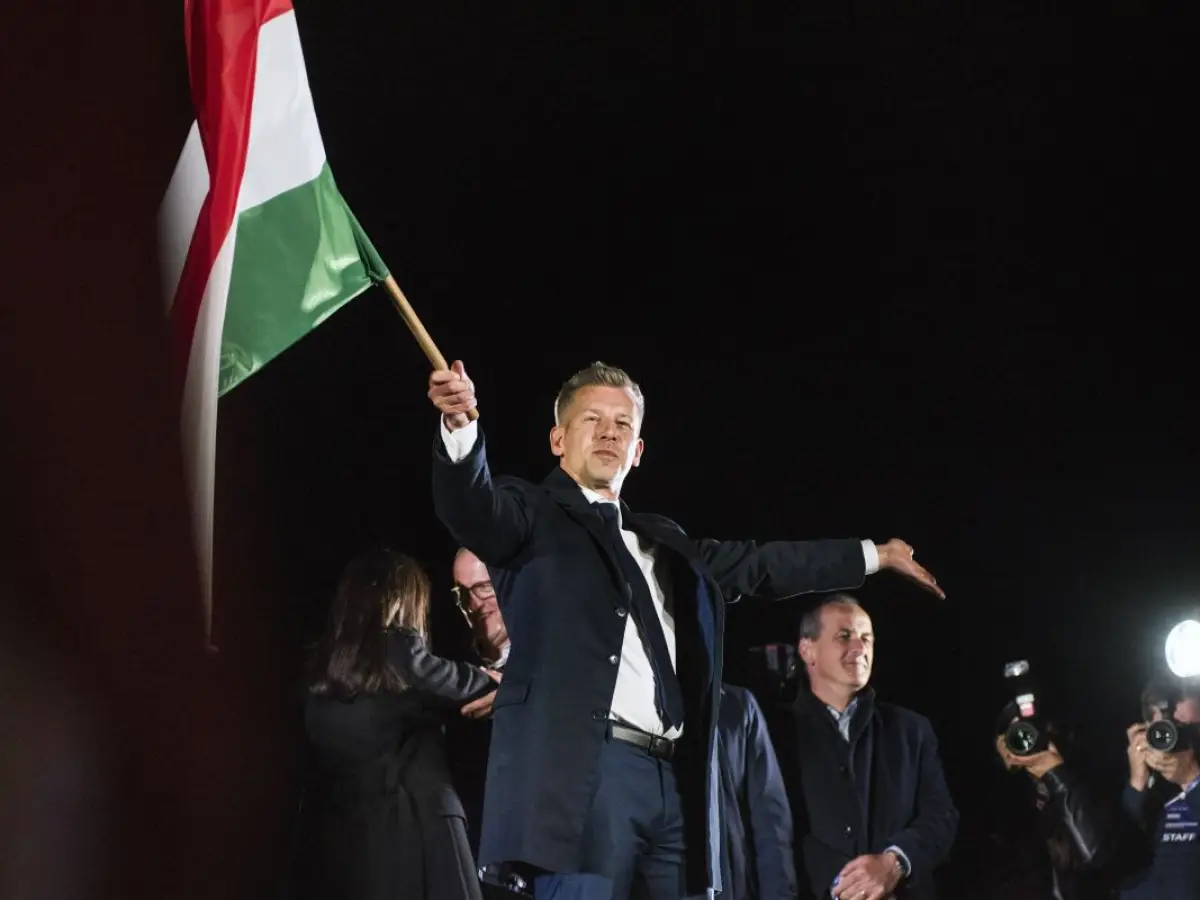

With 98.15% of the votes counted, the results of the 12 April elections in Hungary are now final: the Tisza party, led by Peter Magyar, has secured 138 of the 199 seats and 53.56% of the vote, achieving a two-thirds majority in Parliament. Fidesz, led by Viktor Orbán, secured 55 seats (37.86%) in an election that registered a record turnout of nearly 80%, driven by the capital, Budapest, but above all by medium-sized towns and the younger electorate.
“Together we liberated Hungary, we have reclaimed our country,” Magyar declared from the stage of the celebrations overlooking the Danube in front of Parliament, whilst Orbán described the result as “painful for us, but clear” and congratulated the winner in an announcement. Yet, rather than a substantive change, Hungary now risks merely a cosmetic one. The illiberal system built by Viktor Orbán over more than a decade through economic ties, laws and reforms of the judiciary and media remains intact in its underlying structures, like ivy bound to continue enveloping the country even after the electoral defeat.
Péter Magyar, 45, a centre-right political figure who rose through the ranks of Fidesz and has long been part of its system, is, after all, bringing this legacy with him into government. During the election campaign, Magyar was often described as a “baby Orbán”: a leader who looks to Europe and promises a break with the past, yet who was also an insider – and in some respects still embodies the traits of that power structure he now aims to reform – as evidenced by his views on immigration, on which he aligns with Orbán.
The significance of his victory will depend precisely on this, as well as on his promise to sever ties with Putin’s Russia. The “super-majority” Magyar commands offers him the tools to tackle structural issues, from energy dependence to the management of European funds, from the defence sector to the health of the rule of law. Nevertheless, any attempt at transformation will have to contend with a well-established political and industrial infrastructure, one that is unlikely to disappear with an election. Just like Orbán, who will sit in opposition and be less in the spotlight.
Péter Magyar's evolution and the founding of Tisza
Péter Magyar’s personal trajectory helps to understand why the new prime minister is perceived both as a reformer and as a figure who has risen through the ranks of the Hungarian establishment – a dual profile that contributed to his electoral success. Born on 16 March 1981 in Budapest in a family of lawyers, he graduated in law from the capital’s Catholic university and is outspoken about his faith.
Following his initial involvement with Fidesz, he gradually entered the corridors of political power, until 2006, when he married his party colleague Judit Varga, the future Minister of Justice, and worked alongside her in Brussels within the European institutions. Upon returning to his homeland, he took on technical roles in public companies and the civil service, but the Fidesz leadership considered him too independent and not sufficiently aligned with the party line, while he increasingly took on the role of his wife’s communications strategist. In 2023, when the marriage ended, his ties with Orbán’s system also frayed: Magyar was gradually sidelined, and this personal breakdown became the basis for his public narrative as a former insider distancing himself from his old party.
The new Tisza party (from the initials of Tisztelet és Szabadság Párt, the Respect and Freedom Party) was thus founded in 2024 in a remarkably short time, in the wake of the scandal surrounding the pardon granted to a man convicted of child abuse, resulting in the resignation of the then President of Hungary, Katalin Novák, and also politically engulfing Magyar’s ex-wife, Judit Varga. In this climate of crisis, Tisza presented itself as a means of breaking with the existing power structure rather than as a complete break with Fidesz’s conservative tradition. Tisza’s core message was one of ethical reform of the institutions and greater transparency while maintaining strong references to homeland, sovereignty and national identity that appealed to a moderate, patriotic right-wing electorate.
The “sovereignist international” was not enough for Orbán
The transition in Hungary is coming at the end of a long period marked by tensions with Brussels, the country’s growing dependence on Russian oil and gas, and a gradual political alignment with the Washington-Moscow axis. It is no coincidence that, during the final days of the election campaign, Orbán received a highly symbolic visit in Budapest from US Vice-President JD Vance, who spoke of the European Union's alleged interference in the elections, describing it as “disgraceful”, and openly backed the re-election of the outgoing prime minister, an ally to both Donald Trump and Vladimir Putin.
This backdrop was complemented in recent months by a veritable “sovereignist international”: from Matteo Salvini’s visit to Budapest in late March to the January campaign video in which the Hungarian Prime Minister was endorsed by Giorgia Meloni, Benjamin Netanyahu, Marine Le Pen, Santiago Abascal, Javier Milei, Alice Weidel and other figures from the global radical right. Orbán’s symbolic construction has thus intertwined with increasingly evident friction with Brussels over the rule of law and funding for Kyiv. The image that has emerged is one of a Hungary anchored to a dual axis, Atlantic and Russian, while its energy dependence on Moscow has reached extreme levels, exceeding 90% of crude oil imports by 2025. In this context, Magyar’s decision to accuse Orbán of “panic-mongering” orchestrated by “Russian advisers”, following the discovery of explosives near a gas pipeline from Serbia, marks a clear departure from the methods of the past.
Defence, energy, climate
It is in the strategic field of defence where the discontinuity announced by the new government appears most radical, directly impacting relations with NATO and Hungary’s position between Russia, Ukraine and its European partners. Tisza promises to raise military spending to 5% of GDP by 2035, to invest in the Hungarian army, to review defence industry contracts in search of any instances of corruption, and to launch a wide-ranging purge against Russian influence within the state apparatus.
It is precisely the combination of the climate crisis, energy security and the use of European funds that makes environmental policies one of the most sensitive testing grounds for the new course. Hungary is legally bound to achieve climate neutrality by 2050 and has committed to reducing greenhouse gas emissions by 50% by 2030 compared to 1990 levels, with a National Recovery Plan that allocates around 67% of the climate component’s resources to actions linked to the energy transition, well above the European minimum of 37%.
Under the Orbán governments, however, these formal objectives have coexisted with a political practice that has reinforced dependence on Russian fossil fuels and has often channelled EU funds into traditional infrastructure projects, some of which have been described by civil society organisations as having “harmful” effects on the environment. Only time will tell, therefore, whether Magyar – with a mandate built on promises of transparency, reforms and realignment with Brussels – will use European levers to drive efficiency, renewables and industrial innovation.
Europe and the risk of an “Orbán spin-off”
The political shift in Budapest immediately sent ripples through European capitals, indicating that the change of government is being seen as a possible realignment of Hungary with the EU mainstream. “Europe’s heart is beating stronger in Hungary tonight.” These were the first words from European Commission President Ursula von der Leyen. In Brussels, one of the first acts of the upcoming prime minister is expected to be unfreezing the €90 billion loan for Ukraine that Orbán had vetoed, a move that would have an immediate impact on Budapest’s European credibility regarding foreign policy and solidarity with Kyiv. Paris has also picked up on the signal: Emmanuel Macron was among the first to congratulate Magyar and open the door to a revival of cooperation.
Nevertheless, the question of the fate of the “hegemonic infrastructure” built by Viktor Orbán over more than a decade in government remains open: a network of power that extends far beyond national borders and which, as of today, may not simply dissolve but rather spread elsewhere, giving rise to a sort of political “spin-off”. As Alberto Alemanno, Jean Monnet Professor of European Union Law at HEC Paris, observes, “Orbán doesn’t disappear. He retains a transnational network: CPAC, Patriots for Europe, Trump’s orbit, Kremlin-adjacent channels. Losing Budapest doesn’t mean losing Brussels or Washington. He will regroup, reframe, and re-export his model. The real question is whether Orbán’s hegemonic infrastructure outlasts the election, trough tricks and abuses… and transnational collaboration within and outside of the Union.”
Even in a scenario of internal upheaval, therefore, the ecosystem of alliances, think tanks, media outlets and political platforms that has supported the outgoing prime minister continues to play a key role in the European debate and in the EU project itself.
Cover: Peter Magyar celebrates the election results, photo by Attila Husejnow / SOPA / SIPA / IPA Agency