

The first Chinese character I ever learnt to write was tiān 天, which means “sky” or “heaven”. Perhaps because it’s easy to remember. It is made up of the character dà 大 (great), which depicts a person with outstretched arms, and a line representing the vault of the sky. A great person dominated by the sky above: it has always reminded me of Kant’s gravestone inscription, “the moral law within me, the starry heavens above me”.
In the words of the German philosopher, the character 天, in its splendid visual synthesis, has in common the moral quality attributed to it in Chinese culture, where it recurs in various fundamental concepts. Such as tiānxià 天下, which literally means “under the sky” or even “all under heaven”, i.e., the world. Developed 3,000 years ago under the Zhou dynasty, tiānxià is a school of thought that considers the world in its entirety as a political entity, aiming to integrate peoples in the name of the Confucian “great harmony” (dàtóng 大同). But if, back then, it was the centripetal force of the Celestial Empire that rendered any strategy of conflict fruitless, today the principle of tiānxià could offer us a clue to imagine a future multipolar world order founded on coexistence. That is the view of Zhao Tingyang, a philosopher still too little known outside China, whose work over the past twenty years has brought this ancient concept up to date and reintroduced it into contemporary political and geopolitical discourse.
Transcending nation-state interests, in Zhao’s vision the tiānxià project opposes the globalisation driven by a dominant culture (that of the West, and specifically US) with a form of “worldisation”, namely, a horizontal process of exchange that does not assume the primacy of any single system – neither democratic nor authoritarian, neither liberal nor communist, neither Western nor Eastern – but instead borrows the best from all. Zhao cites the example of human rights, a theme heavily promoted by Western democracies and, unfortunately, frequently used as a pretext for waging holy wars. “In traditional Chinese philosophy,” he writes, “the concept of human rights does not exist, but instead the concept of human duties has been developed,” a topic of which, however, we speak too little in the West. Together, the two concepts can complement each other perfectly.
The underlying idea is, therefore, to move towards “a hybrid system that combines the advantages of multiple systems, bringing together, in a state of mutual balance, democracy, freedom, justice, responsibility and efficiency”. A truly welcome synthesis, especially at a time in history when the world seems overwhelmed by entropy, and when problems – the climate, economic and humanitarian crises – are increasingly taking on a global dimension. But to get there, we need a process “built on mutual learning”.
In this issue of Renewable Matter, therefore, we have started from here – from learning and reciprocity – allowing China (its intellectuals, activists and journalists) to speak about China as much as possible, and listening, captivated, to its message. In the knowledge that not only are we all under the same sky, but also, as Confucius wrote, “all under heaven belongs to everyone”, to those alive today and to those who will live tomorrow. And incidentally, in Chinese the word for “tomorrow”, míngtiān, also contains the character for “sky”, alongside another wonderful character: míng 明, meaning “bright”.
DOWLOAD AND READ ISSUE #62 OF RENEWABLE MATTER: CHINA
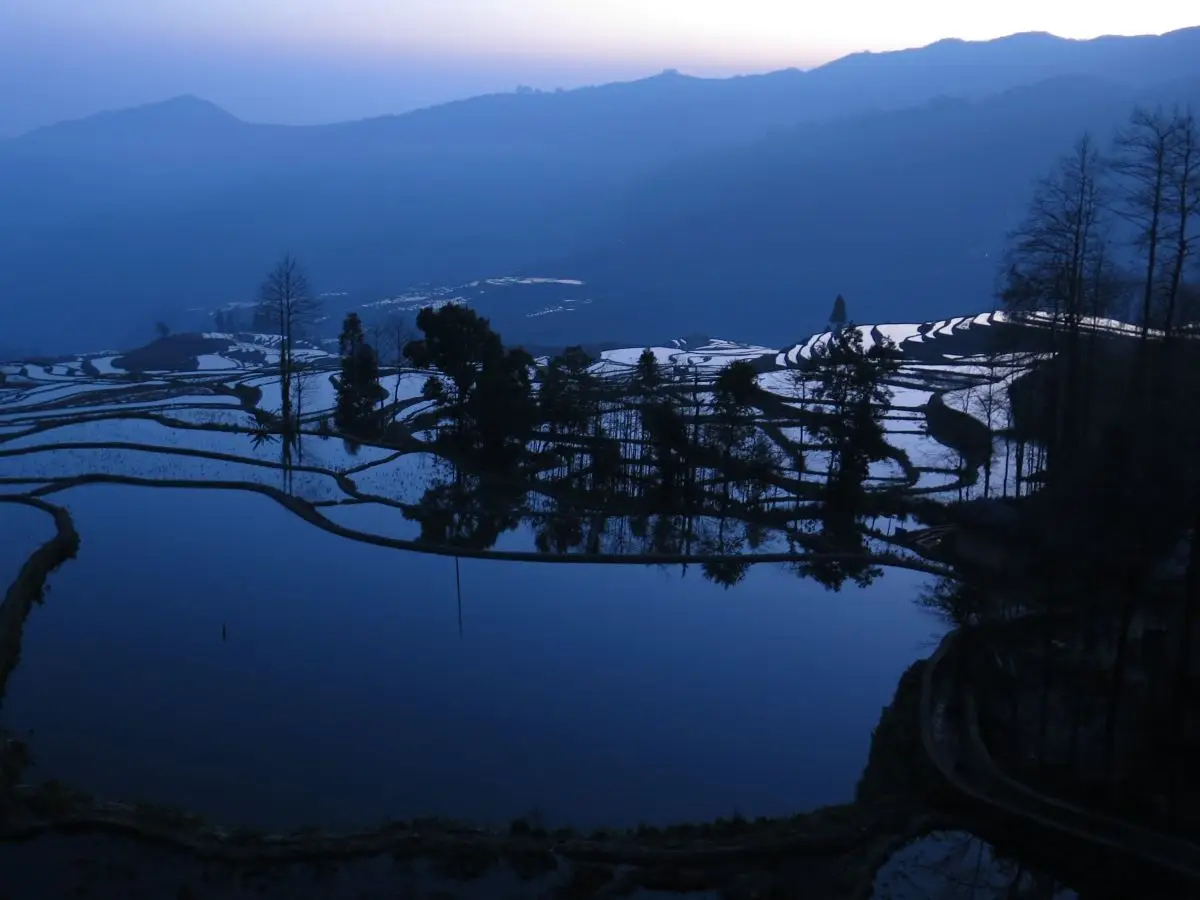
Cover: sunrise at the rice terraces of Yuanyang, Yunnan Province, photo by Martino Cipriani