



Three hundred kilometres upstream from the dam that no longer exists, on the outskirts of Zaporizhzhia, biologist Vadym Maniuk walks across the parched, crunching ground. Beneath his feet, millions of freshwater mussel shells cover what, until 6 June 2023, had been the bed of the Kakhovka reservoir. “There used to be four metres of water here,” he says. “Billions of living organisms were killed suddenly, in a few days when the reservoir emptied.” Further south, in the Kherson region, prosecutor Vladislav Ignatenko is overseeing hundreds of environmental investigators who are sticking red flags into the ground, collecting soil samples and sealing them in plastic bags bearing the Ukrainian police logo. “The next location is here, in the Kherson district,” he says, pointing to the map. “I’m not going there, it’s too dangerous,” chimes in a member of his team. The city has been under constant Russian bombardment since Ukraine reclaimed it in November 2022.
It is in this landscape, amidst fossilised seabeds and war zones, that an unprecedented chapter in international law is being written. Ukraine is the first country in the world to take to court a charge of ecocide committed during wartime. But four years on from the large-scale invasion, the gap between legal ambition and the reality of the evidence is wider than the media narrative suggests.
The bill of the damage: $145 billion
As reported by Renewable Matter, Ukraine has submitted to the international community a claim for $43 billion for climate damage resulting solely from the war: the first claim for climate reparations related to an armed conflict in history, based on the report Climate Damage Caused by Russia’s War in Ukraine – 36 months, which estimates that the conflict has generated 294 million tonnes of CO₂ equivalent, more than the annual emissions of 175 countries.
But that figure is only a fraction of the overall picture. In January 2026, the Ministry of Economy, Environment and Agriculture in Kyiv compiled a database of 10,668 environmental crimes, bringing the total estimated environmental damage to 6.4 trillion Ukrainian hryvnias, approximately $145.6 billion. The State Environmental Inspectorate breaks the figure down as follows: 1.32 trillion hryvnias for soil contamination, 962 billion for forest fires, and nearly 178 billion for water pollution. Three million hectares of forest have been damaged, and 20% of the national forest heritage is under occupation. Over 800 protected sites – 20% of the entire Ukrainian conservation network – have been affected. Over 75,000 animals have died, and more than 80 species are at risk of extinction.
“We document every fact of ecocide to ensure the inevitability of the aggressor’s accountability and the restoration of our state’s natural resources,” declared the Ukrainian environmental inspectorate.
Only two cases with full evidence
In court, however, the reality is far more discretionary. Out of the 14 cases classified as ecocide by the Prosecutor General’s Office, only two have a complete body of evidence and are currently at the trial stage: the deliberate bombing of the Kharkiv Institute of Physics and Technology, home to the subcritical nuclear facility “Neutron Source”, struck 74 times between March and September of 2022; and the intentional destruction of the Oskil dam, blown up by retreating Russian troops in September of the same year to prevent the Ukrainian advance. The investigation into the destruction of the Kakhovka dam – the most devastating ecological disaster of the conflict – is still ongoing.
The problem is structural. According to an investigation by the Institute for War and Peace Reporting (IWPR) published in March 2026, under Ukrainian law, ecocide is a stand-alone criminal offence under Article 441 of the Criminal Code and is not classified separately as a war crime. The evidentiary threshold is high: it must be proven that the actions “may cause an environmental catastrophe”, thereby excluding many instances of damage, however severe.
The massive contamination of the Seim River in August 2024, resulting from discharges from the Russian village of Tyotkino and responsible for a region-wide fish die-off – including species listed on Ukraine’s Red List, with damage estimated at $1.4 billion – was classified as environmental damage, not as ecocide. The same applies to the bombing of oil depots, forest fires in combat zones, and the drone strike on Christmas Day 2025 that released nearly eight tonnes of pollutants into the atmosphere over Chernihiv.
“We are pioneers and there is no precedent in the international system,” stated Maksym Popov, the Attorney General’s special adviser on environmental crimes. “We’re not hoping for a trial in the short or medium term; right now, it’s a matter of accumulating evidence.” In December 2025, 35 countries and the European Union signed the Council of Europe Convention in The Hague, establishing an International Claims Commission. The scheme, built around the Damage Register, already operational since 2023 and having received over 86,000 claims, marks a historic milestone: for the first time, a system for war damage compensation explicitly includes the environmental dimension. The Council of Europe set up the preparatory committee in February 2026, and the Convention will enter into force after 25 ratifications.
There is, however, a paradox that speaks volumes about priorities: as of 1 March 2026, the environmental damage category had not yet been opened in the register. The mechanism exists, but the environment remains on the waiting list.
The war-time greenwashing of the ghost national park
However, Russia is not content with destruction alone. In a historically almost unprecedented move, it is rewriting the geography of conservation to its own advantage.
In January 2026, the Moscow government established a 16,700-hectare national park in the occupied territories of the Zaporizhzhia region. Its boundaries coincide exactly with those of the Ukrainian Velykyi Luh National Park, the “Great Meadow” – a landscape that, for Ukrainians, is far more than just a protected area. Velykyi Luh was the land of the Zaporozhian Cossacks, the site of the Sich, and the cradle of the Ukrainian state. Its original landscape – a mosaic of river islands, floodplain forests and branches of the Dnipro – was submerged in the 1950s by the construction of the Kakhovka Reservoir, and 37,000 inhabitants from 90 villages were deported.
For 70 years, Velykyi Luh lay submerged. Then, on 6 June 2023, the destruction of the Kakhovka dam by Russian forces emptied the reservoir in a matter of weeks. And something unexpected happened: the ecosystem started regenerating. The islands reappeared, vegetation returned, and the Cossack trails resurfaced. For Ukrainian biologists, in particular those from the Ukrainian Nature Conservation Group, it was an extraordinary opportunity: to restore the country’s most diverse ecosystem across more than 200,000 hectares, at least partially offsetting the biodiversity losses caused by the war.
The Russian response was, instead, the creation of a Russian national park on the very same territory – a land currently under active combat. The logic, documented by the UWEC (Ukraine War Environmental Consequences Work Group), is twofold: on the one hand, to legitimise Russian control over the occupied territories in the eyes of the international community; on the other, to establish a propaganda shield. If the conservation areas were to gain recognition, any Ukrainian attempt to liberate them militarily could be portrayed as a crime against nature.
How Russia exploits the Zaporizhzhia power station
This is not a theoretical hypothesis: throughout 2025, Moscow repeatedly accused Ukraine of attacking the Zaporizhzhia nuclear power plant, but an investigation by Greenpeace Ukraine found no evidence to support these allegations. On the contrary, Russia is systematically converting civilian infrastructure into military assets.
Such is the case with the Zaporizhzhia nuclear power plant, the largest in Europe, with a capacity of 6,000 megawatts – equivalent to the entire nuclear fleet of countries such as Slovakia or Hungary. Occupied by the military since March 2022, with its six reactors shut down, it has become the most extreme example of the conflict’s exploitation of the environment. Satellite analyses commissioned by Greenpeace Ukraine from McKenzie Intelligence Services between 2024 and February 2026 show that the plant now resembles a military base: its cooling pond has shrunk by 100,000 square metres, reinforced bunkers have been built along the banks, and fortifications and anti-drone nets surround the perimeter. In December 2024, satellite imagery had revealed BM-30 Smerch and BM-27 Uragan rocket launchers in the immediate vicinity of the plant.
“The militarisation of the Zaporizhzhia nuclear power plant has now entered its fourth year and is becoming increasingly systematic. The construction of bunkers, trenches, anti-drone fortifications and interference with the cooling system are clear signs of Russia’s efforts to maintain long-term military control over a nuclear facility,” stated Jan Vande Putte, nuclear expert from Greenpeace Ukraine.
At the World Atomic Forum in September 2025, Putin has declared that “ensuring nuclear safety and the physical protection of nuclear facilities and installations is an absolute priority” for Russia. Around the same time, Rosatom confirmed plans to make the facility operational and connect it to the Russian power grid. The population of Enerhodar, the town adjacent to the plant, has plummeted from 50,000 to around 10,000. The organisation Truth Hounds has documented 226 cases of unlawful detention among residents and plant workers.
This is not the only case of environmental-related repression in territories controlled by Moscow. In January 2026, Russian scientist Alexei Dudarev was arrested on charges of treason, presumably for participating in the drafting of a report on the Arctic as part of the Arctic Monitoring and Assessment Programme. In Crimea, in September 2025, occupation authorities arrested the Ukrainian marine biologist Leonid Pshenichnov. For Moscow, environmental research has become a matter of national security.
The fifth crime that does not exist yet
The Ukrainian case is playing out on two fronts. At the national level, trials are proceeding, albeit slowly, amid evidence gathered under bombardment, inadequate Ukrainian labs, and the need to involve foreign facilities for analysis. Internationally, the aim remains to include ecocide as the fifth crime in the Rome Statute of the International Criminal Court, alongside genocide, crimes against humanity, war crimes and aggression. In February 2024, ICC Prosecutor Karim Khan launched a public consultation on a new policy regarding environmental crimes: an important signal but far from an amendment to the Statute.
The Ukrainian strategy is what we might call “the Lemkin method”: to first create the legal reality through national practice, then the international norm. Just as the Polish jurist Raphael Lemkin did with genocide: first the concept, then the 1948 Convention.
However, the legal expert Yakovliev, interviewed by the IWPR, adds a crucial point: the difficulty of proving ecocide does not alter the fact that the aggression is illegal and that compensation must be paid for its consequences. “The problem now is not just the destruction of forests, but of the entire ecosystem. It is a grave problem that Russia is waging war that destroys all life in its path.”
As Ukraine’s Prosecutor General Andriy Kostin noted in the International Bar Association’s journal: “Ukrainians know very well that every war crime has a name, and we know the names of those who rain death upon our cities and who devastate our forests, rivers and meadows. We also know their address: 103132, Moscow, Russia. The Kremlin.”
But time is working against the evidence: the soil is changing, water is diluting pollutants, and burnt forests are providing fertile ground for invasive species that will wipe out the original ecosystem. It will take a hundred years to clean up the damage, according to Greenpeace Ukraine. It will take two or three generations for pioneer trees to grow before the forests look like forests again. Nature does not wait for the courts.
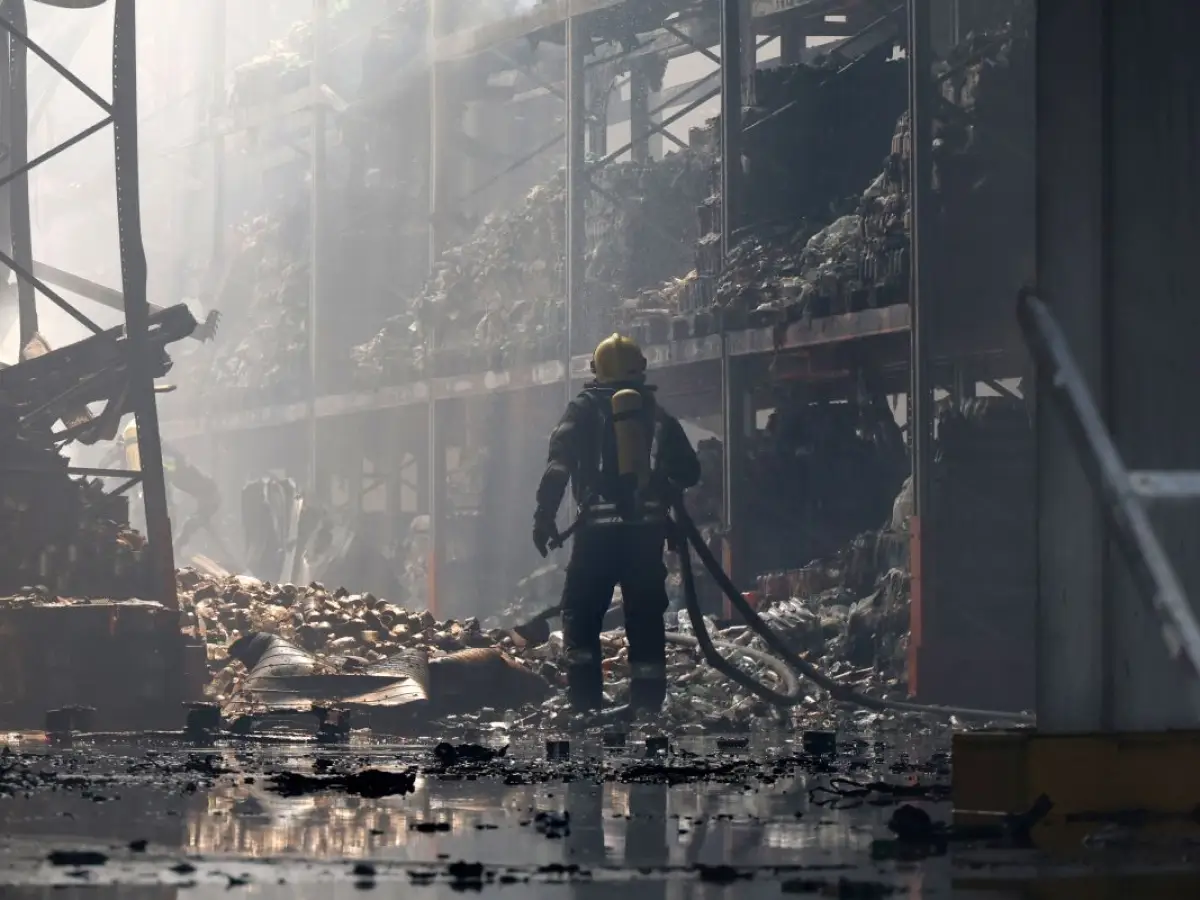
Cover: A firefighter responds to a fire caused by a Russian missile strike in Vasyshcheve, in the Kharkiv region of Ukraine, on 30 July 2025. Photo by Viacheslav Madiievskyi/Ukrinform, IPA Agency