
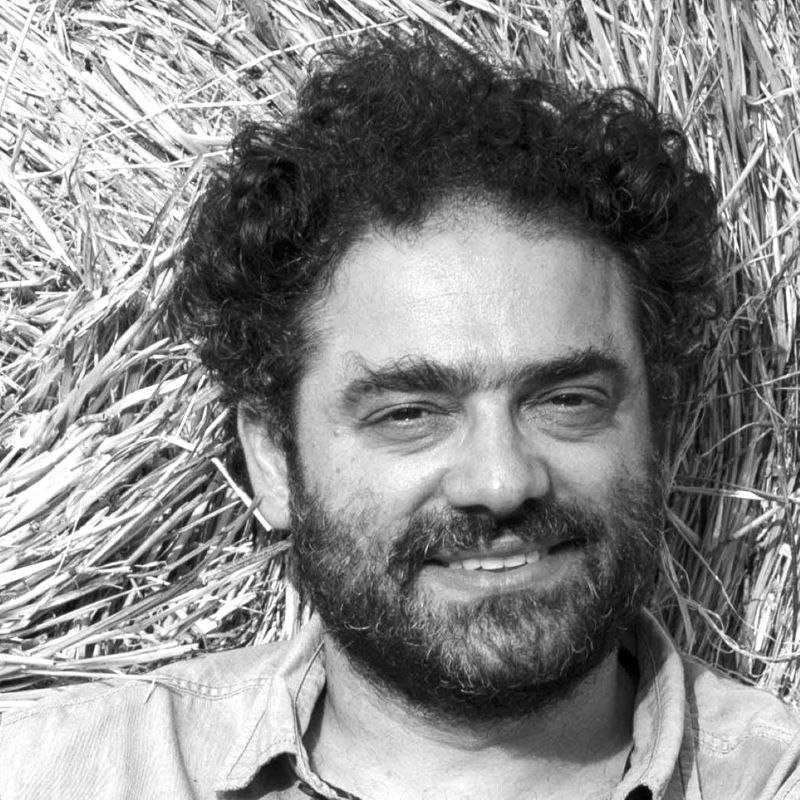

Giorgos Kallis is one of the leading voices in the international degrowth movement within the academic world. He is one of the leaders behind a pioneering European research project on the post-growth economy (REAL), a new economic paradigm that brings together various post-capitalist theories united by the common goal of demonstrating that prosperity without growth is possible (it encompasses the “doughnut”, “well-being”, “steady-state” and “degrowth” economies).
In 2025, Kallis released an essay to mark the 50th anniversary of the first landmark document on the limitations of growth, the now-famous The Limits to Growth (1972), developed by MIT and the Club of Rome, with the emblematic title: Post-Growth: The Science of Well-being Within the Planet’s Limits. An essay that is a genuine manifesto, aiming to outline the contours of an alternative economy. We interviewed him to explore the topic further.
In your essay, you write: “As far as energy and raw material consumption is concerned, the necessary reductions are easier to achieve in a post-growth economy.” How did you come to this conclusion?
To put it simply: the more the economy moves, and the faster it grows, the greater the reliance on raw materials will be. Some economists may object to this simple line of reasoning by pointing out that intangible assets exist or that we can replace environmentally harmful materials with less harmful ones, as was done in the 1970s. Fifty years on, this argument no longer holds true. There is no evidence of this dematerialisation. Generally speaking, the more the global economy grows, the more material consumption increases, at varying rates depending on the geographical area and the period in question. So the environmentalist argument still has merit because, in practical terms, the link between the economy and raw materials is very strong. Only if the economy slows down can the extraction of raw materials decrease, but without this leading to a lower standard of living. Moreover, more theoretical arguments also exist, for example, the one suggesting that, even if all polluting materials could be replaced, at some point there will be an insurmountable physical limit. Thermodynamics explains this clearly. So, if growth is infinite, there will come a time when materials can no longer be substituted for one another. This is true even if we were dealing with intangible production, since we now know that this still, invariably, entails a certain increase in the use of materials. In fact, over the last fifty years there has been no evidence of a decline in the use of raw materials. In short, less economic activity means less extraction of raw materials. If we were to limit ourselves to meeting our basic needs, avoiding all production of the superfluous, we could use 20 or 30% of the energy we currently use.
In the analysis summarised in your article, there is a clear critique of so-called “green growth”. Why does this type of growth not offer a way out of the ecological crisis we are currently facing?
Growth of “only” 3% a year, over time, turns into something that multiplies rapidly. The same applies to green growth: the growth of the green economy is inevitably accompanied by rapid growth in the non-green economy. That in itself is enough to explain why green growth is not the solution. But we can look at the same phenomenon from another perspective. Let's consider the current rise in renewable energy sources. The consequence is not that we use less oil, or that oil has been replaced by renewables. Rather, the use of both energy sources is added together so that the economy as a whole continues to grow. Of course, renewables must grow, but alongside a rapid decline in polluting energy sources such as oil. The model of generalised growth does not allow for this. In the history of the capitalist economy, we have witnessed the same phenomenon even when it was claimed that coal had given way to oil. In reality, there was no replacement, but rather an accumulation of energy sources, with all these sources growing together. In order for them to truly replace one another, we need a different economic model, in line with the post-growth economy. We know full well by now that green growth is only “green” in part. For example, this applies in terms of carbon, but not in terms of the use of raw materials such as lithium or the occupation of land (such as mountains or agricultural land). It must be made clear that nothing is truly green through and through. Only if we do not produce anything can we say that we are doing something “green”.
It would seem that no type of future economy can avoid placing the circular economy at its core. How is this viewed from a post-growth perspective?
It’s a problem if we view the circular economy as something technocratic, an economy tied solely to the disposal cycle, or simply a way to develop business in this sector. If that’s the case, we are facing something we already experienced years ago when there was so much talk of “sustainability”. But, in principle, I very much agree with this type of economy. A post-growth economy, in fact, ought to be circular. But what exactly does that mean? For us, it is what the steady-state economy advocates. The principle underlying this theory is that things circulate without increasing production, avoiding investment aimed at growth. In this case, the two concepts (circularity and post-growth) converge. They do not converge, however, when the circular economy becomes a specific manifestation of the green economy.
In the essay, we get the impression that the post-growth economy is, first and foremost, an economy serving the political project of moving beyond capitalist society. Am I wrong?
You are not wrong. I would say that a post-growth economic system will necessarily have to be post-capitalist. As one of the theorists of post-growth, Tim Jackson, who wrote a book with the explicit title Post-growth: Life After Capitalism [John Wiley and Sons Ltd., 2021, ed.], also points out. Some of us hold even more radical views. Like me, for example, I speak explicitly of eco-socialism and how to implement the principles of democratic and ecological socialism at an economic and political level. Within the same paradigm, some feel that the economic change we are proposing will lead to a post-capitalist, if not clearly socialist, economy, while the theories of the doughnut economy or the well-being economy do not go that far. They are “agnostic” about overcoming capitalism.
We know that the Welfare State historically emerged within a growing economy: how can a “welfare system” be sustained without growth?
Historically, this has been the case. Economic growth is necessary for the Welfare State within a capitalist system. The “capitalist class” always seeks to increase its profits, and if it wants the general public to benefit as well, the economy must grow; otherwise, it will fall into stagnation or recession. If the economy grows, the costs associated with purchasing new equipment (for hospitals, for example) and wages in that sector rise in line with the economy as a whole. But this does not prove that growth is necessary to achieve a welfare state. The latter requires adequate resources for specific services, nothing more, nor ever-increasing investment. We need a good education system, we need to meet healthcare needs, and we need a system of basic care and support for the entire population (from pensioners to children). These areas do not necessarily need to grow, as the steady-state economic model makes clear. Instead, what we really need is to use the vast resources currently available – or the new ones being invested in the arms market – for these purposes. We must prevent them from being used for wars or to destroy the environment and instead channel them into the welfare state. Now more than ever in history, there are economies capable of mobilising vast quantities of resources, which generally favour the rich or are used to produce pointless or destructive things. We need to direct them in the right direction, for the well-being of all.
In this regard, how can current wars (such as the ongoing war in Iran) be interpreted from a post-growth perspective as “wars for growth”?
In my view, they are an expression of a historical transition, of the decline of US hegemony within the current capitalist system. I think war is to be understood not so much as a race to secure resources, but rather as a manifestation of the old hegemony’s desire to remain in command. This is increasingly difficult, given that the US has overextended its control over the world while its economy is unable to sustain it.
Shouldn’t we be devoting more attention to the relationship between war and growth? Are there any studies on the war economy from a post-growth perspective?
There aren’t. We suffer from a sort of gap in this regard. For example, we haven’t thought about the relationship between pacifism and degrowth, despite it being an important source of the degrowth movement, as well as the green movement, right from the start.
Reading your arguments on post-growth, another general question arises: how can we avoid debt in this kind of future economy?
Actually, public debt would increase under the degrowth models I was referring to. It is worth taking a closer look, however, at what debt actually is today. Timothy Mitchell, a renowned professor at Columbia University, explains this very well in his new book, in which he outlines the specific nature of debt in capitalist systems and argues that growth has been the main route to repaying it. Debt has been the way to reorganise the entire economy and prevent it from reaching unthinkable levels. In an economic system that is not based on the principle of debt – which then requires growth in order to be repaid – but rather on the principle that we have needs to be met and the means to do so, debt is no longer necessary. The key issue becomes the redistribution of what is necessary and what is not. In this context, debt should not increase. At a theoretical level, there is a proposal within “modern monetary theory” that supports precisely this same argument, advancing a proposal for reforming the monetary system. Everything must be rethought in terms of resources related to our needs, without producing more money than is generated by work and production, in order to avoid inflation and debt.
Cover: Giorgos Kallis