

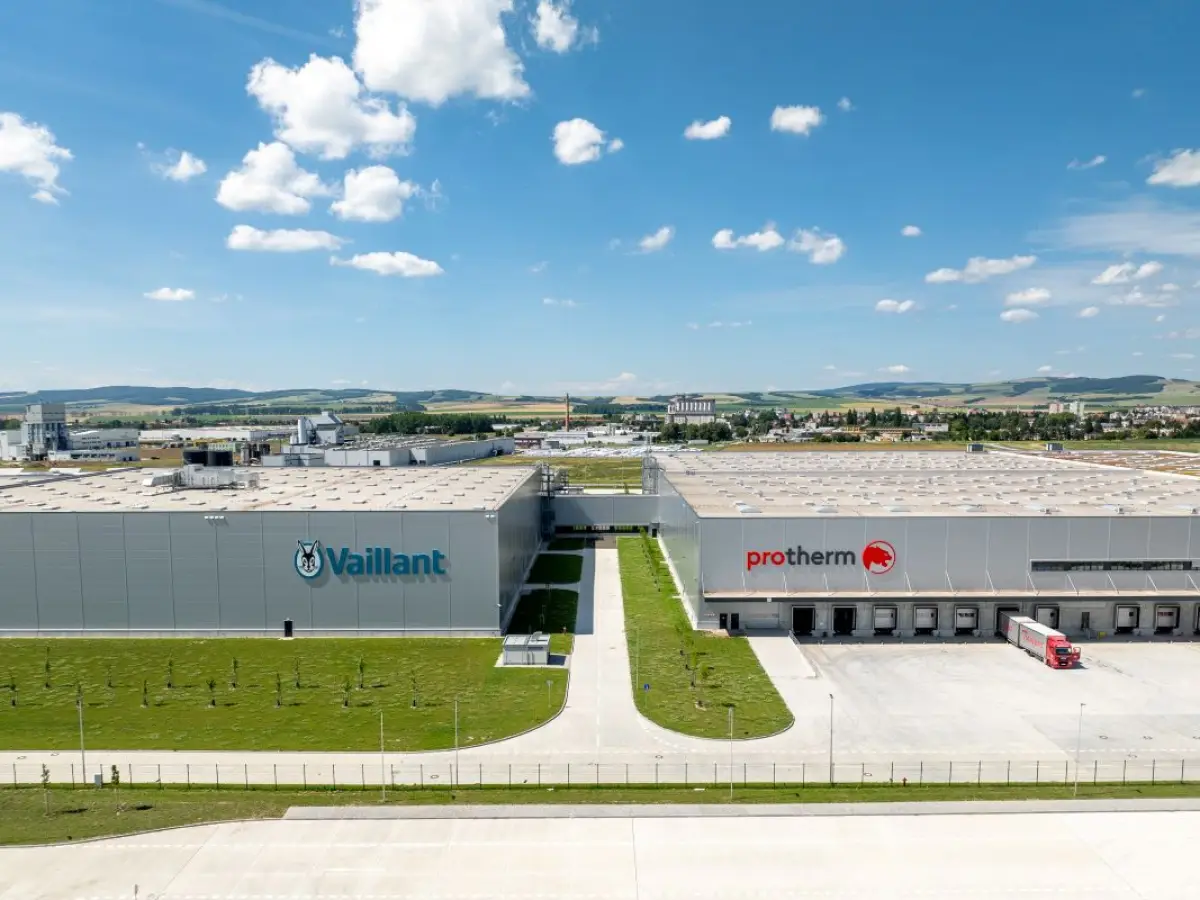

Bratislava – Visiting the Vaillant Group’s new mega-factory in Senica, Slovakia, one figure stands out above all others: a potential capacity of 500,000 electric heat pumps per year. A production capacity which, on its own, can contribute significantly to the decarbonisation of heating in Europe. At a time when the European Union aims to install ten million new heat pumps by 2027, a €120 million plant, inaugurated in September 2023 and now fully operational, illustrates more than many strategic documents just how much the energy transition depends on manufacturing and the ability to innovate industrial processes.
The Senica plant is the largest and most technologically advanced site in Vaillant’s production network, a group that celebrated its 150th anniversary in 2024. The plant covers approximately 100,000 square metres and employs 600 people, whose average age is around forty, with women accounting for 41% of the workforce – a proportion that management intends to increase in the coming years. Heat pumps destined for the main European markets (including Italy, Germany and Austria) are shipped from here, in a facility designed from the outset as an industrial hub for the energy transition.
A key element of the European strategy on heat pumps
A recent analysis by the Danish think tank Concito estimates that an Italian household could save around €900 a year by upgrading to a heat pump. On a European scale, replacing 65 million gas boilers could also halve the EU’s overall dependence on gas imports. Yet the heat pump market remains complex: government incentives change frequently, electricity remains more expensive than gas in many countries, and political and industrial resistance to phasing out fossil fuels in the residential sector is still significant.
The Vaillant Group’s choice to invest in a new large-scale facility entirely dedicated to monobloc air-to-water heat pumps is a clear industrial bet: on a market destined to grow in the long term and on a structural transformation of the European heating system.
“Here in Senica, we manufacture for the European market,” explains Simona Elena Silingardi, brand communications manager at Vaillant Group Italia, claiming that the decision to base production within the EU was a strategic one. “We supply our products to every country on the continent, and for us it is strategic to operate in this context: we believe that European industrial production offers advantages in terms of quality and allows us to meet the diverse needs of the market, as well as complying with all the controls required by EU directives.”
The new Vaillant heat pumps
At the Senica facility, the company manufactures the new aroTHERM pro, aroTHERM plus and aroTHERM perform ranges, all of which use R290 refrigerant. The aim is to combine energy efficiency, reduced environmental impact and greater compatibility with existing buildings due to the possibility of achieving water flow temperatures of up to 70–75°C, also suitable for traditional radiators. The factory carries out tests on 100% of products along the production line, including gas and high-pressure testing systems, X-ray quality controls and climatic chambers that simulate real operating conditions from -25°C to +48°C, in order to guarantee consistent performance across different European environments.
“When it comes to products like heat pumps, we cannot simply talk about the product itself but rather about complex systems with sophisticated electrical and hydraulic components,” explains Antonio Andricciola, heat pump product manager at Vaillant Group Italia, to Renewable Matter. “Training, both inside and outside the factories, is essential if we want these technologies to really work in the field. The goal, both inside and outside the factories, is to build skills and loyalty in a sector – heat pumps – that requires increasingly hybrid technical profiles: mechanics, power electronics, data management, and even interfaces with the world of renewables and domestic storage.”
A flagship factory for industrial sustainability
“Vaillant’s megafactory in Senica has been built to the BREEAM standard, one of the most widely recognised certifications in the field of sustainability,” comments Roberto Cortese, Associations & Public Affairs Manager at Vaillant Group Italia. “We achieved the ‘Excellent’ rating, around 77%, the highest possible for manufacturing facilities. There is a higher level, ‘Outstanding’, but this is mainly reserved for office buildings.”
On the environmental front, the site features eight beehives to support local biodiversity and honey production, as well as meadows, ecological corridors and habitats for insects, amphibians and reptiles. Rooftop gardens and rain gardens help improve the microclimate and manage rainwater naturally. From an energy perspective, the facility utilises a geothermal system with around 230 boreholes, each 100 metres deep, for heating and cooling; it powers 100% of its electricity consumption with renewable energy and has an on-site photovoltaic system that produces approximately 450 MWh per year, covering part of its energy needs and further reducing CO₂ emissions. Inside, green spaces, natural light and radiant heating systems ensure the comfort and well-being of workers, while bicycle parking and charging points promote more sustainable mobility.
In the plant’s Experience Centre, an interactive demonstration brings the issue of emissions to life: a direct comparison between a traditional gas-fired system and a heat pump immediately highlights the potential for reducing climate impact. There is one cautionary note, however: this gap widens the more the electricity powering the heat pump comes from low-emission sources and tends to narrow when the energy mix remains heavily reliant on coal and gas.
On the one hand, in short, the Senica megafactory demonstrates that it is possible to build large, low-impact plants in Europe, integrating geothermal energy, photovoltaics, advanced water management and a focus on biodiversity across the entire site perimeter. On the flip side, it makes it clear that the decisive factor lies beyond the factory gates: in decisions regarding electricity systems, incentives, urban infrastructure and the social acceptance of technologies still unfamiliar to many. The direction of Europe’s transition will depend on how well industries, governments and local communities can align these plans; for now, the production lines in Senica keep rolling, and it will be up to the rest of the system to prove it can keep pace.
Cover: photo by Vaillant