


“The international community should make clear and unequivocal voice in opposing the regression of the world to the law of the jungle.” This was how Chinese Foreign Minister Wang Yi responded on Sunday, in a telephone conversation with his Russian counterpart Sergey Lavrov, to the attack on Iran by the US and Israel.
China's stance on the umpteenth violent escalation, led by Donald Trump in defiance of international law, is the same as that adopted for Venezuela and the previous attack on Iran in June 2025: strong criticism and a call for compliance with shared rules, in line with the usual image of a responsible power that cares about global stability. But beyond the prompt institutional indignation, it is the disruption of oil routes that troubles the Dragon. According to some studies, though, China would not be caught unprepared.
Ghost barrels
Officially, Beijing does not import oil from Iran. Based on the latest data from the General Administration of Customs of China, five countries (Russia, Saudi Arabia, Malaysia, Iraq, and Brazil) accounted for 62% of crude oil imports in 2025. Next are the United Arab Emirates, Oman, Angola, Kuwait and Canada, and an unspecified “others” category accounting for the remaining 14% of imports. Neither Venezuela nor Iran appears on the list.
Nevertheless, as reported in a study by Columbia University's Centre on Global Energy Policy, tracking oil tankers reveals significant volumes of crude oil coming from these two countries. According to data from the think tank Kpler, in 2025 China will have imported at least 2.6 million barrels per day of sanctioned crude oil, or 22% of total imports. Of these, 1.38 million barrels per day will come from Iran, 389,000 from Venezuela and at least 800,000 from Russia.
The mysterious gap between official Chinese customs data and Kpler's estimates is easily explained: in order to conceal their origin and avoid sanctions, the barrels are relabelled with alternative origins, such as Malaysia and Indonesia. The Columbia research centre backs this up with data: “China imports more ‘Malaysian’ crude (1.3 million BPD in 2025) than Malaysia produces (535,000 BPD in 2024)”. while in Indonesia, between 2024 and 2025, there was a “surge in Indonesia’s exports to China from less than 3,000 BPD to 291,000 BPD”, which probably actually contained Iranian crude oil.
In summary, Kpler calculates that 17% of Chinese oil imports in 2025 came from Iran and Venezuela, which respectively send (or rather sent) 87% and 55% of their oil exports to China.
The ant strategy
In short, it appears that the People's Republic is now in a rather uncomfortable situation in terms of its energy security. Were it not for the fact that, pragmatically and cynically, the Chinese government had already been gearing up for a crisis in its established oil routes for some time. With the ant strategy: building up reserves.
Last year's data show a significant increase in China's crude oil imports (+4.4%), but more importantly, a surge in the volume of its reserves, made possible also by the growth of renewable energy. In numbers, according to consulting firm Rystad Energy, the average stockpile in 2025 was 430,000 barrels per day, compared to “only” 84,000 barrels per day in 2024, stored by both state-owned and independent companies.
Simultaneously, Beijing began, primarily following the first attack on Iran in June, to redirect its oil routes in the Gulf, focusing on more stable countries such as the United Arab Emirates, Saudi Arabia, and Oman. That said, it continued to buy Iranian oil at bargain prices for as long as possible, benefiting from the fact that Iran was under US sanctions.
Turning to the American continent, Brazil has gained increasing importance among China's suppliers over the last year, with a 28% increase (208,000 barrels per day) in crude oil exports to Beijing. Canada, meanwhile, has helped to supply the oil that, before Trump, came from the United States.
Now there remains the issue of the closure of the Strait of Hormuz, although this is a problem for everyone, not just Beijing. With its accumulated reserves, though, many analysts reckon China will be able to hold out for many months. Waiting for the next geopolitical shift, and in the meantime pushing ahead with the energy transition.
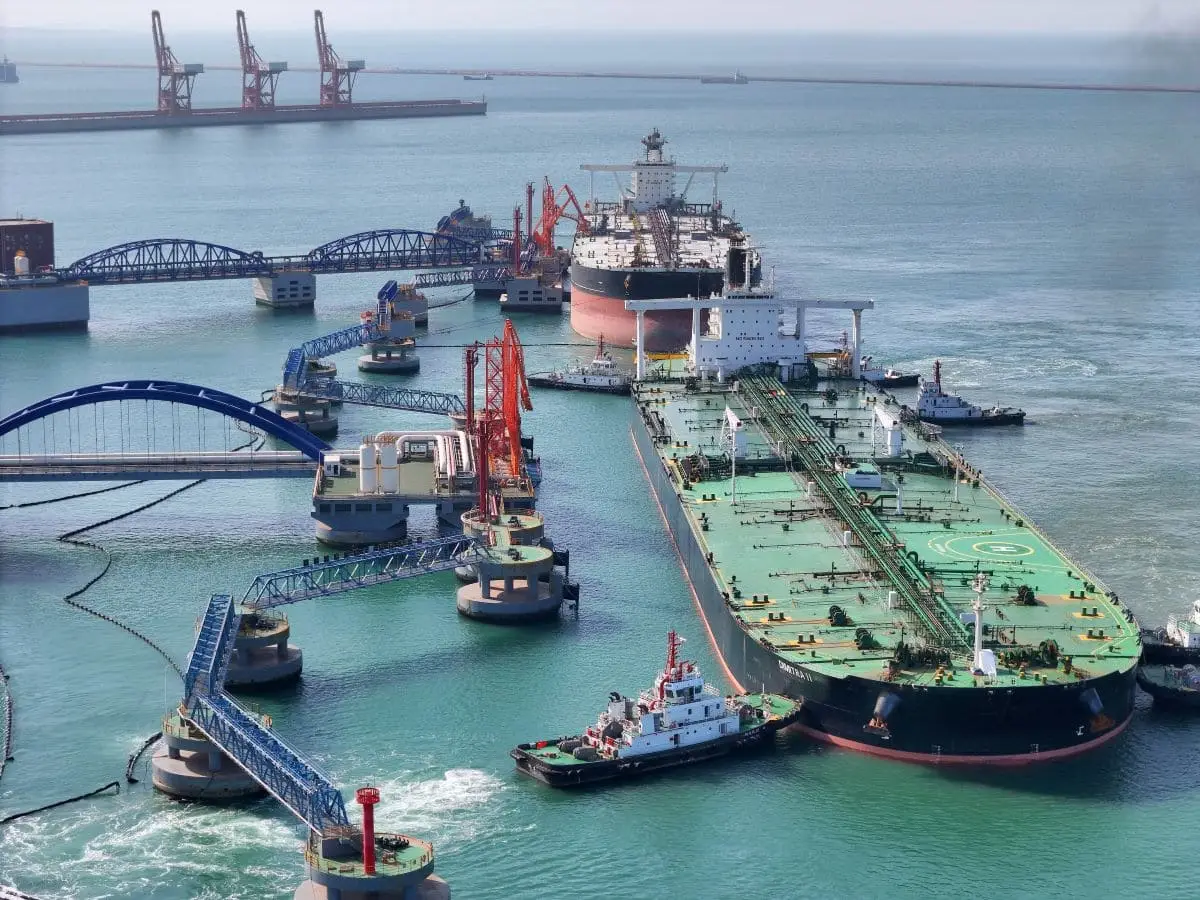
Cover: In China, tugboats pull an oil tanker carrying 264,000 tonnes of crude oil to the Yantai pier. Photo by Tang Ke/Utuku/ROP, IPA Agency