


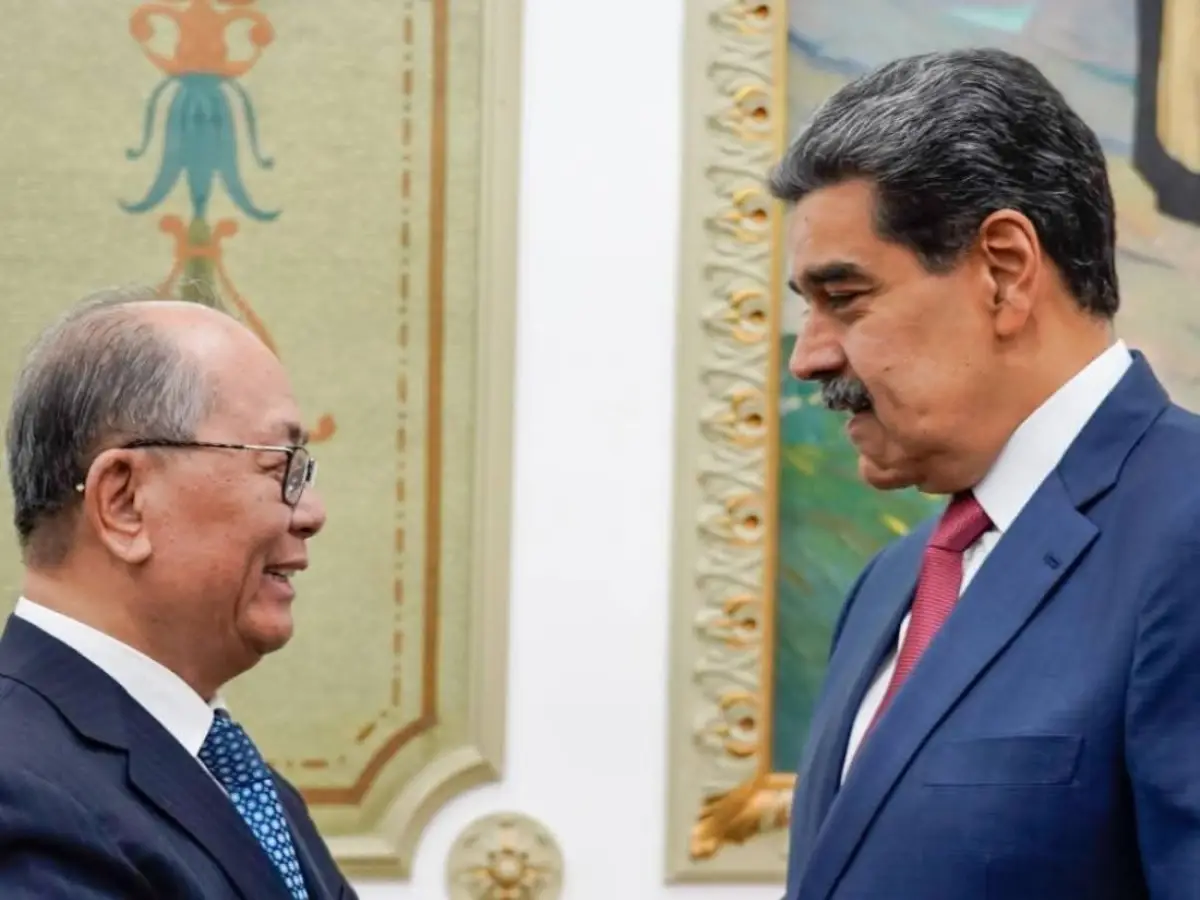

“It was a friendly meeting, reaffirming the strong bonds of friendship between China and Venezuela. In good and bad times!” The last words posted on Nicolas Maduro's social media profiles on the evening of 2 January, a few hours before his overnight apprehension by US military forces, reference the meeting just concluded with the Chinese special envoy for Latin America: photos shared by the Venezuelan president on his Telegram account depict him warmly shaking hands with a smiling Qiu Xiaoqi. Only a few hours later, in the video released by the White House, Maduro is handcuffed, in slippers and escorted by US special forces.
Rarely has a comparison between two images more explicitly revealed the geopolitical, strategic and economic subtext of a military operation. While there is little doubt that the war on drug trafficking is merely a pretext, as are the oil interests of the United States, what we are now trying to decipher are China's reactions.
Beijing’s official reaction
The first official response from Beijing came on the evening of 3 January (morning in the United States). A brief but decisive statement was posted on the Chinese Foreign Ministry's website: “China is deeply shocked by and strongly condemns the US’s blatant use of force against a sovereign state and action against its president. Such hegemonic acts of the US seriously violate international law and Venezuela’s sovereignty, and threaten peace and security in Latin America and the Caribbean region. China firmly opposes it. We call on the US to abide by international law and the purposes and principles of the UN Charter, and stop violating other countries’ sovereignty and security.”
On Sunday, 4 January, Foreign Minister Wang Yi also issued a statement reiterating China's position: “We have never believed that any country can act as the world's police, nor do we accept that any nation can declare itself the world's judge.”
Later, on Monday 5th, Sun Lei, chargé d'affaires of the Permanent Mission of China to the United Nations, added fuel to the fire, denouncing “unilateral, illegal and bullying acts of the United States,” guilty of having “seriously violated the principles of sovereign equality, non-interference in internal affairs, of peaceful settlement of international disputes, and the prohibition of the use of force in international relations,” as stated on the Chinese news agency Xinhua’s website. “The United States has placed its own power above multilateralism, and military actions above diplomatic efforts, posing a grave threat to peace and security in Latin America and the Caribbean and even internationally,” concluded Sun, reiterating China’s demands to guarantee the safety of president Maduro and his wife and their immediate release.
China’s interests in Latin America
As Lorenzo Lamperti rightly pointed out on ChinaFiles, the broad reference to the entire Latin American and Caribbean region is by no means accidental. In May 2025, Beijing hosted a bilateral forum with CELAC, the Community of Latin American and Caribbean States: an occasion not only to announce that trade between China and Latin America had reached a record level of $519 billion and to sign a series of agreements and investments, but also to reaffirm the role of “moral guide” of the Global South to which China, more or less explicitly, aspires. At the forum, Wang Yi stated, in a manner that was anything but veiled, that “Latin America and the Caribbean are not anyone's backyard”.
However, Trump's move not only jeopardises Chinese investments in the area, but also disrupts the cooperation and development plans that Beijing had set out in writing just a month ago in the new government policy paper dedicated to the region. This document follows the guidelines of the Belt and Road Initiative, namely commercial expansion, infrastructure development and financial cooperation, but “without political interference”: a stark contrast to the intrusive Monroe Doctrine revisited in the Trump era.
Oil and credit
As far as Venezuela in particular is concerned, first of all it should be noted that the country, like almost all Latin American states, is officially part of the Belt and Road Initiative and is also one of the most active partners in terms of funding received from China. US interference therefore jeopardises Beijing's interests on two fronts: oil and credit.
On the first front, China is the largest buyer of Venezuelan oil, accounting for about 70% of Caracas' total exports (over 600,000 barrels per day at the end of 2025). Of China's total oil supplies, Venezuela's share (around 5-7%, depending on estimates) is not actually very large: the volumes of crude oil imported from Russia, Saudi Arabia and Iran are much greater. Of course, having an extra supplier is always useful, especially considering the political turmoil in Asia Minor, but Beijing has been aiming to reduce its dependence on exports for some time, which is why, despite the boom in renewables, it is struggling to let go of coal.
In terms of credit, however, the matter could become more complicated. According to estimates by the US-based research institute AidData, reported by The Guardian, Venezuela is “the fourth largest recipient of loans from official Chinese credit institutions, with approximately $106 billion in commitments between 2000 and 2023.” A year ago, Venezuela's debt to China was estimated at around $10 billion. For this reason, as revealed by Bloomberg citing anonymous sources, on 5 January, China's main financial regulatory authority asked credit institutions to report their exposure to Venezuela.
When asked by The Guardian about the issue, Victor Shih, a Sino-American political scientist at the University of California, commented: “If, under pressure from the United States, the Venezuelan government, which is heavily indebted to multiple actors, were to prioritise US creditors over Chinese ones, Chinese banks could suffer significant losses.” The solution for Beijing, Shih notes, might be, once again, to use rare earths as leverage, i.e. to threaten to block exports in order to force Trump to reach an agreement with Chinese creditors.
A precedent for Taiwan?
Last but not least, let's talk about the elephant in the room: will the US's unilateral aggression against Venezuela set a precedent for China to do the same with Taiwan? Chinese nationalists have been raving about this all over social media. By Monday, posts about Maduro on Weibo (the Chinese Twitter) already had more than 650 million views, with many users suggesting that the Beijing government should follow suit and resolve the Taiwan issue by force.
However, international analysts are much more cautious and downplay this aspect: although Xi Jinping continues to talk about “reunification” with Taiwan as inevitable, it is likely that he will proceed with the same caution he has shown so far. Taiwanese politicians themselves believe that the use of force is highly unlikely, such as Wang Ting-yu, a member of parliament and member of Taiwan's Foreign Affairs and Defence Committee, who stated emphatically: “China is not the United States and Taiwan is not Venezuela. The comparisons are wrong and inappropriate.” However, many observers note that the military operation in Venezuela has created a “new normal” that Beijing (but not only Beijing) could invoke.
For now, the final word has been given by Chen Binhua, spokesperson for the Taiwan Affairs Office of the Chinese State Council, who, in response to questions from the press on 7 January, stated: “The United States has brazenly used force against a sovereign country, an action that seriously violates international law” and to which China is opposed. He then reiterated that Taiwan is a matter of internal politics for Beijing: “Taiwan is China's Taiwan. Resolving the Taiwan issue is a matter that concerns only the Chinese people and does not tolerate external interference.” However, he concluded that “if the separatist forces for Taiwan independence dare to take reckless actions and cross the line, we will take resolute measures and deliver a direct blow.”
Cover: Qiu Xiaoqi and Nicolas Maduro, from Nicolas Maduro’s Facebook profile