

In the 1984 slasher film, Nightmare on Elm Street, US Midwestern teenagers fall prey to the evil Freddy Krueger, who after invading the teenagers’ dream worlds turns their dreams of dismemberment and atrocity into horrific and deadly reality. Donald Trump’s previously largely disjointed ramblings about annexing Greenland, turning Canada into the 51st US state, and re-establishing US territorial control over Latin America and the Caribbean have finally undergone a transition from rhetorical dream into the beginnings of a new deadly reality with the kidnapping of Venezuela’s president and the call for the US to “run” Venezuela in the interests of the US and its oil companies. The main questions about this would seem to be: why now? Does this represent a planned strategy or an ad hoc approach driven as much by domestic politics as by some sort of foreign policy goals? And finally, can we decode from the rhetoric of Trump and his agents some type of overriding logic however ad hoc the actions turn out to be?
On the first point, the 6 January 2021 was the day that the US Congress was scheduled to approve the results of the 2020 US presidential election. Trump incited a crowd of his supporters to go to the Capitol and protest against the proceeding in the hope that it would be overturned and Trump would return for a second term. So, on 4 January 2026 Trump orders a seemingly long-planned kidnapping of President Maduro of Venezuela and his wife and then charges them with involvement in drug trafficking while also claiming not to be engaged in regime change and having a strong interest in exploiting the country’s significant reserves of petroleum.
At the same time, back home, Trump’s role in the Epstein sex-trafficking scandal and the perception of failure to fulfill many of his promises, from curing inflation to ending the Russia-Ukraine war, suggest the need to distract by an action abroad: justified, however, in terms of a “neighborhood” national interest that will not involve a military occupation and support for the opposition in Venezuela that apparently won the 2024 presidential election there. So, distraction from both memory of Trump’s own attempt at overturning an election and ongoing political difficulties at home seem to explain much about the timing of this event.
The crucial question, though, is whether this is a one-off, the first in a pattern of distractions or the beginning of a planned strategy? Already pundits are pointing to Greenland, Cuba, Colombia, and, potentially, Mexico as next on the list. Whether this can be achieved at one and the same time as trying to bring the still-existing regime in Venezuela to heel is an obvious question. Trump seems to believe that threats and insults can work to force governments into submission. In the end, however, the failure to engage with full-fledged regime change in Venezuela, however “collaborative” the existing government proves to be, will show others how hollow such threats can turn out to be without some sort of explicit military and economic coercion.
Lurking in the discordant rhetoric of the Trump regime, nonetheless, are two fairly consistent themes that may eventually lead in this direction. This could be sooner rather than later if difficult domestic politics continues to stimulate foreign adventures. One is on the resurrection of the so-called Monroe Doctrine from 1823, when the US government of the day declared the Americas off-limits for new European interventions. Renamed the “Donroe Doctrine” to signal its connection to Trump, this new version is all about the Americas as a US territorial sphere of influence in which external Great Powers such as China and Russia are personae non gratae. Under this rubric, Cuba and Venezuela are the most obvious candidates for interventions.
The second is the emphasis on raw materials such as petroleum and rare earths in a repeat of nineteenth century territorial imperialism, including the expansion of the US itself into the continental interior of North America. An obsession with reviving and expanding access to fossil fuels has long been a feature of Trump’s politics and his appeal among a segment of the US population.
That Venezuela’s oil reserves are largely of heavy crude has apparently played into the calculus because most of the Gulf Coast refineries in the US favor this type of oil. Extracting it from the shallow oilfields of the Orinoco basin and shipping it northwards, however, is something else entirely, as many oil experts have noted. It is not only inefficiency and corruption that have plagued the Venezuelan oil industry but difficulties in accessing its oil, say compared to the oil sands of Alberta in Canada or the easy pumping of oil in Saudi Arabia. Little attention seemingly has been given to these drawbacks. When it comes to Trump, he never lets facts get in the way of a good story.
Apart from the attempt at giving historical cover to the territorial obsessions of Trump by recourse to the Monroe Doctrine, the entire refocusing of US foreign policy now under way is a major departure from what has inspired the US place in the world at least since the Second World War, if not earlier. This was the dual emphasis on 1: making the world safe for a global capitalism based very much on denying the centrality of territory to economic transactions and utilizing market-based channels and not governmental patrimonialism as the main mechanisms for economic growth; and 2: at least paying lip service to sponsorship of liberal democracy and alliances with like-minded governments.
European governments and the European Union today seem to operate on the assumption that these emphases are still in place. At the very least, I should think, they might be preparing for a future in which neither is the case. Of course, Trump can also be viewed as articulating a strange nativist backlash in the United States to the country as the stage for modernity in favor of the sort of atavistic vision of the world associated with a contemporary Napoleon or a Hitler. This makes him dangerous because as well as seemingly unrestrained by other US institutions like the courts or the Congress, he is unburdened by much respect for norms of civility or by much understanding about what actually had “made America great:” its openness to the world and sense of planetary consciousness as revealed in the moon shots of 1968. A global nightmare is replacing the dream of America.
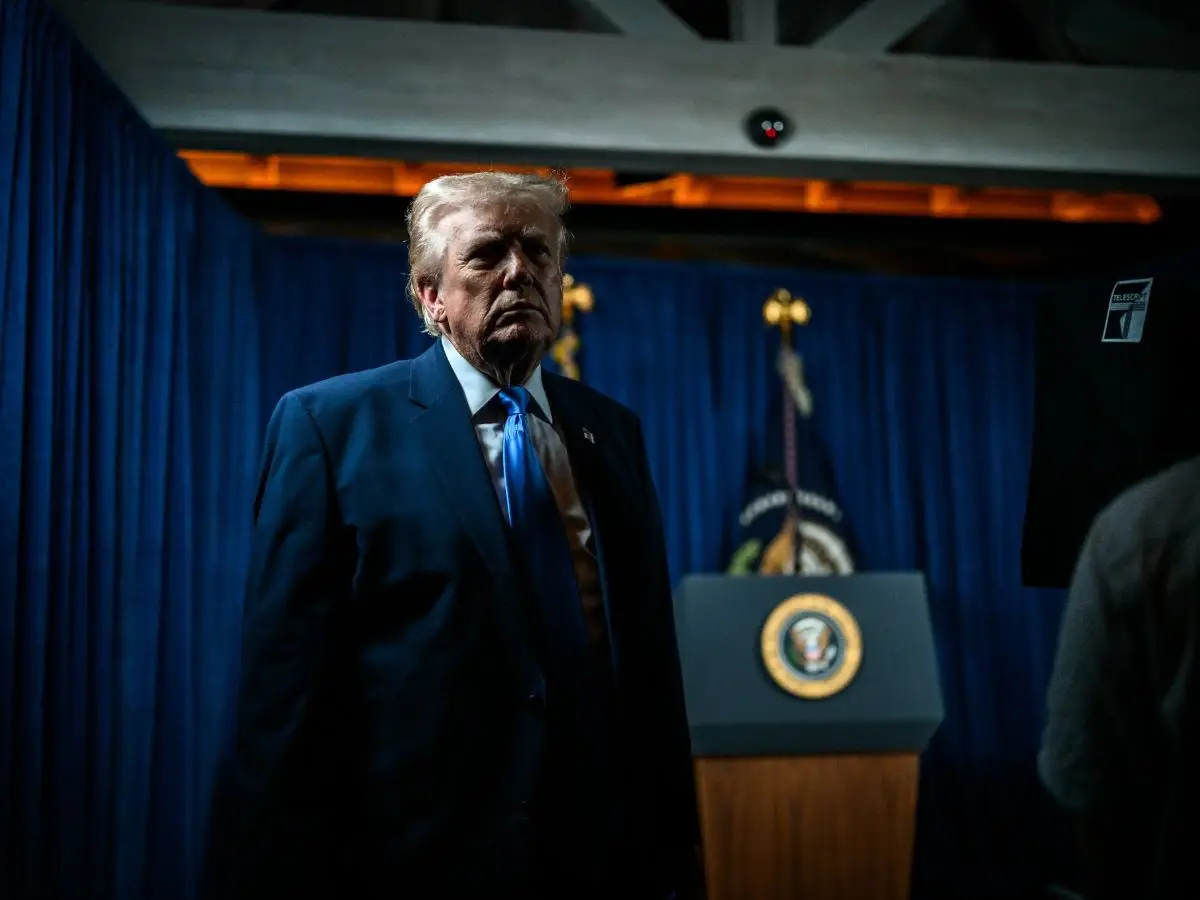
Cover: Donald Trump, Official White House Photo by Daniel Torok, via Flickr