


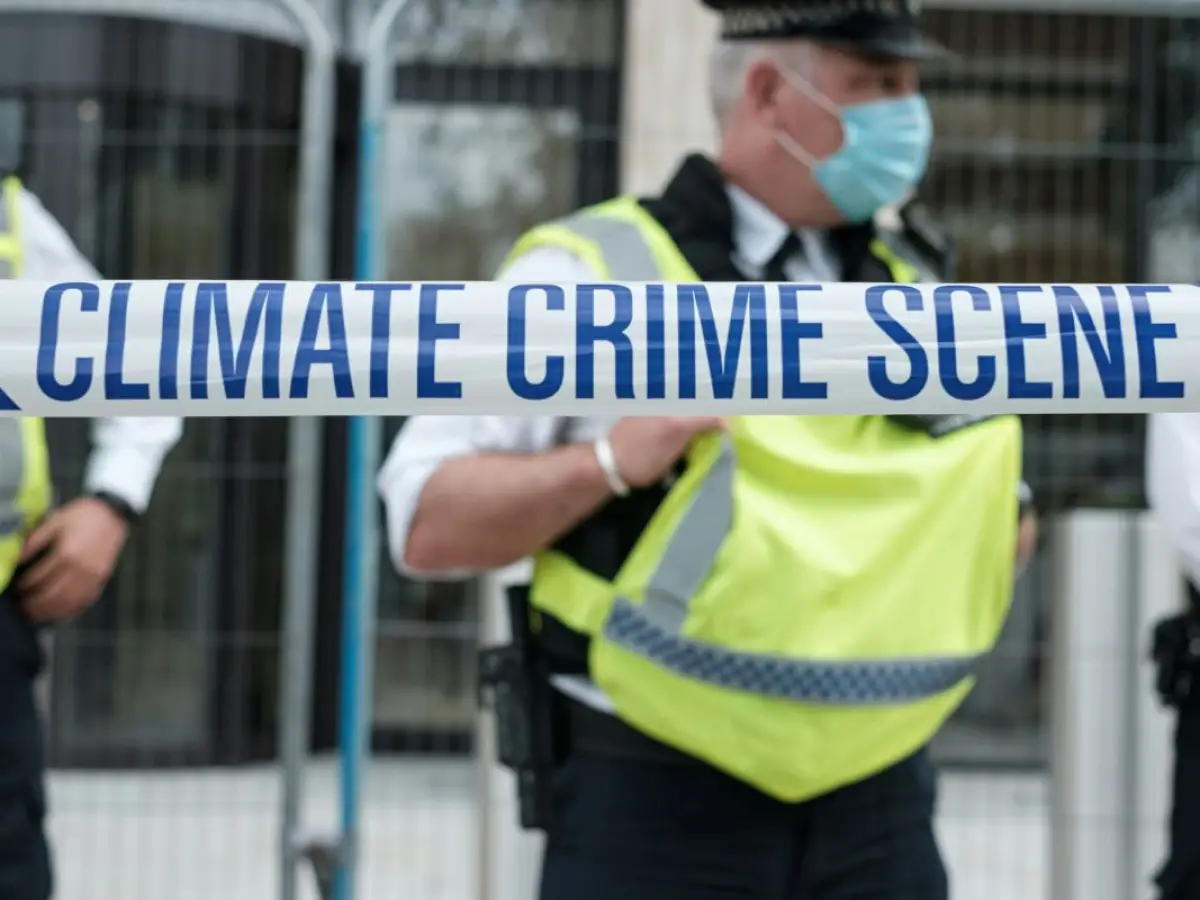

In 2026, the courts will be the new battleground for the climate crisis. This is not a metaphor: Ukraine is preparing to file the first claim for climate reparations in history against Russia, estimating the cost of the 236.8 million tonnes of CO₂ equivalent generated by the invasion at $43 billion. The precedent could redefine what it means to be liable for a war. No longer just crimes against humanity, no longer just destruction of infrastructure: now even the carbon emitted by tanks, burnt forests, and buildings razed to the ground, requiring reconstruction, has a price. And someone will have to pay it.
The Ukrainian claim, expected to be filed in early 2026 with the Register of Damage for Ukraine (RD4U), a mechanism established by the Council of Europe to document the damage caused by Russian aggression, represents much more than financial compensation. This is proof that climate litigation is entering a new phase: from administrative courts to international courts, from lawsuits against governments for failing to comply with climate agreements to claims for compensation for actual damage suffered by real people.
The paradigm has shifted. Polluters must pay. And the courts are beginning to agree. Emissions come not only from military fuels or explosions, but also from the 3 million hectares of burnt forests, the destruction of buildings that release all the carbon embedded in concrete and steel, and the loss of soil absorption capacity. The Initiative on Greenhouse Gas Accounting of War (IGGAW), a Ukrainian government research project funded by the European Climate Foundation, has calculated each item by applying a social cost of carbon of $185 per tonne, the same parameter used in international climate studies.
RD4U, accessible at rd4u.coe.int, has already recorded over 70,000 war compensation claims and will accept climate claims in the coming months. The Ukrainian initiative is supported by the advisory opinion of the International Court of Justice (ICJ) issued on 22 July 2025, a landmark ruling in environmental and climate litigation that essentially affirmed the human right to a healthy, clean and sustainable environment. It was a turning point: victims of environmental damage were told they could go to court and seek justice. And indeed they are doing so, in numbers never seen before.
The global explosion of climate litigation
According to data from Columbia University's Sabin Centre for Climate Change Law, by the end of 2025, over 3,000 climate litigation cases were filed in 60 countries. In 1986, when the first case was filed, nobody could have imagined that forty years later the courts would become one of the hottest fronts in the climate battle. In 2024 alone, over 200 new cases were filed. The pace shows no sign of slowing down: an increase of between 200 and 300 new cases is expected by 2026.
The geography of litigation is radically shifting. The United States remains the most litigious country, with 1,986 cases filed by June 2025, but the Global South now accounts for nearly 60% of cases filed since 2020. Brazil, with 135 cases, is the third most litigious country in the world and has examined more claims for climate damage than any other nation, focusing primarily on illegal deforestation.
However, it is the very nature of litigation itself that is changing. Until a few years ago, most lawsuits concerned the “ambition gap”: citizens and organisations taking governments to court to demand higher emission reduction targets. Today, the paradigm has shifted towards “polluter pays”. And increasingly, it is multinational oil, gas and cement companies that are being asked to pay. Victims of floods, droughts and heatwaves are demanding concrete compensation for the damage they have suffered. And the courts are slowly beginning to recognise that this demand has a legal basis.
“What was a moral imperative 10 years ago has become a legal imperative. Now the courts are catching up,” declared Sarah Mead, co-director of the Climate Litigation Network, in an interview in December. Joie Chowdhury, senior solicitor at the Centre for International Environmental Law (CIEL), adds: “People often see these cases as big fights against companies, carbon or technology, but it's also people's immediate needs: putting food on the table, getting your kid to school, when all the infrastructure has collapsed after a massive storm.”
Multinationals on trial
2026 will be a year of crucial decisions against some of the world's largest energy and industrial corporations. Legal proceedings begun in recent years will finally come to a head, with decisive hearings and possible rulings that could set binding precedents.
Shell is on trial in the Philippines, where survivors of Typhoon Odette in December 2021 have filed a lawsuit in the UK High Court demanding compensation for the oil multinational's role in global warming. The storm caused over 400 deaths and devastated entire communities in the Eastern Visayas. The plaintiffs argue that Shell's historical emissions have contributed to the intensified extreme events that regularly affect the Philippine archipelago.
As reported by Loes van Dijk, founder of Climate Court and ambassador for the European Climate Pact, the lawsuit was formally filed with the High Court in the final weeks of 2025, establishing itself as one of the key cases to follow in 2026. The proceedings follow on from the historic 2021 ruling, when a court in The Hague ordered Royal Dutch Shell to reduce its emissions by 45% by 2030 compared to 2019 levels, recognising for the first time a company's responsibility for scope 3 emissions, those generated by its customers and suppliers.
Holcim, the Swiss cement giant, is facing a lawsuit from four fishermen on the Indonesian island of Pari, about 40 kilometres north of Jakarta. The islanders, supported by the organisation Swiss Church Aid, are demanding a 43% reduction in Holcim's emissions by 2030 and approximately $4,000 in compensation each for damage caused by flooding. The island is particularly vulnerable to rising sea levels and increasingly frequent storm surges. If upheld, this would be the first case in which a Swiss company has been held liable for its contribution to global warming. The cement industry is responsible for around 8% of global CO₂ emissions, yet it has rarely been the subject of climate litigation. The Holcim case could break new ground.
TotalEnergies, meanwhile, is facing legal action in a Belgian court. Hugues Falys, a farmer from Flanders supported by several NGOs, including Greenpeace, FIAN and the Ligue des droits humains, has filed a lawsuit seeking compensation for the damage that extreme weather events have caused to his farm. But Falys's claim goes further: he is asking the court to order TotalEnergies to stop new investments in fossil fuel projects and to reduce oil and gas production by 75% by 2040. It is a bold move that could force one of France's largest energy companies to radically overhaul its business model.
These three cases have one crucial element in common: they are based on scientific advances that make it possible to link the emissions of specific companies to extreme weather events with ever greater precision. Research in attribution science has become increasingly sophisticated, and courts are beginning to recognise it as admissible evidence. A significant precedent was set in May 2025, when a German court dismissed the case brought by Peruvian farmer Saúl Luciano Lliuya against RWE, but ruled that companies can be held liable for their emissions. It is a recognition of principle that paves the way for future legal successes.
More than 60 “polluter pays” lawsuits have been filed globally, and dozens are still ongoing, according to data from Zero Carbon Analytics. The majority are targeting fossil fuel companies: ExxonMobil, Shell, Chevron, ConocoPhillips and BP have each been named in more than twenty lawsuits. Climate Analytics has calculated that the share of climate damage attributable to the 25 largest oil and gas companies for emissions from 1985 to 2018 amounts to approximately $20 trillion.
Italy and “The Fair Cause”
In Italy, 2026 could be the year in which the Court of Rome finally rules on “La Giusta Causa” (The Fair Cause), the climate lawsuit filed in May 2023 by Greenpeace Italy, ReCommon and 12 citizens against ENI, the Ministry of Economy and Finance, and Cassa Depositi e Prestiti. In July 2025 (a month to note for legal battles), the Court of Cassation, in joint sessions, ruled that Italian judges have jurisdiction to adjudicate on damages resulting from climate change, based on both national and supranational legislation. Climate lawsuits in Italy are admissible and can be pursued, even to condemn fossil fuel companies to limit their emissions.
The Court of Rome will now have to examine the merits of the case and determine whether ENI is indeed liable. ENI had objected to the “absolute lack of jurisdiction of the ordinary court”, arguing that climate cases were not admissible in Italy. The Court of Cassation shut that door. Now the judge assigned to the case will have to examine the merits of the damages that ENI has contributed to inflicting on the plaintiffs. The citizens and the two NGOs are asking for ENI, the MEF and CDP to be held liable for damage to health, safety and property, and for having endangered and continuing to endanger those same assets as a result of climate change.
The lawsuit against Leonardo and the Italian state
Another legal battle began in Italy on 29 September 2025, when seven associations – AssoPacePalestina, A buon diritto, ATTAC Italia, ARCI, ACLI, Pax Christi, Un ponte per – together with Palestinian citizen Hala Abulebdeh filed a lawsuit in the Civil Court of Rome against Leonardo S.p.A. and the Italian state. The legal action, led by lawyers Luca Saltalamacchia, Veronica Dini, Michele Carducci and Antonello Ciervo, calls for the contracts for the supply of arms and military technology between Leonardo and Israel to be declared null and void, on the grounds that they violate Article 11 of the Constitution and Law 185/1990, which prohibits the export of arms to states responsible for serious human rights violations.
Leonardo, one of the world's largest arms manufacturers and 30% owned by the Ministry of Economy and Finance, supplies Israel with components for the F-35 fighter-bombers used in the bombing of Gaza, super-fast naval guns, GBU-39 bomb fins and radars. In the report From economy of occupation to economy of genocide by UN Special Rapporteur Francesca Albanese, released in June 2025, Leonardo is explicitly mentioned not only for its military hardware but also for its academic cooperation with Ben Gurion University of the Negev on artificial intelligence and data science, technologies used in operations against the Palestinian population.
If the court recognises the contracts as null and void, Leonardo and the Italian state will no longer be able to provide military support to Israel. It is one of the first legal actions launched in an EU member state against a private company involved in military supply agreements with the Israeli state and could mark a new frontier in litigation related to armed conflicts and their humanitarian and environmental consequences.
The Quirra case
In Sardinia, another case linked to military activities has reached a crucial stage. In November 2025, in the appeal trial on the Quirra firing range, Deputy Attorney General Andrea Massidda requested that the civil parties' appeal be upheld, awarding compensation to military personnel and civilians harmed by military exercises. Eight former commanders of the Perdasdefogu joint firing range and the Capo San Lorenzo outpost were all acquitted by the Court of Lanusei in 2021 after a seven-year trial. They were accused of negligence which, according to the prosecution, had caused dozens of suspicious deaths due to serious illnesses linked to substances released during military drills inside the base.
From a criminal point of view, the case is now closed with the acquittal. However, the issue of compensation remains, related to the appeals filed by lawyers Bachisio Mele, on behalf of the Sardinian committee “Gettiamo le basi” (Let's lay the groundwork), and Giuseppe Caboni, representing several people from Escalaplano affected by serious illnesses. The investigations by the Lanusei Public Prosecutor's Office, begun in 2002, had hypothesised that the areas where the exercises involving explosions and missile launches took place were not closed to the public and that the necessary protective equipment was not provided to military personnel. The trial has been postponed until 3 March 2026. The Quirra case is one of the longest and most controversial environmental disputes related to military activities in Italy, with 168 suspicious deaths among shepherds, citizens and military personnel documented during the investigation.
United States: a front that won't give up
Climate litigation in the United States is proceeding along parallel and contradictory tracks. On the one hand, several states and municipalities are successfully pursuing lawsuits against Big Oil for decades of climate misinformation. Maine, Vermont and New York have filed lawsuits demanding billions of dollars in damages. Federal courts are rejecting the oil companies' procedural objections, thereby allowing the cases to proceed.
On the other hand, however, “anti-climate” litigation is on the rise: lawsuits filed to slow down, block or overturn mitigation and adaptation policies. In 2024, the Grantham Research Institute found that 27% of 226 new climate cases aimed to resist or delay climate policies, and 88% of these were filed in US courts. Trade associations, conservative think tanks and some Republican-led states are using courts to hinder the energy transition. It is a strategy that aims to slow down regulatory changes and create legal uncertainty around climate policies.
Loes van Dijk's weekly update in her Climate Litigation Tracker notes that the landscape in the US is particularly lively for other reasons as well. A federal judge has overturned FEMA's decision to terminate a disaster mitigation programme. Earthjustice has filed a lawsuit to block ConocoPhillips' Arctic exploration approvals. Los Angeles County has sued oil companies over the risks of toxic pollution from unsealed wells. In Wisconsin, there is pressure to disclose data on the energy demand of a Meta data centre. And in California, a federal judge has ordered the plaintiff to clarify allegations of greenwashing in the Florida Crystals sugar case.
The Global South is taking action
While the North has dominated climate litigation for years, nowadays it is the Global South seeing the fastest growth. And cases are becoming increasingly bold, tackling issues that intertwine human rights, environmental justice and corporate responsibility.
In Africa, the African Court on Human Rights has ordered Kenya to finally abide by previous rulings in favour of the Ogiek people and to protect the Mau Forest, one of the continent's most critical ecosystems. The case has been dragging on for years and is now entering a decisive phase. In South Africa, Thungela Resources shareholders have filed a lawsuit against the coal mining company after repeated refusals to put climate resolutions on the agenda. Still in South Africa, environmental justice organisations have challenged air pollution exemptions granted to Eskom, the national electricity company, on the grounds that they violate air quality legislation and, alternatively, are unconstitutional.
In Asia, residents of West Sumatra have filed a civil lawsuit against the Indonesian state for negligence following a deadly ecological disaster. At the same time, NGOs have filed the first-ever complaint under the Equator Principles regarding the Papua LNG project, together with a complaint under the OECD guidelines targeting ArcelorMittal's climate strategy and emissions trajectory.
Climate litigation in Japan, New Zealand and Belgium
In December 2025, Japan saw its first climate lawsuit filed: hundreds of people sued the central government for its “grossly inadequate” response to climate change. The lawsuit marks a turning point for a country traditionally reluctant to engage in environmental litigation.
New Zealand, following the Supreme Court's 2024 green light for Māori activist Mike Smith to sue seven corporations – including Fonterra, the world's largest dairy exporter – for their role in global warming, is bracing for a trial that could redefine corporate liability. Smith argued that the principles of tikanga Māori, the traditional system of obligations and recognition of wrongs, could be incorporated into New Zealand common law. The Supreme Court acknowledged the existence of “climate change damage”, paving the way for future legal action based on this new legal category.
In Belgium, following the June 2021 ruling by the Brussels Court of First Instance sentencing the government for inadequate climate policies that violate human rights – while refusing to impose specific targets – Klimaatzaak announced an appeal to the Court of Appeal. The Belgian case is one of a series of European lawsuits against states that have had mixed outcomes but have all contributed to consolidating the idea that climate inaction can be prosecuted.
The new frontiers of climate litigation
Climate litigation is spreading into areas previously unexplored. It is no longer just fossil fuels: now intensive agriculture, transport, the food sector and large-scale distribution are also being targeted. While some lawsuits target greenwashing practices, others challenge the decisions of institutional investors who continue to finance high-emission projects.
In Germany, the environmental organisation Deutsche Umwelthilfe brought two significant lawsuits: one against the Rothaus brewery for misleading advertising related to the slogan “Climate Positive 2030”, and another against the state of Berlin for failing to update its climate programme as required by law. This is an example of how litigation is becoming increasingly granular, targeting not only large fossil fuel companies but also businesses in seemingly marginal sectors and non-compliant local authorities.
In Norway, the controversy over the Førdefjorden mining waste dump has intensified with an appeal filed by environmental groups seeking an injunction to block the disposal of mining waste in the fjord. The case raises questions about the compatibility of mining activities with the protection of marine ecosystems and the rights of coastal communities.
In France, NGOs have taken legal action against the state, accusing it of illegally excluding overseas territories from the protections provided by the European Social Charter. This case intersects social rights and climate justice, given that many of these territories are particularly vulnerable to the impacts of climate change. Other activists and non-governmental organisations subsequently filed criminal complaints against the directors and shareholders of TotalEnergies who voted in favour of climate strategies considered incompatible with the goal of limiting global warming to 2°C.
In the United Kingdom, a group of New Zealand and British students filed a lawsuit against BP shareholders who rejected proposals to align the company with the Paris Agreement targets. Such actions aim to hold investors personally responsible for the strategic choices of the companies in which they hold shares.
A worrying phenomenon is the increase in SLAPPs, strategic lawsuits against public participation. Shell has filed lawsuits against Greenpeace, TotalEnergies has done the same in France, and ENI in Italy. These proceedings, often based on flimsy accusations, aim to drain environmental organisations of financial resources and discourage public criticism. The European Union adopted an anti-SLAPP directive in 2024, but its implementation in the various member states is proceeding slowly.
Climate litigation, therefore, is reshaping global climate governance. Courts are filling the gap left by politics: where conferences of the parties and international agreements fail to generate sufficiently ambitious binding commitments, courts are stepping in to protect fundamental rights. The consequences for companies are significant. Legal risk is becoming a material factor that investors must consider. For example, insurance companies are beginning to exclude climate change liabilities from their coverage, and shareholders are pressuring boards of directors to adopt credible transition strategies.
The situation is no less complex for governments: countries that fail to meet their commitments could find themselves paying billions in compensation. The climate reparations mechanism that Ukraine is preparing to use against Russia could be replicated in other contexts: Gaza, Darfur, Yemen.
2026 will not be the year in which all these cases come to a conclusion. Many will continue well beyond that, with appeals, recourse and technical expert reports. But it will be the year in which climate litigation finally becomes mainstream, in which the option of taking polluters or those who fail to meet their climate commitments to court will be considered not an exception but a normal legal option.
Cover: photo by Ehimetalor Akhere Unuabona, Unsplash