


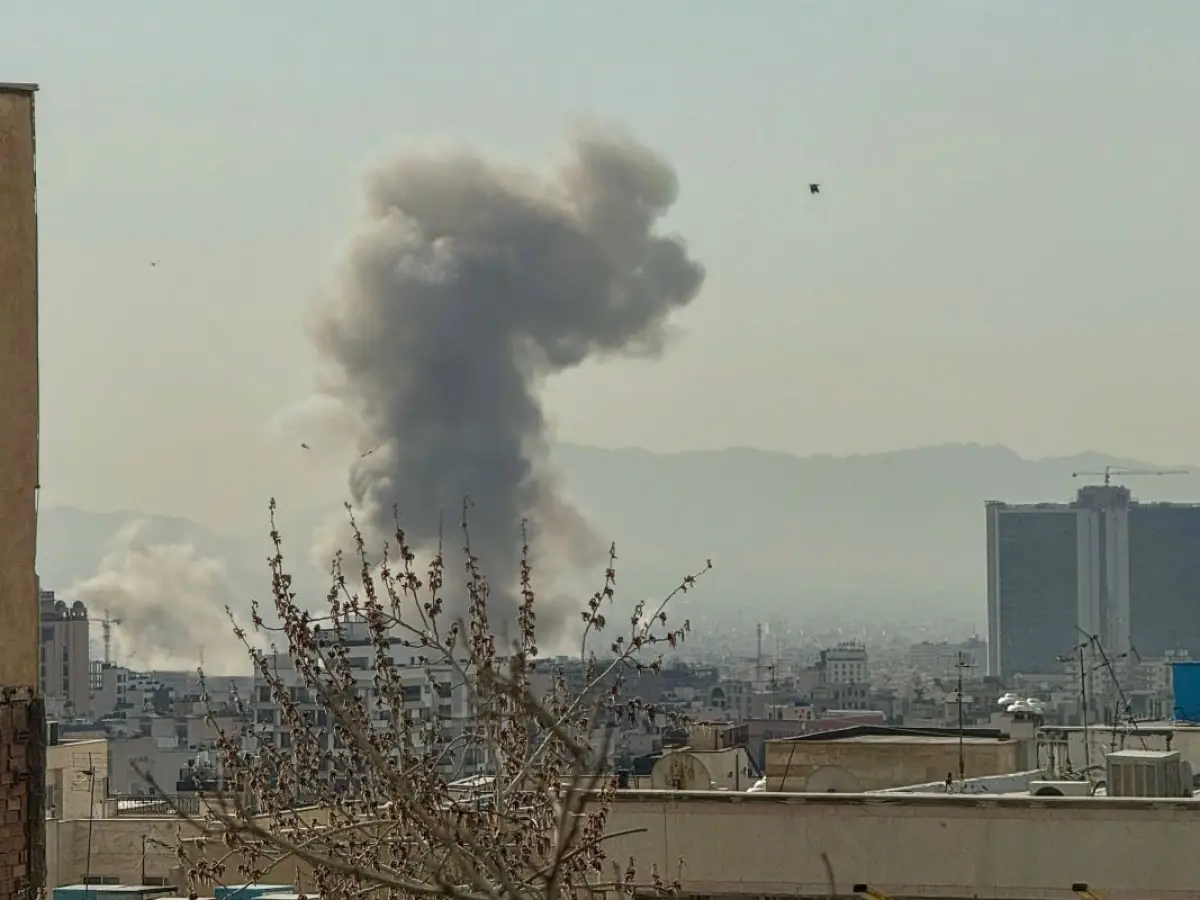
The Middle East entered a new and destabilizing phase on Saturday morning, 1 March, when Iranian state media confirmed that Supreme Leader Ali Khamenei was killed in his office during the Israeli-US attacks, marking the most consequential decapitation strike in the history of the Islamic Republic since 1979. A 40-day mourning period for the longtime Iranian leader has been officially announced.
The confirmation followed statements by US President Donald Trump, who wrote on Truth Social: "Khamenei, one of the most evil people in History, is dead." He added: "He was unable to avoid our Intelligence and Highly Sophisticated Tracking Systems and, working closely with Israel, there was not a thing he, or the other leaders that have been killed along with him, could do." Israeli Prime Minister Benjamin Netanyahu had already declared the evening before, on 28 February, that Khamenei had died during the attacks on his compound, destroyed in "a powerful, surprise strike", stating: "we destroyed the compound of the tyrant Khamenei in the heart of Tehran".
Explosions were first reported on Saturday shortly after 09:30 local time in Tehran, with smoke rising over Jomhouri Square and Hassan Abad Square. According to the Iranian Red Crescent, 24 of Iran’s 31 provinces were hit. More than 200 people were killed and over 700 injured on Saturday alone, with at least 108 fatalities reported at the Shajareh Tayyebeh girls’ elementary school in Minab after Israeli strikes. Satellite imagery verified by the BBC showed extensive damage within 1 km of Leadership House, including blackened buildings and debris fields.
The Israel Defense Forces stated that approximately 200 fighter jets participated in what it described as an "extensive attack against the missile array and the defence systems" in western and central Iran, dropping hundreds of munitions on roughly 500 targets. An intelligence source told CBS that around 40 senior Iranian officials were killed, including IRGC commander Maj Gen Mohammad Pakpour and Defence Minister Brig Gen Aziz Nasirzadeh.
In response, Iran launched missiles and drones toward Israel and four Gulf states hosting US military bases: Bahrain, Kuwait, Qatar and the UAE. About 150 ballistic missiles were fired toward Israel, according to Israeli media, with air defence systems intercepting many but not all projectiles. One person died and at least 20 were wounded in central Tel Aviv, Haaretz reported. Loud blasts were heard for a second consecutive day in Dubai and Doha after retaliatory strikes. The conflict has forced the closure of major airports, including Dubai International Airport, the world’s busiest international hub, and Iran has shut its airspace indefinitely.
Crucially, Tehran announced the closure of the Strait of Hormuz, the narrow maritime corridor through which approximately 20% of global oil and gas shipments transit. The EU naval mission EUNAVFOR ASPIDES reported that the IRGC transmitted radio warnings that "no ship is allowed to pass the Strait of Hormuz", signaling a severe escalation with potentially immediate macroeconomic consequences.
Why Israel and the United States attacked
The strikes came two days after US-Iranian nuclear talks ended without agreement. President Trump had repeatedly threatened military action if Iran refused a new nuclear deal, declaring: "We're going to destroy their missiles and raze their missile industry to the ground. It will be totally again obliterated," and "And we will ensure that Iran does not obtain a nuclear weapon."
Israeli Defence Minister Israel Katz said Israel had "launched a preemptive strike against Iran to remove threats", framing the operation as defensive in nature. Netanyahu described the joint action as an "operation to remove the existential threat posed by the terrorist regime in Iran". The US Central Command later clarified that the objective was to "dismantle the Iranian regime's security apparatus, prioritising locations that posed an imminent threat", including IRGC command-and-control centers, missile launch sites and air defence systems.
Iran has consistently maintained that its nuclear activities are peaceful. However, US officials argue that Iran’s ballistic missile programme, combined with its uranium enrichment capacity, represents an unacceptable proliferation risk. Trump also issued a stark ultimatum to Iranian armed forces members, urging them to lay down their weapons to receive "complete immunity", or "face certain death". Addressing the Iranian public directly, he said: "When we are finished, take over your government. It will be yours to take. This will be probably your only chance for generations."
The strategic calculus appears aimed not only at degrading Iran’s military capabilities but also at catalyzing regime change. Khamenei, who had led Iran since 1989 after succeeding Ayatollah Ruhollah Khomeini, embodied the continuity of the post-1979 clerical system. His assassination introduces unprecedented institutional uncertainty. Under Iran’s constitution, the Assembly of Experts, a body of 88 clerics elected every eight years, must select a new Supreme Leader. In the interim, a council composed of the president, the head of the judiciary and a cleric member of the Guardian Council will assume leadership responsibilities, according to state media.
International reactions and the risk of systemic escalation
Global reaction was swift and polarized. At an emergency session of the UN Security Council, Secretary-General Antonio Guterres warned that diplomacy had been “squandered”. "Military action carries the risk of igniting a chain of events that no one can control in the most volatile region of the world," he said. “I call for de-escalation and an immediate cessation of hostilities.”
Iran’s UN ambassador described the strikes as “initiated an unprovoked and premeditated aggression” and said: “This is not only an act of aggression, it is a war crime, and a crime against humanity.” The US ambassador, Mike Waltz, defended the operation’s legality, stating: “Iran cannot have a nuclear weapon. That principle is not a matter of politics. It’s a matter of global security.”
China’s UN ambassador Fu Cong expressed deep concern over “the sudden escalation of regional tensions,” while Russia’s envoy Vassily Nebenzia condemned the US-Israeli air strikes and demanded they “immediately cease their aggressive actions”.
From an economic perspective, the closure of the Strait of Hormuz is particularly alarming. Approximately one-fifth of global oil consumption and a significant share of liquefied natural gas exports pass through this corridor daily. Any sustained disruption could drive double-digit percentage increases in crude prices, intensifying inflationary pressures worldwide and compounding existing supply-chain fragilities.
The United States Central Command reported that its forces had “successfully defended against hundreds of Iranian missile and drone attacks” and that no US casualties had been recorded so far, though Trump acknowledged that “the lives of courageous American heroes may be lost”. He further indicated that “heavy and pinpoint bombing” would continue “uninterrupted throughout the week or, as long as necessary”.
With over 200 confirmed deaths in Iran, at least one fatality in Israel, and civilian casualties in the UAE, the conflict has already expanded beyond bilateral confrontation. The assassination of Khamenei not only reshapes Iran’s internal power structure but also raises the probability of a broader regional war with profound geopolitical and economic ramifications.
Cover: A column of smoke rises above Tehran after an explosion on 28 February 2026, Mahsa/MEI/SIPA, IPA Agency