


It was a shock but not much of a surprise when Israeli and US air forces unloaded munitions on targets in Iran on Saturday, 28 February 2026. The buildup of US forces in the immediate vicinity and the lackluster US approach to negotiating a “settlement” of Iran’s so-called nuclear program, which Donald Trump had previously announced was utterly destroyed in the first round of bombings in June 2025, suggested that a military response was in the offing. Decapitating regimes, presuming that they are hierarchical in structure and without any depth in the surrounding political institutions, has become a feature of US military actions worldwide since the end of the Cold War. None of them – in Iraq, Afghanistan, and Libya, for example – has turned out as intended. Yet, here we are again, and with a US President who promised, as an essential part of his 2016, 2020, and 2024 electoral messaging, an end to wars engaged in “regime change.”
From the viewpoint of Israel’s Prime Minister Netanyahu, this intervention makes considerable sense. He is facing an election this year, and his legal and political difficulties at home are aided by dealing with Israel’s “great enemy” and sponsor of regional surrogates such as Hamas and Hezbollah: the Islamic Republic of Iran. The benefits to the US and the rest of the world seem less compelling. Without not only a sustained bombing campaign but also “boots on the ground”, it is not clear exactly how a regime change can be engineered. Vladimir Putin’s experience in Ukraine suggests that a three-day “special military operation” is not likely to produce any guaranteed political objective, even if you know what that might be. Trump seems to think that a popular uprising following on from the violently suppressed demonstrations of early January 2026 will miraculously produce an organized opposition or a new compliant ruler will emerge, such as seems to have happened following the US intervention earlier in 2026 in Venezuela, who will essentially “do deals” with Trump that change the external orientation of the regime without actually removing it. No plausible rationale for either is on offer. The opposition to the regime inside Iran is divided and has no military resources to challenge a systemically rooted coercive state apparatus. Across a country of 92 million-plus people, there are also important ethnic and religious divisions that suggest a greater likelihood of civil war than a simple shift in the nature of the central regime.
What seems much clearer is that the renewed war with Iran is likely to produce a significant number of consequences for the world as a whole, whatever happens in the short term in Iran itself. World oil and gas prices are already rising because of the anticipated dangers to shipping passing through the Strait of Hormuz from the Gulf into the Arabian Sea. Somewhere between 15 and 20% of the world’s oil supply moves through the Strait. China receives 37% of its oil through the Strait, much of it from Iran. In the aftermath of the Russian invasion of Ukraine, a considerable amount of Europe’s gas supply, formerly supplied by Russia, also moves from Qatar by ship on the same seaway. The costs of shipping are also increasing as insurance rates go up, not just for oil tankers but also for container ships; some of this latter is in anticipation of Iran’s Houthi allies in Yemen threatening shipping through the Red Sea. Gold and silver prices are also moving upwards as investors move into safer assets. 2026 is not 1979 with respect to US and European dependence on Middle Eastern oil. Fracking has made the US the world’s largest oil producer. Solar, hydro, and wind have also made the world as a whole less dependent on oil and gas supplies for heating and illumination. Nevertheless, oil and gas supplies are still vital for transportation and other energy uses worldwide.
More locally, the Gulf States, including Saudi Arabia, Qatar, and the UAE, have increasingly marketed themselves as safe havens for tax avoidance, money laundering, long-distance flight changes, and political exile along the lines of Switzerland and other “offshore” locations. Trump and his family are heavily “invested” in Qatar, the UAE, and Saudi Arabia, whatever Trump’s claims to put America First in a competition with villainous “globalists.” The immediate response of Iran has been to lash out with drones and missiles at the US bases in these places and, as the days pass, at civilian buildings as well. The longer the war goes on without any satisfactory solution, the more difficult it will be to represent these places as safe havens for anything very much of what they advertise.
So, the Epic Gamble of “Epic Fury” (the name the Trump administration has given the Iran military intervention) is that some sort of regime change in Iran congenial to Israel and the US will occur without any kind of military occupation of the country and that the negative externalities, particularly in terms of world markets in oil and gas, will be temporary. Of course, the US action is not without its domestic roots in terms of putting Trump’s opponents off balance in an election year in which “rallying around the flag” possibly compensates for significant economic failures (such as the tariffs) and a cost of living crisis Trump promised to resolve. The new Iranian distraction, following on from Greenland, Venezuela, Nigeria, and elsewhere, may not be well thought through. But at least for a couple of months it will take the headlines away from the Epstein Files, the tariff failure, and the immigrant hunting by ICE. This is what happens when Reality TV takes over a country’s presidency. Each episode must end with a cliffhanger.
Also read: Trump's energy imperialism is a danger to the future of the human species
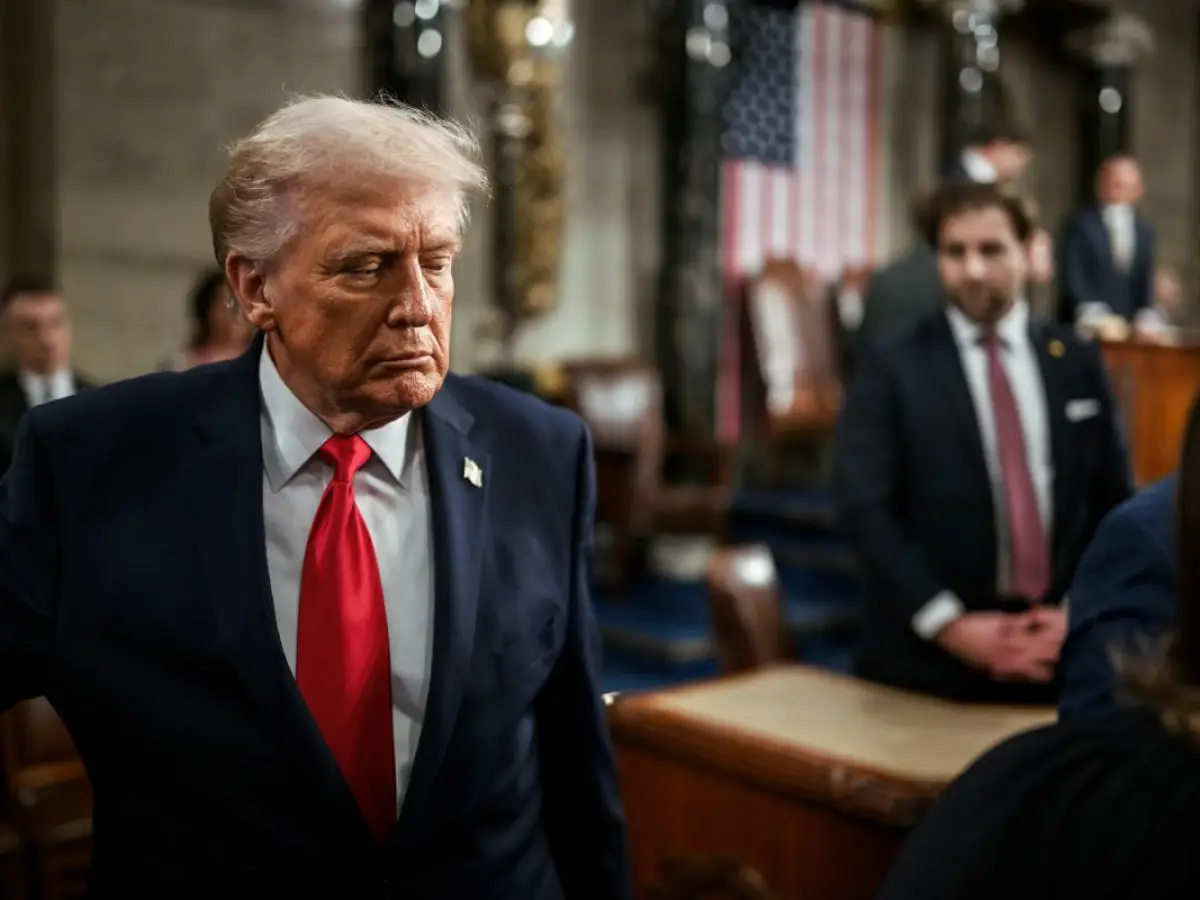
Cover: President Donald Trump delivers his State of the Union address, Tuesday, February 24, 2026, on the House floor of the U.S. Capitol in Washington, D.C. Official White House Photo by Daniel Torok, via Flickr