


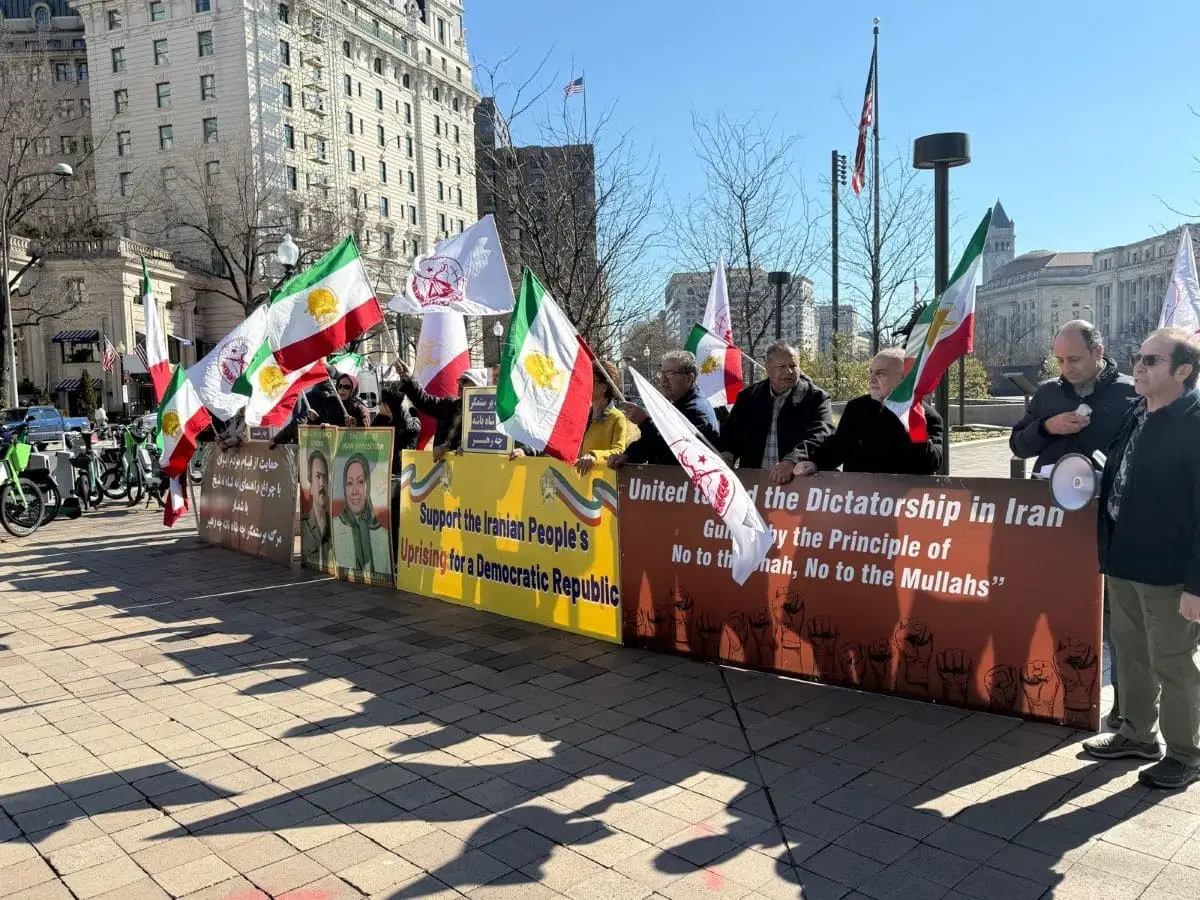

The peaceful weekend of the US capital, which woke up to its second day of war on a sunny Sunday, contrasts with the scenes seen in Tehran, Tel Aviv, and various capitals of the Gulf countries. Until Saturday afternoon, 28 February, many Americans strolling along the National Mall seemed unaware that the conflict had begun. “Really? I missed that,” says Kara Johnson, 58, from Virginia. “We’re safe here though, aren’t we?” Near the White House, small groups of demonstrators gathered with placards calling for peace in Iran and Palestine, though Lafayette Square, long a symbolic stage for political protest, is currently closed for renovation works.
“Trump went to war without Congress authorising it. Iran is a theocratic dictatorship and needs to go, but democracy has little to do with this. It’s just another move to distract us from the Epstein files,” says Mark from Maryland, clutching a cardboard sign reading “peace”. Along the sun-drenched National Mall, citizens continue their jogs and strolls. Their comments are more ironic or misinformed than aware of the fact that their country is once again at war. “The Empire Strikes Back!” quips a man in his sixties, declining to give his name. “We’re worried about our troops stationed at the bases. There have been numerous attacks involving Iranian hypersonic missiles,” says Jeff, a US defence consultant visiting Arlington Memorial, the military cemetery in Washington, with his relatives.

At the corner of Pennsylvania Avenue and Pershing Park, activists from the NCRI, the National Council of Resistance of Iran, have assembled. The left-leaning political coalition in exile, founded in 1981, opposes the Islamic Republic; its most influential faction is the People’s Mojahedin Organization of Iran (PMOI/MEK). “We are the democratic alternative to the regime,” says Tara Shafiee, a feminist activist whose family has suffered killings and persecution under the ayatollahs. “My cousin was shot in the head, and my husband, who is a footballer, had to flee the country.”
The hope is for a provisional government of national unity that would pave the way for elections. Yet the path ahead is far from clear. “We don’t know what might happen, and we have little trust in the Shah’s son, Reza Pahlavi.” With the death of Ali Khamenei, new scenarios are opening up. But Khamenei is no Gaddafi or Saddam Hussein: the power of the Revolution is deeply entrenched and highly organised. “Breaking the grip of the IRGC [the Islamic Revolutionary Guard Corps] will not be easy.”

Meanwhile, the decision to strike Iran has prompted accusations of a constitutional breach for launching a war without congressional authorisation. Many Democrats and at least two Republicans on Capitol Hill have reacted to what Trump himself has described as “major combat operations”, careful to avoid the word “war”, and Congress is expected to vote on whether the country should enter into such a conflict. It was under these circumstances that the attack on Khamenei was launched by Israel, acting on intelligence from US sources.
Asked by NPR radio how much notice the Trump administration had given Congress, Democratic Senator Tim Kaine replied bluntly, “Zero. The evidence suggests that the secretary of state called the speaker of the House, and that was it. We did not receive notice”. Yet another attempt by Donald Trump to expand presidential authority, at a time when he seems more preoccupied with making sure his face appears on all the posters marking the 250th anniversary of Independence (his face is also featured on cards and tickets issued by the National Park Service). For New York Mayor Zohran Mamdani, “Americans do not want this. They do not want another war in pursuit of regime change. They want relief from the affordability crisis. They want peace”.

The energy outlook
In the coming days, oil and gas prices are expected to soar. That, at least, is the view shared by most commentators across American networks. With markets closed until Monday, 2 March, a sharp rise in fossil fuel prices appears all but inevitable (oil has already increased by ten dollars since January), even though years of US sanctions have resulted in Iranian oil exports no longer constituting a significant share of global supply. The more pressing concern is the Strait of Hormuz, where all the oil and LNG from the Gulf passes through. On the evening of Saturday, 28 February, the Iranian authorities announced that they would close the passage to all ships. Moreover, in the last few hours, Saudi Arabia and other Gulf countries have been considering whether to enter the conflict. Meanwhile, Opec+ has announced that it will increase oil production in an attempt to calm the markets, following the confirmation of the killing of Ayatollah Ali Khamenei.
Kevin Book, research director at ClearView Energy Partners, a Washington-based consultancy, told the Financial Times, "The US SPR [strategic petroleum reserve] still has plenty of oil to flow in an emergency, but when it comes to strategic stocks, duration matters. Scale does, too. A full Hormuz crisis could outstrip offsets provided by strategic stocks in the US and International Energy Agency members".
This is a matter of serious concern for Europeans, and not just because of oil. Ana Maria Jaller-Makarewicz, Lead Energy Analyst at the Institute for Energy Economics and Financial Analysis, explains the economic consequences of the conflict in Iran (you can read a full interview with her in the next issue of the Magazine, out on 12 March) "A further escalation in conflict that disrupts delivery of Qatari LNG could cause Europe to import 65% of its LNG from the US this year. European gas storage levels are relatively low at around 30% of capacity, so record LNG imports - again from the US - will be needed to refill storage. Price-wise, Europe’s TTF gas hub will see volatility increase dramatically and prices could jump to 2022's record values. It is clear Europe’s energy security once again could be jeopardised by supply disruptions, increased import dependency, price volatility and market uncertainty”.
There remains only one solution to the fossil fuel risk: replacing gas consumption with renewable energy and energy efficiency is essential to reducing dependence on LNG imports. To withstand ayatollahs and erratic presidents alike.

Cover and in the text: photos ©E.Bompan