


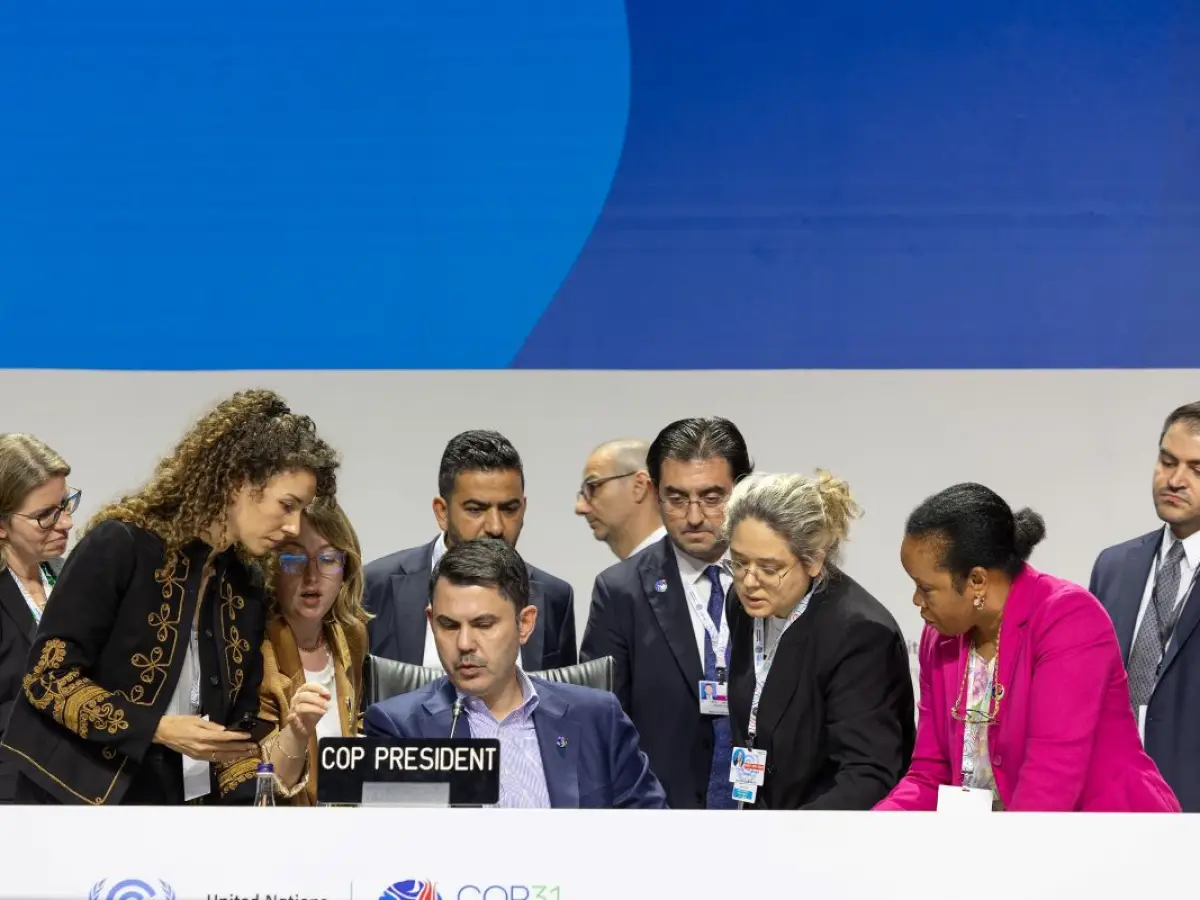

There is no doubt about it this time. Seventeen years after COP15 in Copenhagen, the 31st United Nations Climate Change Conference has failed to produce any political outcome, a clear and indisputable failure. After nearly 48 hours of delays and utterly disastrous management by the Turkish and Australian presidencies, COP31 concluded in the late afternoon of Sunday, 22 November, in Antalya, Turkey, with a total rejection by a large majority of its main political text, the Cover Decision.
The island nations, the European Union, the countries of Latin America and the developing countries rejected the document proposed by COP President Murat Kurum. No references to the transition away from fossil fuels; insufficient references to the IPCC report ahead of the next review of the Paris Agreement’s progress (the Global Stocktake); too many concessions to the oil and gas sector, particularly regarding all CO₂ capture and storage technologies; no roadmap to halt deforestation; and no clear commitment to electrify 35% of energy consumption from clean sources by 2035.
“It is unacceptable to have a climate agreement that makes no reference whatsoever to fossil fuels, nor to the transition away from them,” said Darragh O’Brien, the Irish Minister for the Environment, putting an end to any attempt to reach an agreement: “The European Union is firmly opposed to this text.” O’Brien, whose country holds the European Semester, has effectively put the final nail in the coffin of the Antalya negotiations.
The mistakes were many – far too many – starting with the dual chairmanship, which immediately displayed excessive confidence and arrogance in managing the political agenda. It underestimated both the uncompromising stance of the oil-rich states (Russia and Saudi Arabia above all) and the determination of ministers such as Juan Carlos Navarro of Panama, who described the text as insufficient to maintain the target of limiting global warming to 1.5°, and negotiators such as Kathy Jetn̄il-Kijiner of the Marshall Islands, who declared in the plenary session: “We will not be forced to accept bogus solutions. We will not jeopardise our future to serve the interests of fossil fuels”.
Among the key issues where agreement fell through, the decisive factor was the lack of consensus on declaring, once and for all, the original sin of climate change: the role of oil, gas and coal. Following the presentation of the Transitioning Away from Fossil Fuels plans by the Brazilian COP30 presidency, based on scenarios from IRENA, there was no opportunity to include a specific clause on the transition. Instead, the text merely reiterated what had already been decided in Dubai in 2023, without providing the Parties with guidance on a genuine strategy for transitioning away from fossil fuels. The oil-producing nations, on the other hand, called for the inclusion of an “aspirational” target of 1 billion tonnes per year for carbon capture, utilisation and storage (CCUS) – a costly technology that currently lacks sufficient scale, which oil-producing countries are promoting as a substitute for phasing out the use of fossil fuels. For the least developed countries, the red line was the absence of a framework and an implementation plan to triple funding for adaptation, essential for the nations most exposed to the impacts of climate change.
A failure in mitigation and adaptation
Just as serious is the failure of the Mitigation Work Programme (MWP), the only formal agenda item dedicated to mitigation within the UNFCCC. The Parties will revisit this issue at the next session in Addis Ababa. The MWP’s mandate to urgently scale up ambition and implementation on mitigation during this crucial decade, in order to balance the global budget – while remaining non-prescriptive, non-punitive, facilitative and respectful of national circumstances – has long been at the centre of disagreements.
The draft COP31 decision had recognised that the MWP should provide Parties with an opportunity to review and share their strategies, taking into account the outcomes of the global stocktake to guide nationally determined contributions, yet respecting their nationally determined nature. During the negotiations at COP31, the Parties had begun to converge on certain changes to the calendar of events under the MWP and on the desire to establish a multi-year work plan structured around broad themes to be implemented during the period 2028–2030. Yet, not even on this was there any consensus.
The slow progress on the Global StockTake (GST) – the five-year review of climate progress launched in Antalya and due to be presented at COP33 – is also a factor. The debate over the characteristics that Nationally Determined Contributions (NDCs) should have remains unresolved (it has been pending for years) amongst countries such as the United Kingdom, the European Union, small island states (AOSIS) and least developed countries (LDCs), who argue that further guidelines are needed to make the NDCs more comprehensive, ambitious and consistent with the findings of the first Global Stocktake; and those who do not, such as the Arab States, which have now become a real stumbling block in the negotiations. Without the GST serving as a genuine guiding compass, the NDCs are not truly effective for mitigation.
Progress on adaptation has been slow. The Adaptation Fund is moving to the Paris Agreement with a new board of directors, but the transition will only be finalised once the first revenues from Article 6.4 on carbon markets are received. On the Global Goal on Adaptation, the technical task force has been set up to operationalise the 59 Belém indicators. The Baku Adaptation Roadmap continues with workshops and a synthesis at CMA10 (2028). On Article 2.1(c), there is only a minimal decision. The real crux of the matter – tripling adaptation finance by 2035 – emerges weakened: no base year, no methodology, no roadmap. No decision has been taken on National Adaptation Plans: the matter will be revisited in June 2027, with a view to COP32.
COP32 and the future of the negotiations
Antalya will leave us with a bitter taste in our mouths, just as happened in Copenhagen in 2009 and in Madrid in 2019. These events highlight the overall geopolitical complexity and the struggles of multilateralism in a world where the US is a clownish state focused on gas exports and AI; China refuses to assume the global leadership it truly deserves beyond photo opportunities; and Europe remains a collection of states rather than a strong, cohesive federal entity, lacking alliances with satellite countries between the Mediterranean coast and Russia to the east. The United Nations, the true global model to which we should aspire, remains weak and under attack from all sides. As Jacopo Bencini, in his capacity as president of the Italian Climate Network, stated, “COPs are always part of a broader political landscape, and this time the verdict came from outside: Shenzhen has effectively killed off Antalya”, referring to the China-US-Russia trilateral meeting held on 19 November.
If, at a global level, we need a new political and civil class that can truly revitalise the United Nations and the mechanisms of cooperation and multilateralism, then we need a reform of the COPs to restore them to their original spirit, in which, rather than selfie-taking photo opportunities and displays of corporate power, we return to genuinely discussing policy and finding new, more efficient mechanisms. Fewer trade fairs and exhibition halls, more negotiation. This includes reforming the presidencies (the fact that the process depends so heavily on the current chair poses a political risk, as demonstrated by the incompetent Murat Kurum), rethinking the consensus-building process, and simplifying procedures, as the implementation of the Paris Agreement today risks becoming excessively convoluted and diverting attention from the three key pillars: mitigation, adaptation and finance.
The reunification of all environmental negotiations remains essential, given the interconnections – at least between the three Conventions (climate, biodiversity, desertification) and UN Water – and this work is indispensable. And, finally, the review by 2030 (the date for the relaunch of the Sustainable Development Agenda) of the long-standing division between industrialised and developing countries, a real sticking point in climate ambition. On this issue, the forum must be the G20 and the United Nations, and joint leadership is needed from Europe, the US, China, India and Brazil.
The next two-year election cycle will be a veritable battleground for the climate: the United States, Italy, France and Turkey. Every vote will count in shaping the political direction of the COPs, ultimately remaining in the hands of the citizens. The absence of political leadership, including Meloni’s distracted approach, at COP31 was the hallmark of its failure. Given the centrality of the climate to the future of humanity, no head of state should fail to attend the high-level segment of the negotiations or the concluding session. Politics and the media are essential, alongside civil society, for keeping the process at the heart of the agenda. Without them, the Paris Agreement remains nothing more than a fine document for posterity – and all three were missing in Antalya.
Cover: photo by Kiara Worth © UN Climate Change