



It is hardly news that China has long been at the top of the global clean-tech manufacturing league. According to the latest IEA figures, between 60% and 85% (depending on the supply chains) of manufacturing capacity for energy transition technologies is concentrated in the People’s Republic, from solar panels and wind turbines to batteries and electric vehicles.
Less widely known, however, is how much Chinese clean-tech exports help cut greenhouse gas emissions beyond China. In 2026, based on data from the first three quarters of the year, Chinese technologies sold worldwide will prevent globally a full 2% of the emissions that might otherwise have been generated by fossil fuel consumption.
This is the finding of Lauri Myllyvirta, lead analyst at the Centre for Research on Energy and Clean Air (CREA), in a study commissioned by Carbon Brief and published just days before the opening of COP31 in Antalya.
Myllyvirta estimates that, if the trend recorded up to October continues, as seems likely, Chinese exports will have prevented 450 million tonnes of CO₂ emissions by the end of the year, roughly equivalent to Brazil’s annual emissions. Take a longer-term view, however, and look at the savings over the entire lifetime of all the equipment exported, and the figure rises to 8.4 billion tonnes of CO₂ avoided, equivalent to the combined annual emissions of the United States and India.
Another piece of good news is that the greatest benefits are being felt in countries across the Global South, where Chinese technologies are proving to be the most important driver of decarbonisation.
The figures behind China’s exports
Myllyvirta’s analysis estimates how much fossil fuel consumption has been avoided, and how many emissions have consequently been saved outside China, thanks to exports across the four main clean-tech sectors: solar, wind, EVs and batteries. A similar study was carried out in 2024, when the reduction in CO₂ emissions was estimated at around 1%. Today, that figure is 2%: the positive impact of these exports has grown by 26% over the past year, following a further 36% increase in 2025.
Looking at it in more detail, Chinese exports of electric cars and heavy-duty vehicles (buses and lorries) rose by 61% in the first three quarters of 2026, while wind turbines were up 45%, batteries 39%, solar PV 22% and electric two-wheelers 21%. Exports of wind and solar technology in 2026 alone will make it possible to generate, each year, an amount of electricity (800 TWh) equal to that produced by one hundred coal-fired power plants.
Where emissions are avoided the most
Perhaps the study’s most interesting finding is that the biggest gains in decarbonisation occur in emerging economies across the Global South. As early as 2025, 73% of the emissions avoided (over the entire life cycle of the equipment) thanks to Chinese technologies were in countries of the Global South, which in 2026 accounted for 87% of the increase compared to the previous year.
South Asia has seen the greatest reductions in emissions, but the trend can be observed across the world, including in North America. Indeed, when individual countries are considered, the United States ranks second only to India in terms of emissions avoided thanks to clean technologies imported from China. In 2026, the figure rose by a further 12%. Above all, this is due to solar technology, whose exports from China to the US rose by 13% in the first three quarters of 2026, despite Trump’s tariffs. “The resilience of Chinese clean-tech exports to the US indicates strong demand for the technology, despite the Trump administration’s steps to slow down deployment and discourage imports”, notes Myllyvirta.
Markets and overcapacity
China may dominate global clean-tech markets, but it is worth remembering that most of its production is still destined for the domestic market. In 2025, China exported only 43% of the solar cells and panels, 13% of electric vehicles, 17% of batteries and 7% of wind turbines it manufactured. As for the solar sector, however, exports continue to grow (partly due to a slowdown in domestic sales in 2026), which is causing some concern among other players in the global market, who fear being replaced by the People’s Republic’s unrivalled production capacity.
When it comes to concerns over Chinese overcapacity, not just in solar PV but across the clean-tech sector as a whole, the report offers some reassurance: “most of China’s clean-energy exports have been built on new or expanded markets, enabling other producers to maintain their own sales volumes”. In fact, Myllyvirta suggests, challenging a certain “sinophobic” narrative, Chinese exports may actually have helped expand the market, creating opportunities for other players too.
“One key question [...] is: are China’s exports additional, or are they simply displacing exports from other countries in a zero-sum dynamic?”, the researcher writes on his LinkedIn profile. “Analysis of clean-tech trade suggests that China's exports have generally been additional, meaning they have not displaced exports by other producers but rather captured or enabled market growth for these clean-energy technologies. For example, the value of EV exports from other countries has grown much more than those from China, led by the EU27 – particularly Germany – as well as Mexico, Japan, the UK and South Korea. Similarly, there has been growth in the value of exports of heat pumps, solar inverters and electrolysers from both China and from other countries.”
In short, rather than seeing China's unstoppable clean-tech expansion as a threat, we should recognise it as an ally, both for decarbonisation itself and for the development of the global industry that goes with it.
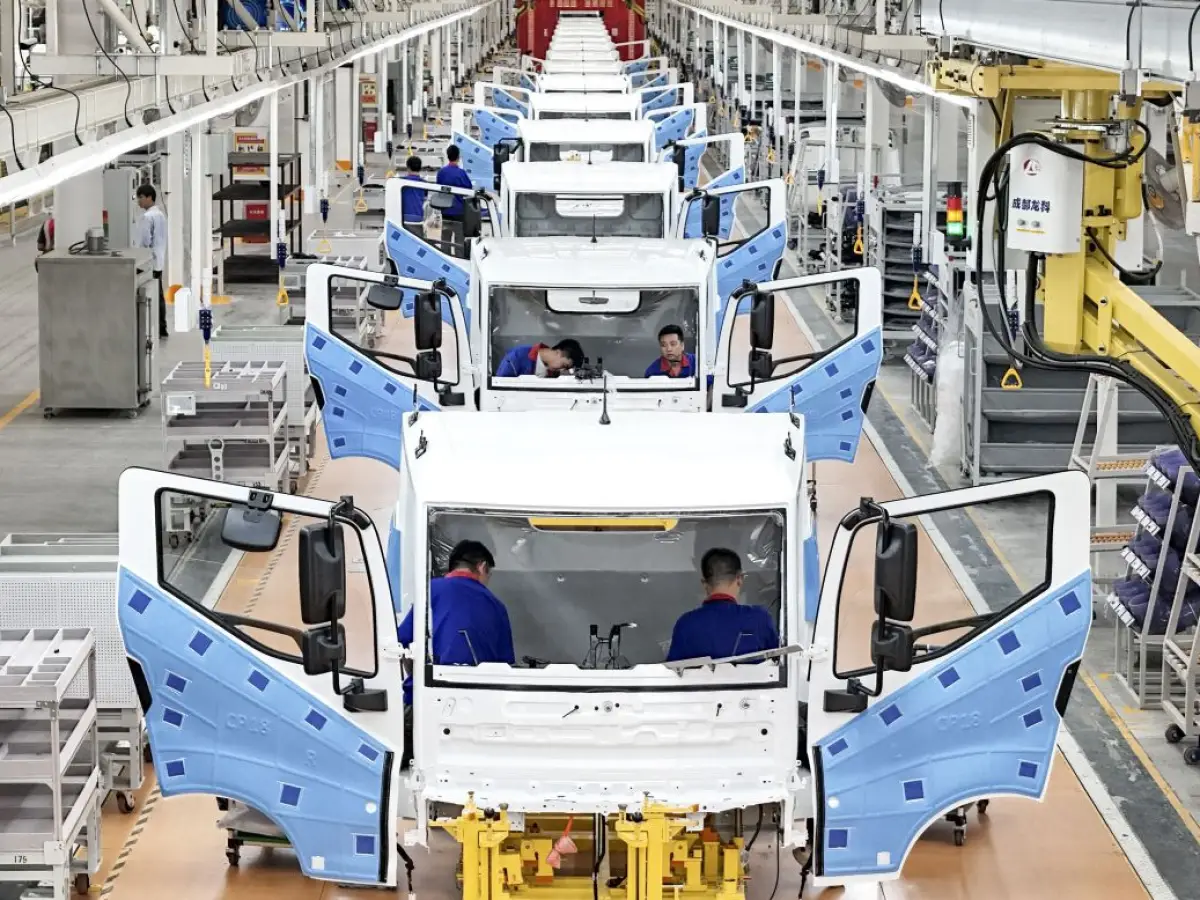
Cover image: workers on the assembly line for electric trucks at Jiangsu Auto Manufacturing, a BYD subsidiary specializing in commercial vehicles, in Huai'an, Jiangsu Province, eastern China © Karry Zhao/Utuku/ROPI, IPA Agency