


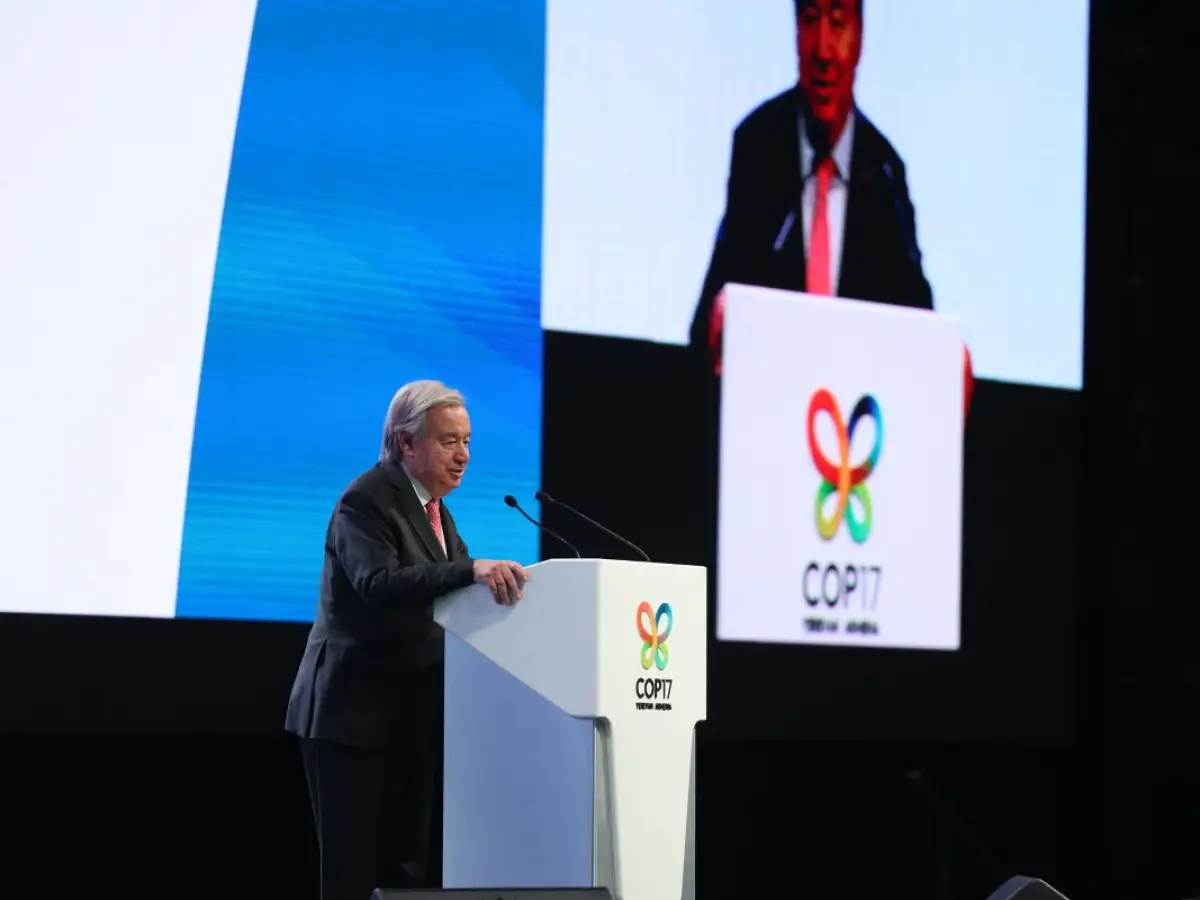

Fewer than half of national biodiversity targets are on track. This is the most significant finding in the report State of Biodiversity Action, presented on 15 October in Yerevan by United Nations Secretary-General António Guterres. This document is crucial for guiding the biodiversity negotiations at COP17, which began on Monday 19 October and will run until 30 October in the Armenian capital, Yerevan.
The State of Biodiversity Action is the first global assessment of progress on the Kunming–Montreal Global Biodiversity Framework, adopted in December 2022 with twenty-three targets for 2030 and four milestones for 2050. It is the cornerstone strategy for biodiversity protection, effectively nature’s Paris Agreement: nearly two hundred countries signed it four years ago.
“It’s not all bad news; there is also some positive news in the report,” Guterres told journalists covering the press conference. “For example, there has been a great deal of progress, even if it is not enough.” It will now be up to the participants in the COP17 negotiations to raise the level of ambition.
Many commitments, few results
Halfway through the process, formal participation is widespread. Almost 90% of the 196 Parties to the Convention on Biological Diversity have set national targets, around 60% have updated strategies and action plans, and over 70% have submitted national reports. Indigenous peoples, local communities, sub-national governments, businesses and civil society have registered around 5,000 grassroots commitments to actions aimed at protecting and restoring nature.
But commitment has not been followed by implementation. National targets cover, on average, 22 of the 23 global targets, but often only partially. Many countries promise positive incentives, but few are committed to reducing harmful subsidies, as called for by Target 18: the commitment is to cut them by $500 billion a year by 2030, and progress has been slow. Target 3, known as 30by30 – the protection of 30% of land and seas by 2030 – also remains a long way off.
Then there is the issue of financial resources. The State of Biodiversity Action report notes that developed countries are failing to bridge the “biodiversity finance gap” of $200 billion.
Initiatives aimed at supporting this objective are facing difficulties: a special “framework” fund for biodiversity has received less than $140 million from developed countries over the past two years, while the “long-standing” Cali Fund on DSI (on the use of digital sequences relating to genetic resources) has raised just $6,000 from private companies. Private individuals are the ones trying to bridge the gap. The Species Recovery Donor Alliance, composed of nine donors, including the Bezos Earth Fund set up by the founder of Amazon, has pledged to invest $500 million by 2030 to support the recovery of endangered species in over one hundred countries, as announced by Cristian Samper, managing director and head of Nature Solutions at the Bezos Earth Fund, at the Leaders’ Summit held on the sidelines of COP17. The availability of funding – or the lack thereof – will be one of the main points of contention in the COP17 negotiations.
Among the financial priorities, the report highlights the reform of harmful incentives, sustainable production and consumption, more rigorous corporate reporting on their impacts and their dependence on nature, and investment directed towards conservation and restoration. According to UN data, for every dollar invested in protecting or restoring nature, around 30 end up in activities that degrade it. “The report shows that many of the elements critical to progress, including finance, capacity, cooperation and data, are still missing,” said Guterres. “Nature will not thrive good intentions alone.”
At a press conference, the Secretary-General was even more direct. “The key issue is [political and economic] influence.” That of the mining industry, certainly, but also agribusiness, which destroys forests, and intensive fishing – sectors that still have “too much influence to preserve their economic power” and use it to sway policy. The way forward, according to Guterres, lies with the market: “We must change the balance of power.”
“COP15 gave us the legal framework,” said Hambardzum Matevosyan, Armenia’s Minister for the Environment and incoming President of COP17. “COP16 advanced important mechanisms for its implementation. COP17 must now help us determine where we stand, what is working, where progress is falling short, and what must change.” According to Inger Andersen, Executive Director of UNEP, “we cannot tackle climate change, biodiversity loss and pollution in isolation”. Another proposal on the table is the Yerevan Pathway – a roadmap still under negotiation – aimed at accelerating progress towards the targets of the Montreal-Kunming Agreement.
No major technical negotiations are expected at the talks; rather, the focus is on tangible commitments from individual countries, ranging from nature conservation to the mobilisation of financial resources. “We know how far we have come,” concluded Astrid Schomaker, Executive Secretary of the Convention. “We know where the gaps lie. Now we must work together to fill them.”
Cover: António Guterres © CBD COP17 Yerevan