


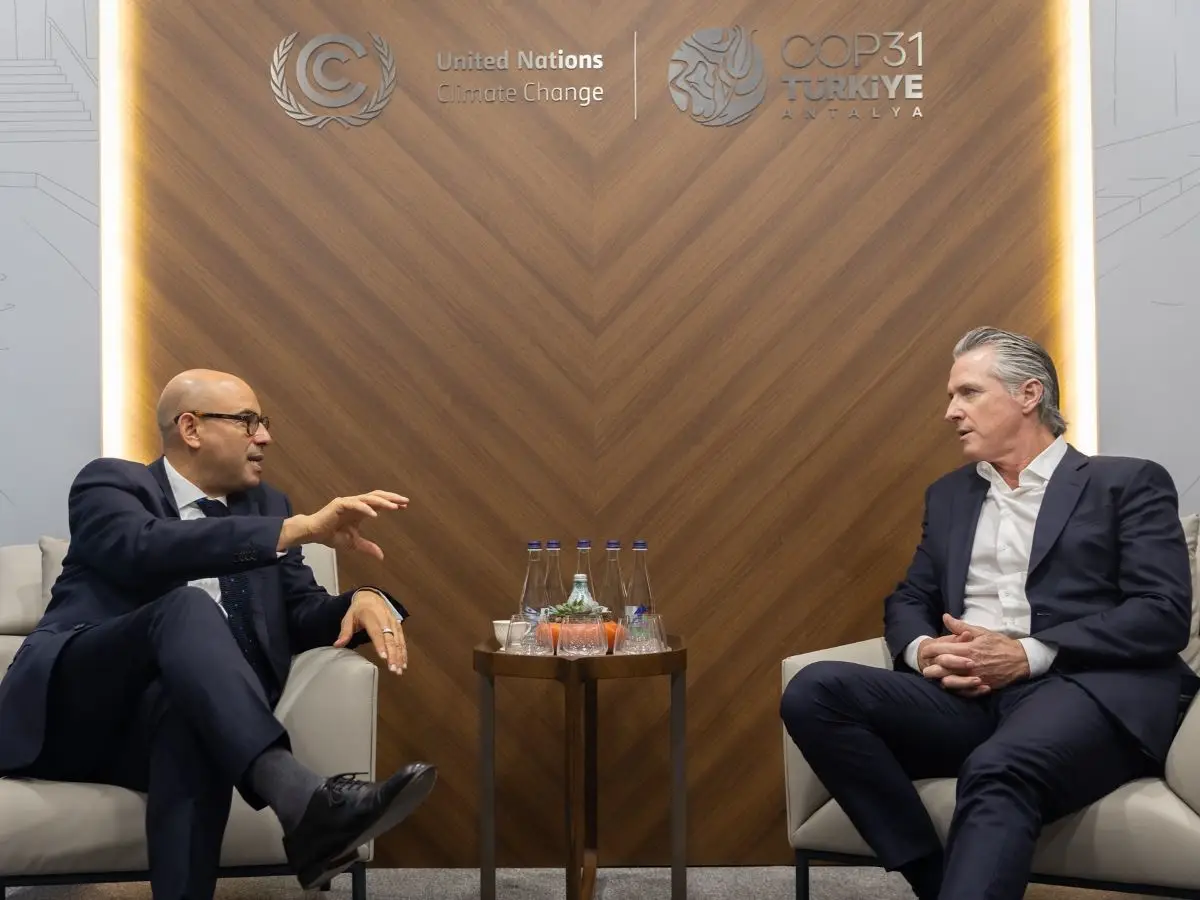

Antalya - If COPs are also judged by the politicians who attend them, the strong presence of US Democratic MPs is an encouraging sign for the future. The absence of an official US delegation at COP31 has turned the spotlight on “America Is All In”, a coalition comprising mainly governors, mayors, local officials and Democratic members of Congress, which brought around 120 delegates to Antalya (none of whom were Republicans).
The stage saw appearances by California’s Governor Gavin Newsom, a likely Democratic candidate for the 2028 presidential election; Minnesota’s Governor Tim Walz, Democratic vice-presidential candidate in 2024; as many as 18 newly re-elected Democratic lawmakers, such as Jared Huffman of the Natural Resources Committee, who has already announced a plan to investigate Trump’s energy and environmental policies; Kathy Castor (from Florida), who chaired the Special Committee on the Climate Crisis (2019–2022) and is a senior member of the Energy and Commerce Committee – the most influential committee on energy matters – and Mike Levin, one of the most active members of the Sustainable Energy & Environment Coalition (SEEC) caucus.
Moreover, the Democrats achieved a historic result in the mid-term elections, winning 260 seats in the House of Representatives and 56 seats in the Senate, crucial for providing full support on climate and environmental issues to a future Democratic presidency, thereby ensuring the US’s return to the Paris Agreement. “We fully understand that we have lost the international community’s trust on climate issues. Donald Trump pulled us out of this Agreement not once, but twice – a complete betrayal of our responsibilities,” said Arizona Democrat Yasmin Ansari at a press conference. “We will come back working 10 times harder, 50 times harder than we have before to ensure we are an integral part of the group, to guarantee not only that investments are made at a national level, but also to support small island developing states, vulnerable African nations and adaptation initiatives in Africa,” explained Ansari in response to a question on climate finance, brought to its knees by the US withdrawal from the Paris Agreement.
The Democrats are now preparing to attack Trump from all sides on the only front where they can deal a heavy blow to him and his family: corruption and insider trading. Not only with AI but also with fossil fuels. “Donald Trump’s obsession with big oil companies and the fossil fuel industry is synonymous with corruption,” Ansari continued. “Donald Trump and his family have significant investments in the oil and gas industry, particularly in gas sector shares. A war has been unleashed to generate record profits for oil and gas companies in the United States; therefore, as members of the House Committee on Oversight, we will focus on both corporate corruption and the Trump family.” In particular, the investigation will look into the request for one billion dollars from the oil and gas sector to fund the presidential campaign and what rewards the companies received in return.
“The midterm election victory represents a clear rejection of Donald Trump’s vision for the future, based on the dominance of fossil fuels,” adds Kathy Castor. “His climate denialism is the devastating blow to his energy and climate policy. Americans are calling for an economically sustainable way of life, a life full of well-paid jobs and economic opportunities, and a healthy lifestyle protected from the climate crisis.”
Data centres also feature in the agenda. Mike Levin, representing California’s 49th district in Southern California, has joined Castor in introducing a bill on data centres called the SHIELD Act, which sets out two main points. “Firstly: the average American consumer should not bear the costs of this massive expansion of data centres,” explains Castor. “These costs should be borne by the developers of data centres belonging to multi-billion-dollar tech companies. Secondly: all these data centres must use clean and affordable energy.”
At the local and state level, the United States has not reversed course. A report compiled by America Is All In and the University of Maryland’s Centre for Global Sustainability has found that current state policies, market trends and falling technology costs could lead to a 46% reduction in US emissions by 2035 compared with 2005 levels. The United States has already reduced emissions by almost 20%.
Cover: UN Climate Change Executive Secretary Simon Stiell meets with Gavin Newsom, Governor of California. Photo by Kiara Worth © UN Climate Change via Flickr