


September 2015: for the first time, Xi Jinping is received at the White House by Barack Obama. In Washington, climate and the energy transition are at the heart of a rare period of cooperation between China and the United States. In the joint statement, the two leaders describe climate change as one of the greatest threats facing humanity. Beijing announces the introduction of a national emissions trading system and a contribution of 20 billion yuan for developing countries. Washington confirms the Clean Power Plan, intended to reduce emissions from the US electricity sector. In the background is Paris: the understanding reached between Xi and Obama helps pave the way for the global climate agreement that will be signed three months later.
Ten years on, Obama is no longer in the White House. Donald Trump is. The Climate dossier has disappeared from the Oval Office, with no mention of it in the statements issued after Xi’s visit, his first since that distant 2015. After all, the former tycoon’s scepticism towards environmental issues is well known. Yet the paradox could hardly be clearer. Just as climate appears to be losing importance in bilateral relations, the technologies needed for the energy transition are becoming increasingly central to the economic and technological competition between the two superpowers: whoever controls batteries, panels, electric vehicles, materials and components controls a growing share of the infrastructure needed not only for the energy transition, but also for the development of cutting-edge industries.
The People’s Republic arrived in Washington with a clear lead in the production, deployment and export of clean technologies. Seven months into the war in Iran, the United States, by contrast, is facing rising energy costs and greater reliance on gas to power the infrastructure of the future. The provisional outcome of the summit has further strengthened China’s position across the entire supply chain: from critical materials, indispensable to the green economy, to artificial intelligence (AI), a sector in which the Asian country is rapidly closing the gap with the US despite the restrictions on advanced chip sales introduced by Joe Biden.
The White House announcement that “following President Trump’s revival of the US coal industry, China will import at least 10 million metric tonnes of coal” is a smokescreen. As reported on our website, the People’s Republic continues to regard this fossil fuel as a reserve rather than a primary energy source; over the longer term, it relies on renewables to reduce its dependence on overseas energy markets. This hope for greater self-sufficiency is based above all on control of raw materials. That control remains, once again, in Beijing’s hands following Xi’s visit to Washington.
The most tangible outcome of the bilateral meeting is undoubtedly the trade truce. Agreed last year in Busan, South Korea, and due to expire in November, it has been extended until 10 January. In doing so, China secured a further freeze on US tariffs and reductions on certain consumer goods. In return, it has implicitly promised (again) to ease restrictions on rare-earth exports, although the quantities and timing remain to be determined.
Setting aside its previous wait-and-see approach, Beijing responded to tariffs at the beginning of the second Trump administration by announcing restrictions on exports of critical materials. The agreement reached last year has so far covered only non-strategic sectors, while Beijing continues to exercise its right to restrict supplies intended for military purposes with a degree of discretion that has already prompted several complaints in both the United States and Europe. Time is on China’s side. Washington’s efforts to build a domestic industry will require not only massive investment. According to a 2024 S&P Global report, developing a new rare-earth project in the United States takes an average of almost 29 years from the initial discovery of a deposit to the start of actual production.
Further down, the Asian giant’s position is even stronger. According to a report by Atlas Public Policy and the Clean Power Information Project, updated in June 2026, the People’s Republic now accounts for 57% of announced global investment in the production of green technologies. In the first half of 2026 alone, that amounted to 16.7 billion dollars, more than three times the 5.2 billion dollars coming from the United States. As of May 2026, the Asian giant controlled 49% of installed solar capacity worldwide, 50% of wind capacity and 63% of global electric vehicle sales, even though the US market is shielded by tariffs of more than 100% and restrictions on cars using Chinese-made software. “No other country comes remotely close to these results,” Atlas comments.
This advantage takes on greater significance against the backdrop of the current dual energy crisis: the war launched by Washington against Iran has contributed to volatility in oil and gas markets, whilst the rise in demand for electricity driven by AI data centres requires new sources and stable infrastructures. The Trump administration is showing signs of struggling to manage both emergencies. According to polls, the inflationary squeeze could negatively affect the mid-term elections scheduled for November, while since January, protests in forty-two states have halted the construction of over a hundred data centres, which are even more unpopular than nuclear power stations due to their enormous consumption of energy and water. The former tycoon described it as “a sick conspiracy that only benefits China”.
On Friday 25 September, as Trump welcomed Xi to the National Archives, a bipartisan group of members of Congress introduced a bill seeking to ban Chinese components from data centres on national security grounds. But, according to Reuters, none of the US companies currently has the production capacity needed to replace suppliers from the People’s Republic. That is no small headache, given that the AI race is not only about who develops the best models, but also who can build the physical infrastructure needed to run them more quickly.
The new technology was one of the most widely discussed issues immediately before and during Xi’s visit to Washington. The statement released by Beijing on Saturday 26 September mentions it among the eight points on which the two sides reached agreement. Specifically, it refers to “establishing a China-US dialogue to exchange views on the risks and benefits” of AI, as well as establishing “channels of communication” ahead of the next talks, which “will be held in November this year”.
The announcement appears to confirm the creation of the technology-safety mechanism agreed by the two countries’ chief negotiators on the eve of the summit. Little is known about it so far but, according to experts, it could operate like the “hotline” established by the United States and Soviet Union during the Cold War. Several points remain to be clarified, beginning with the terminology: the Chinese readout refers to “rengong zhineng” (artificial intelligence in Mandarin) rather than “Super Intelligence”, the neologism coined by Trump and used by the White House. This terminological dissonance could nevertheless conceal deeper differences. Not only because of the ban on US advanced chip sales, frequently condemned by Beijing, an issue on which both accounts of the summit are silent.
As Kyle Chan, a researcher at the Brookings Institution, explains to Renewable Matter, “One of key differences between AI safety talks now and the nuclear arms negotiations of the Cold War is that back then both the Soviet Union and the US shared the same view of risks from nuclear weapons. But with AI, China and the US have seen risks differently”.
While debate in the US has focused on the capabilities of frontier models, national security and the risk of losing human control, the People’s Republic approaches AI safety through a broader lens: controllability, misuse, information integrity and social consequences. The defining feature of the Chinese approach is therefore the strong interdependence it assigns to development and security: two objectives that must proceed along the same track.
“An incident line could help the two governments communicate about emerging risks. It would not, by itself, answer who can examine a model while it is being developed. On that question, the approaches still differ”, explains Poe Zhao, an independent analyst and editor of the Hello China Tech newsletter. The main difference, according to the expert, “is who gets access, and when. Wider cooperation will remain difficult because AI safety is closely connected to competition over chips, computing power and advanced models”.
While cooperation will not be easy, one thing does appear clear: beyond the Great Wall, technological developments are beginning to trouble the Communist leadership. “Xi has long stressed the importance of human control over AI,” Chan tells us, adding that the Chinese president’s speech at the White House echoed his previous remarks at the World AI Conference in Shanghai this summer. “I don’t think they’re a reaction to recent developments in the US per se, such as the Hugging Face incident. Xi has been emphasizing the importance of human control over AI for a while now. I think it reflects both diplomatic posturing but also a serious concern about AI acting in unintended ways. So while China clearly wants to portray itself as a responsible actor to the world, there are genuine AI risks that Beijing takes seriously.”
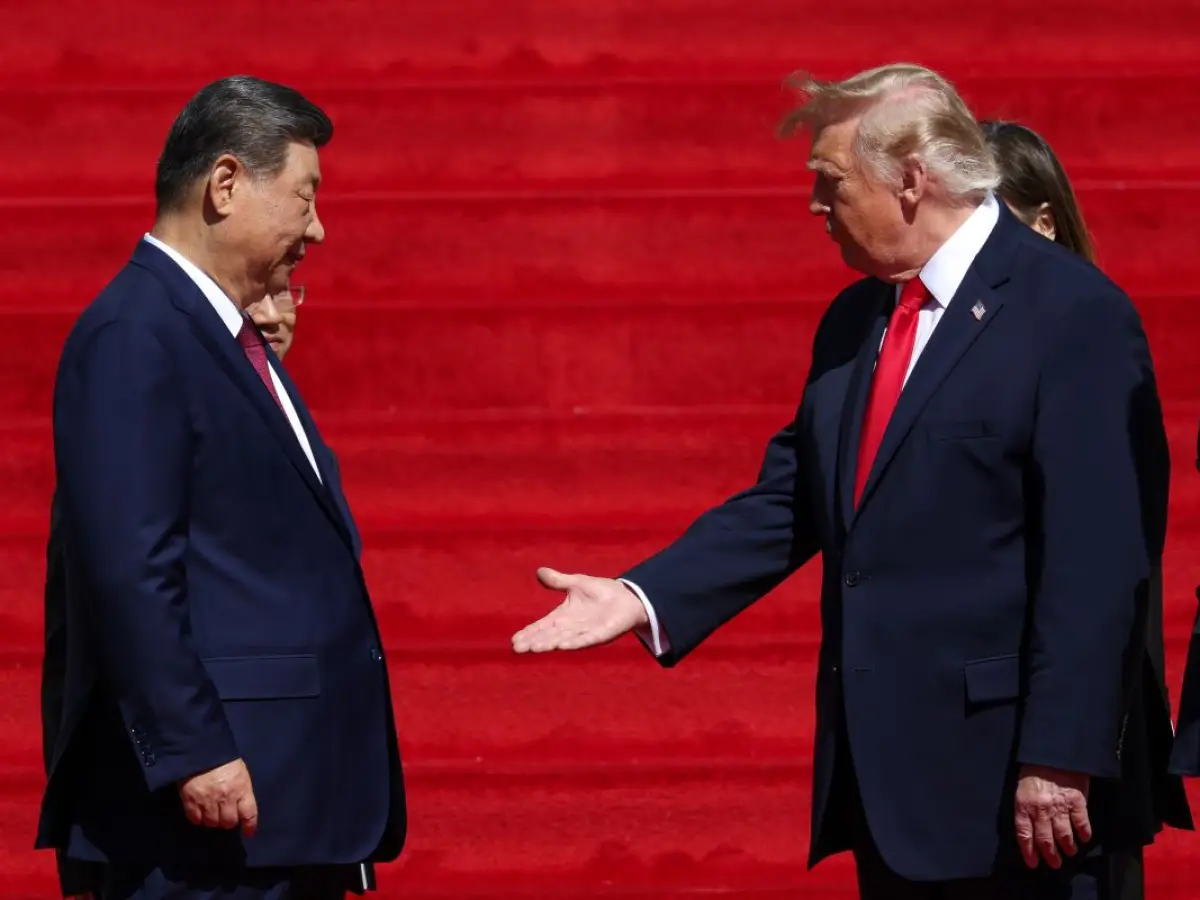
Cover: Chinese President Xi Jinping and U.S. President Donald Trump shake hands as they exit the building after a visit to the National Archives on September 25, 2026 in Washington, D.C. Photo by Samuel Corum/Sipa USA, Agenzia IPA