


In Sanskrit, the name Himalaya means “abode of snow and ice”. Unreachable and eternal, the glaciers of the Earth's tallest mountains were also considered to be the dwelling place of all Hindu and Buddhist deities: a sacred attribution that is anything but naive, considering that right up there originates the largest and most complex water system in the world, on which the lives of a large part of the Asian population depend.
The entire mountain system, including the western offshoot of the Hindu Kush, stretches over 3,500 kilometres in length, crossing eight countries – Afghanistan, Pakistan, India, Nepal, China, Bhutan, Bangladesh and Myanmar. It feeds the sources of ten of the continent's most important rivers: the Yellow River, the Yangtze, the Mekong, the Salween, the Irrawaddy, the Brahmaputra, the Ganges, the Indus, the Amu Darya and the Tarim.
Seasonal regimes and the flow of river basins that today provide essential services to about two billion people depend on the waters of the Third Pole, so named as it represents the third-largest mass of ice after the North and South Poles. But if the hydro-geological balance of the region has remained more or less unchanged for millennia, shaping economies, cultures and religions with its cyclical rhythms, climate change and melting glaciers are now disrupting the very basis of subsistence for the peoples of the area. And what was believed to be immutable and eternal suddenly appears uncertain, precarious and frighteningly vulnerable.
A fragile tower
Among the many monikers used to refer to the Hindu Kush Himalayas, the “water tower” of Asia is particularly intriguing: for scientists, it is an appropriate metaphor to describe its role in governing the balance of the basins downstream. Glaciers virtually function as a vault, collecting snow in the cold season and storing it in their own perennial ice reserve for centuries; then, in the warm season, a small part of this reserve melts and is released as meltwater into the rivers, which thus do not dry up.
It is a “buffer” mechanism in the hydrological cycle, preventing extreme conditions from occurring. And it is a promise of sustainability on which all human infrastructure and livelihood systems in this area have always relied upon, from drinking water supplies to irrigation of fields to hydroelectric power plants. However, with the accelerating retreat of glaciers due to climate change, that pact is now broken, and the water tower has begun to falter.
The peak water
How severe the consequences will be depends on several factors, such as the demographic weight in the region, the size of the water withdrawal, mining and industrial activities, and land use and degradation. Above all, however, the level of global warming that will be reached will be crucial. For a complete overview of the various scenarios that lie ahead, nobody does a better job than the researchers of ICIMOD, the International Centre for Integrated Mountain Development in Kathmandu.
“There are three main scenarios of global warming that we have identified for the year 2100, with the associated loss of Himalayan glaciers,” explains Neera Shrestha Pradhan, head of the Cryosphere and Water sector at ICIMOD, quoting the report Water, ice, society, and ecosystems in the Hindu Kush Himalaya (HI-WISE) issued by the Nepalese institute in 2023. “With a 2 °C global warming scenario, currently highly probable, 50% of the glaciers will be lost by the end of the century; with a 3 °C rise, a loss of between 55 and 75% will occur; while in the worst case scenario of a 4 °C rise, between 70 and 80% of the ice in the Hindu Kush Himalayas will disappear.”
Making matters worse, this disastrous path to water scarcity will not take a linear course, but will follow an inverted U-shaped curve, punctuated by extreme and unpredictable events. In a 2 °C increase scenario, ICIMOD scientists estimate that peak water will be reached around 2050. “It implies that up to that point, the melting of glaciers will lead to an excess of water in river basins, causing floods, inundations and other disasters,” explains Shrestha Pradhan. “Then, after the peak, the amount of water will drastically decrease, resulting in severe shortages, droughts, dried-up rivers and drained springs, with all the imaginable consequences for agriculture, energy supply and people's lives.”
Multi-risk scenario
Unfortunately, we will not need to wait to verify ICIMOD's predictions, for the first part has already begun to come true. Flipping through the pages of the HI-WISE Report, we come across a map of the Hindu Kush Himalayas on which the researchers have recorded all the disasters and extreme events related to the cryosphere occurred in the last decade, along with a macabre death toll: snow and ice avalanches, rock- and mudslides, detachment of glacier parts, and then the so-called GLOFs (glacial lake outburst floods), that is, a flood caused by frightening and sudden overflowing of glacial lakes. Connecting the dots, we can already glimpse what experts call a “multi-hazard” scenario, in which a single event can have widespread and often unpredictable cascading effects on an entire river basin.
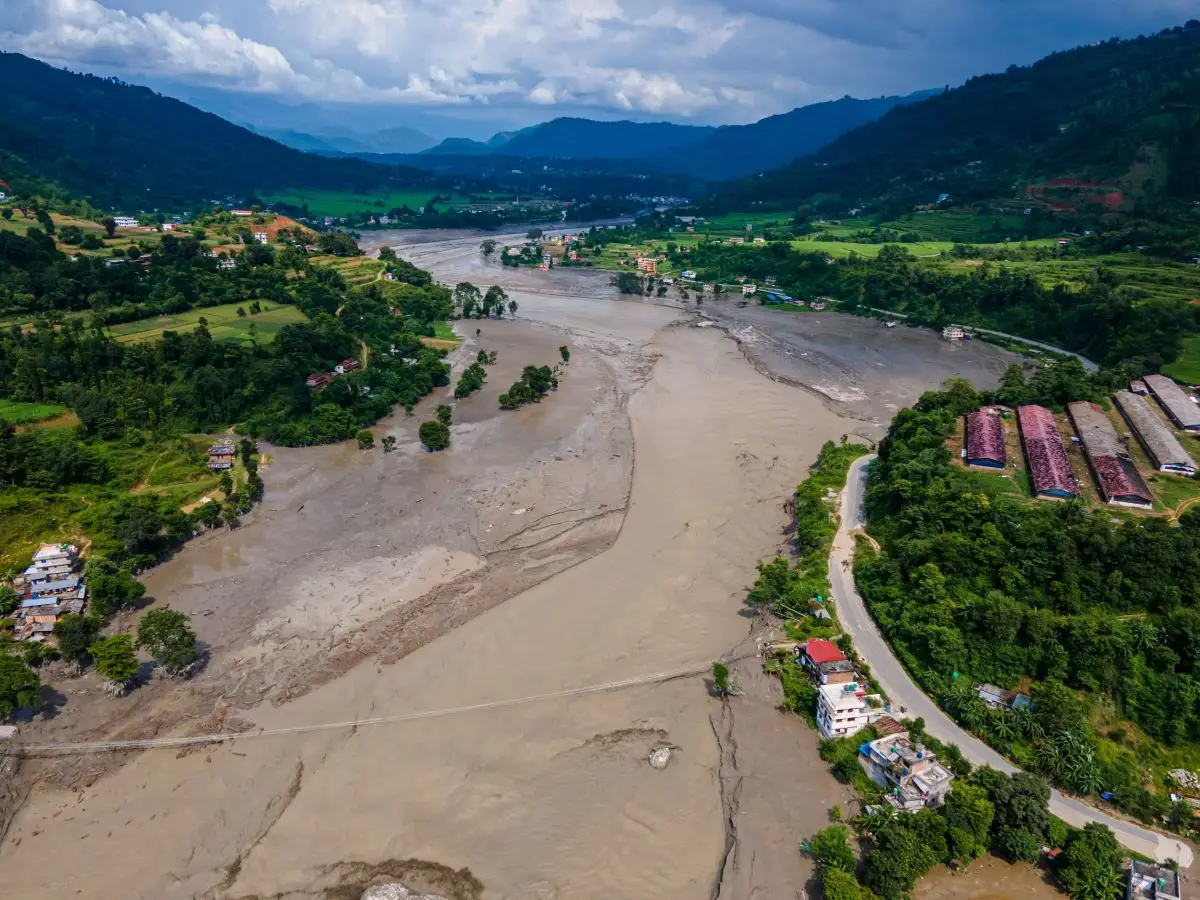
That is what happened, for instance, in June 2021 in the Melamchi River Valley in Nepal. The story has travelled around the world exactly because of the incredible and fatal chain of events that resulted in a catastrophic flood, with dozens dead, hundreds displaced, houses and infrastructure destroyed and fields razed. In short, an unusual temperature rise combined with particularly heavy rainfall led to a rapid melting of the snow, which, in turn, resulted in the erosion of glacial deposits and the sliding of moraine materials into the river downstream, thus triggering sudden floods. “A cascading disaster,” ICIMOD researchers conclude, “in which the combined impacts were much greater than the sum of the individual risks.”
Indeed, the frequency of such events is only going up: in the summer of 2025, several such events were reported, including the cross-border flood that originated on the Tibetan plateau due to the rapid drying up of a supra-glacial lake, and poured into the Nepalese district of Rasuwa via the Trishuli River, killing several people, damaging critical infrastructure and hydropower projects, and blocking trade along the Nepal-China corridor.
Resilience plans
Given that the goal of limiting global warming within 1.5 °C (also considering the unsuccessful outcomes of COP30) is now unrealistic, all that remains is to prepare for the loss of at least half of the Himalayan ice with resilience and adaptation plans.
For the Hindu Kush Himalayan populations, the issue of resilience is, as we have seen, already a matter of life and death. And that is the reason that much of ICIMOD's work on the “climate adaptation” chapter currently concerns risk management: warning systems; glacier, permafrost and watercourse monitoring; protective structures such as barriers or bioengineering solutions; and then education and awareness-raising.
“We have been working on early warning systems for communities for several years in India, Nepal, Bhutan, Bangladesh, Pakistan, and we also used to work in Afghanistan, but this is no longer possible,” says Shrestha Pradhan. “These systems can warn of the risk of flooding two to seven hours in advance, giving you plenty of time to get to safety.” Regarding infrastructure safety, ICIMOD is also working with the Water and Energy Commission Secretariat (WECS) in Nepal to develop guidelines to increase the resilience of hydropower plants and other facilities. “We are also very busy on the awareness-raising front, something that is often overlooked but which is crucial,” Shrestha Pradhan continues. “We have school programmes on disaster management. It is important that the youngest are prepared, as they are the ones who then ‘amplify’ the message, take it home and educate their families. And they will be the future leaders who will have to manage the greatest effects of the climate crisis, the long-term ones.”
While the risk of natural catastrophes is what most frightens the local populations presently, the long-term effects of the loss of Himalayan ice are what should worry most, and should already be alerting the entire world. The water shortage scenarios that lie ahead could, in fact, generate disputes and tensions over hoarding resources or controlling river courses. “But implementing management plans for entire river basins is extremely complicated, since several states would have to be included,” Neera Shrestha Pradhan points out. “We need transboundary governance mechanisms.”
The only one in force in the region, however, is the Indus Water Treaty, which has endured for over 60 years, but is now endangered by tensions between India and Pakistan. ICIMOD, on its part, has been carrying out a commendable diplomatic effort for years to keep the eight countries of the Hindu Kush Himalayas together and communicate. The greatest effort, however, should come from the governments themselves, for otherwise a scenario of wars over water will no longer be just a dystopia.
Cover: An aerial view shows flooding along the Bhotekoshi River affecting low-lying areas and settlements near the riverbanks in Nuwakot, Nepal, on August 26, 2026. Floodwaters reached residential areas and affected infrastructure along the river as emergency authorities continued to assess the extent of the damage and possible casualties. Photo by Ambir Tolang / JNA Press/Sipa USA