


Work continued late into the night: not usually a good sign in international negotiations, and indeed, on the eve of the negotiations, no one was betting on a successful outcome. Yet in New Delhi, in the midst of the global energy crisis triggered by the closure of the Strait of Hormuz, the BRICS bloc (which brings together the world’s 11 largest emerging economies) stunned observers by unanimously approving a joint declaration.
The document is very comprehensive, covering everything from security in the Middle East to the protection of maritime routes, from ecological transition to the safeguarding of critical minerals, right through to the bloc’s strategic repositioning within the United Nations. Reaching a compromise between the positions of Brazil, China, India, Russia, South Africa, Iran, the United Arab Emirates, Saudi Arabia, Indonesia, Egypt and Ethiopia looked tricky, especially after previous summits had ended in deadlock.
Around the same table sat some of the heavyweights of the fossil fuel industry – Saudi Arabia, Iran and the United Arab Emirates, which, incidentally, are still embroiled in conflict with one another over Hormuz and the Bab el-Mandeb Strait – together with countries such as China and Brazil, focusing instead on electrification and critical materials. The summit included Washington’s allies, such as India and the Gulf states, and the United States’ long-standing adversaries, such as Iran, China and Russia.
“Global South is at the front row of global crises, but the back row of decision-making. We must turn the pyramid of privilege into a platform of partnership,” said Indian Prime Minister Narendra Modi at the opening of the proceedings. And the message seems to have been heeded: the final document, New Delhi Declaration: Building for Resilience, Innovation, Cooperation and Sustainability – 140 points condensed into 45 pages – confirms, at least on paper, a united front: if not political, then certainly diplomatic.
Shaping the global order anew has become a necessity for many of its member economies, while the growing demand for representation and autonomy is a pressing need for the entire Global South. Whether it will actually work remains to be seen, and we will likely find out at the next test: the United Nations Climate Change Conference scheduled to take place in Antalya, Turkey, in November.
Towards a just, orderly and fair transition
Let us take a look at the details of the document relating to the energy transition. “We recognise that fossil fuels will continue to play an important role in the global energy mix, particularly for emerging markets and developing economies, and we recognise the need to promote just, orderly, equitable and inclusive energy transitions.”
Paragraph 64 of the joint statement is clear: the BRICS’s “path” to energy transition does not refer to net-zero targets or a phase-out. Phasing out fossil fuels, at least for now, is off limits, and the bloc’s position remains firm: the priorities must remain economic development and energy security.
The BRICS members represent a diverse mix of countries, united by growing energy needs, aspirations for industrialisation and development challenges. They cannot be expected to back any positions in support of the phasing out of fossil fuels. Considering that together they account for almost half the world’s population and around 40% of global GDP, if they remain united, climate negotiations at future COPs will inevitably be influenced to an ever-greater extent by the bloc’s positions.
Technology neutrality, therefore, is synonymous with the right to development. Gas, oil and coal will coexist with solar power, low-emission hydrogen, bioenergy and nuclear power, at the discretion of each member state, in line with its needs and specific circumstances. Simply spending a few days in the Gulf states is enough to understand what the transition means in this part of the world: preparation for the post-oil era involves investing in research, technology and renewables, but without giving up on extracting – and burning – hydrocarbons right down to the very last barrel.
After all, the money for the transition here comes from fossil fuels. All of this is supposed to happen “in line with our climate objectives and in compliance with Sustainable Development Goal 7, as well as the principles of technological neutrality and common but differentiated responsibilities and respective capabilities, taking into account national circumstances, needs and priorities,” concludes the paragraph.
No to unilateral tariff barriers
In Article 108, the document delivers a scathing attack and sets out in clear terms the bloc’s opposition to the West’s climate protectionism: “We oppose unilateral, punitive, discriminatory and protectionist measures that are not in line with international law, such as carbon border adjustment mechanisms, and express concern that such measures undermine efforts made by countries, particularly developing countries, to address the negative impacts of climate change, increase adaptive capacity and resilience.” The attack on the CBAM and the European Union’s green policies is clear.
The BRICS countries oppose the idea that a carbon border adjustment mechanism could negatively impact emerging economies, thereby affecting their competitiveness in global markets. In the bloc’s view, the imposition of customs duties linked to environmental criteria risks becoming a form of protectionism, ultimately widening the economic divide between the Global North and the Global South.
Critical minerals and supply chains
Defending the BRICS energy model inevitably also involves controlling the raw materials of the future. In paragraph 67, a section is devoted to the need to secure supply chains for critical minerals and rare earths that are “reliable, responsible, diversified, resilient, equitable, sustainable and just”.
The declaration clearly affirms absolute respect for the sovereignty of individual states over their own deposits, promoting local added value and opposing any attempt at a monopoly or external sanctions. This is the response to the warning issued by Narendra Modi against the “weaponisation” of resources that are fundamental both to the bloc’s electrification (which, driven by China, India and Brazil, already generates 51% of the world’s solar energy) and to logistical security, threatened by tensions surrounding the Strait of Hormuz.
“This, in some ways, could prove to be a more concrete commitment to decarbonisation than traditional emission-cutting goals. Who controls, produces and can access clean technologies and minerals needed for the transition will shape how quickly countries can switch from fossil-based to low-carbon infrastructure. The New Delhi Declaration shows that the BRICS countries have their eye on this larger goal.”
A counterweight to the West
A shared economic and development strategy seems to take precedence, at least for now, over rivalries amongst the BRICS nations. In 2020, India and China clashed violently along the disputed Himalayan border. Iran, the United Arab Emirates and Saudi Arabia still stand on opposite sides in the war in the Middle East, with Tehran having launched more missiles and drones at Abu Dhabi than at Israel. In New Delhi, however, for the first time since the start of the conflict with Iran, President Masoud Pezeshkian and the Crown Prince of Abu Dhabi, Khaled bin Mohamed bin Zayed, met face to face, while Chinese President Xi Jinping arrived in India for the first time since 2019. The reform of global governance is precisely the glue that binds the BRICS together, the force that unites such widely different partners.
Although it began primarily as an economic group, which brought together the emerging economies with the greatest growth potential, the bloc now presents itself as a possible alternative to the governance of a US-led West – one in which the law of the strongest would not prevail over cooperation. The most significant message that the New Delhi summit sends to international chancelleries is perhaps precisely this: a world governed by institutions and rules defined solely by Western powers, including on the energy transition, no longer works.
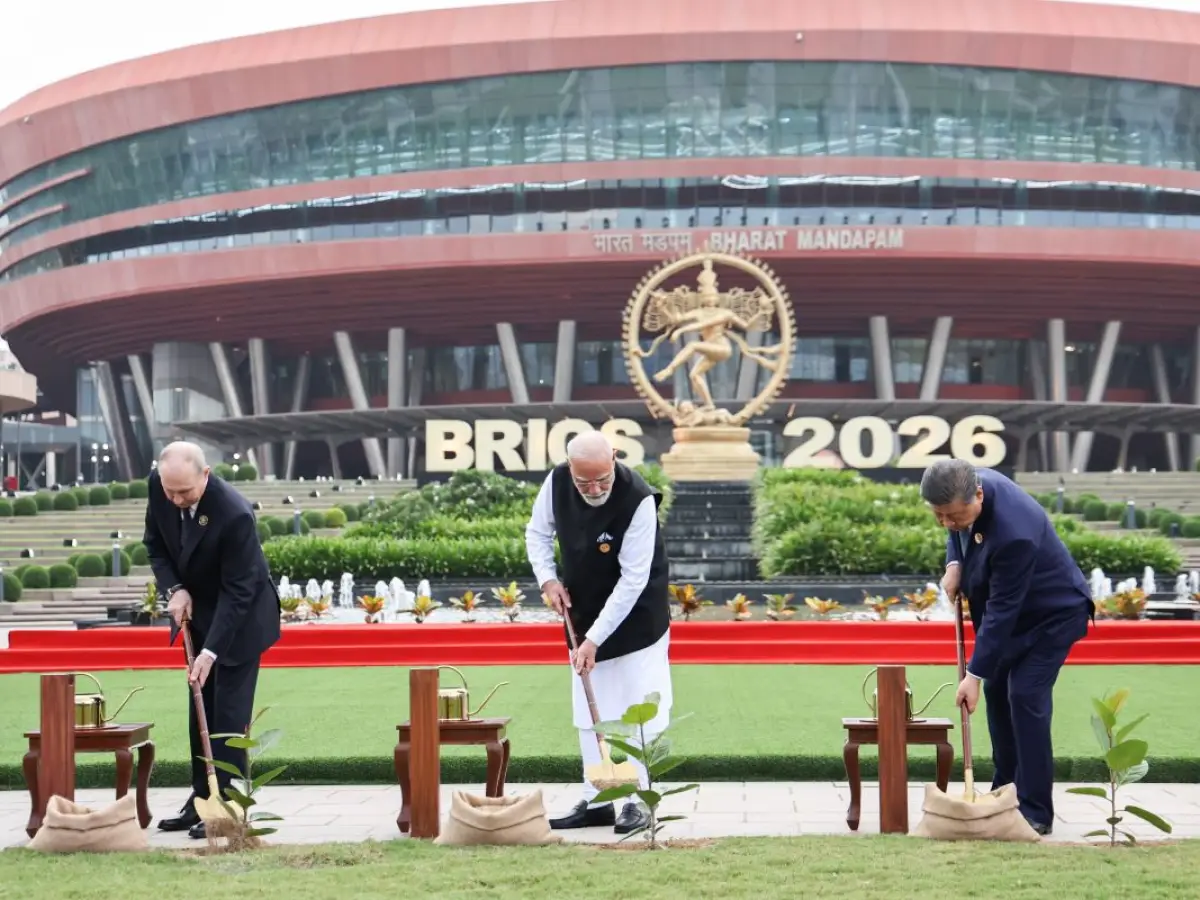
Cover: New Delhi, BRICS summit; Vladimir Putin, Narendra Modi and Xi Jinping plant trees to mark the 20th anniversary of the alliance. Photo by Alexander Kazakov/Russian Presidential Press and Information Office/TASS/Sipa USA, IPA Agency