


Global temperatures are likely to exceed 1.5°C above pre-industrial levels within the next few years, according to a new UNEP report, Limiting Overshoot, published today, 2 September. The threshold, established under the Paris Agreement, has long been a central benchmark in global efforts to limit the impacts of climate change. With warming now expected to breach it sooner than previously anticipated, the report highlights the growing challenges of keeping climate risks from escalating further and explores how to do so.
However, it is still possible to bring temperatures back down through an ‘overshoot, peak and decline’ pathway, which remains the best option for minimising the magnitude, duration and consequences of the peak – all of which remain uncertain and will depend on the measures we take and continue to implement now to tackle climate change.
According to the report, the most optimistic scenario puts peak warming at 1.8°C, while other scenarios suggest it could exceed 2°C. “There are no good outcomes if we remain above 1.5°C”, said Inger Andersen, Executive Director of UNEP, in a press release. “Across the globe, extreme heatwaves are already proving that climate impacts will strike faster, hit harder, and last longer − costing more lives and causing deeper disruption. Now is the time we must double down on climate action.”
The report reiterates the urgency of action, emphasising that this pathway is only possible if we act immediately. Every fraction of a degree of warming avoided will help limit the devastating consequences of the climate crisis, saving lives, reducing economic losses, protecting ecosystems and slowing biodiversity loss. However, even under the most ambitious pathways, some losses may never be reversed, and certain consequences, such as sea-level rise, will persist.
How to limit the overshoot
The prospect of human-induced global warming reaching or surpassing 1.5°C above pre-industrial levels carries severe consequences, yet the report reaffirms this threshold as the world’s long-term goal. Recent studies suggest global temperatures are rising by around 0.25°C per decade or more, with warming already at approximately 1.4°C.
The consequences range from ecosystem and biodiversity loss to more intense extreme weather, shrinking glaciers and rising sea levels, putting small islands and coastal cities at increasing risk from flooding and inundation. Recently, four record-breaking heatwaves during the European summer of 2026 are estimated to have caused at least 35,000 excess deaths, according to an analysis reported by The Guardian (with the figure likely to be much higher due to incomplete data). The consequences of a warming climate are also evident in the rapid loss of glaciers, while the recent disaster in Nepal highlights the human cost, with the death toll surpassing 1,000 and continuing to rise.
The global response needs to unfold across three interconnected phases. The first is an immediate response as temperatures approach and exceed 1.5°C. This means rapidly slowing the pace of warming through deep emissions cuts, including reductions in short-lived climate pollutants such as methane. Methane is a much more potent greenhouse gas than CO₂, but it remains in the atmosphere for a far shorter time, with an atmospheric lifetime of around 12 years. Urgent adaptation measures will also be needed to protect the most vulnerable people and ecosystems.
The second phase is coping and containment as temperatures peak. This will require deep and sustained decarbonisation to achieve at least net-zero emissions, while strengthening societies’ ability to cope with increasingly severe impacts and risks. The final phase is long-term resilience, as temperatures begin to decline and stabilise. It will require sustained net-negative CO₂ emissions, alongside efforts to strengthen sustainability and resilience and ensure lasting adaptation where irreversible limits have been reached.
Yet to limit overshoot, the three compounding challenges (reducing emissions and addressing impacts, limiting peak warming and managing risks, and sustaining decline and scaling adaptation) must be tackled in parallel. “For practitioners an overshoot pathway changes the rules of the game,” said Debra Roberts, Honorary Professor at the University of KwaZulu-Natal in South Africa and Professor at the University of Twente in the Netherlands. “Our plans and strategies need to be rapidly reconfigured to do more of everything: we need to overdeliver on mitigation, adaptation and finance all at the same time and do so over many decades. We need to put in place overshoot governance frameworks that drive integrated responses across all stages of the overshoot pathway that are developmental, fair and equitable and where success is measured in terms of human and ecosystem well-being.”
Adaptation and mitigation must advance together
One of the key messages of the UNEP report is that adaptation and mitigation, the two main responses to the climate crisis, are fundamentally interconnected and must advance together at every stage. Measures that can deliver both benefits should therefore be prioritised, such as expanding urban tree canopy or developing other kinds of Nature-based Solutions.
“Our response requires mitigation and adaptation to move together: near-term emissions reductions can limit overshoot and reduce harm, but inadequate mitigation will push communities and ecosystems beyond their ability to adapt,” said Joeri Rogelj, Professor of Climate Science and Policy at Imperial College London. Both measures will depend on stronger international cooperation, with countries aligning policies and institutions, sharing knowledge and technology, and increasing climate finance − a challenge at a time when multilateralism is moving towards a more fractured system.
The UNEP document also highlight the importance of carbon dioxide removal (CDR) strategies in bringing global temperatures back down later this century. These include established approaches such as ecosystem restoration and afforestation, as well as newer technologies such as direct air carbon capture and storage. Such measures will be essential, “but only alongside deep cuts in greenhouse gas emissions, never as a substitute for them”, stresses Joana Portugal Pereira, Professor at the Federal University of Rio de Janeiro and the University of Lisbon.
This is partly because even optimistic projections for the expansion of CDR are unlikely to lower temperatures by more than a few tenths of a degree this century, while facing uncertainty in scale, technology and physical feasibility. At the same time, the potential for CDR diminishes as the planet warms. Wildfires destroy forests and reduce their capacity to absorb CO₂, while rising ocean temperatures can degrade marine ecosystems and weaken their ability to store carbon.
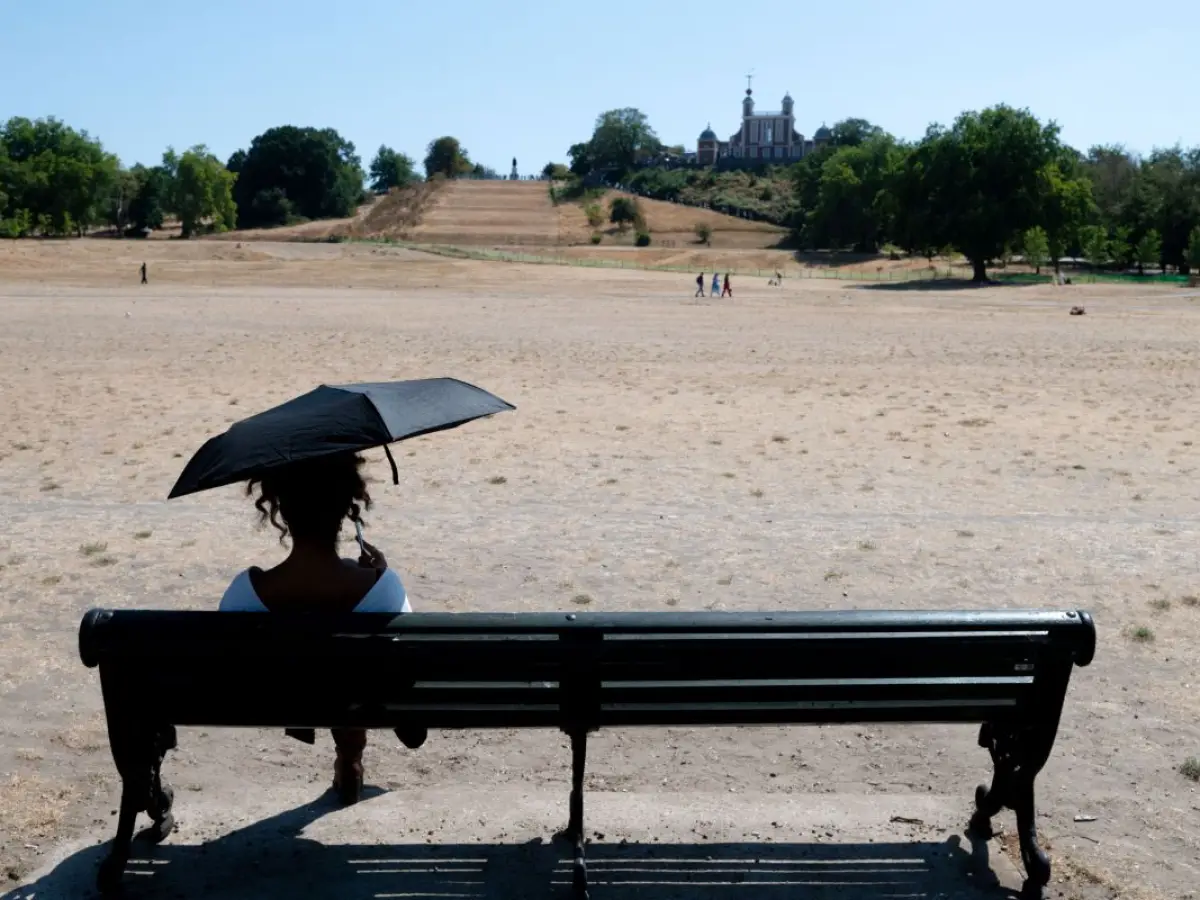
Cover: visitors seek shade beneath umbrellas in Greenwich Park, south-east London, as hot and dry weather continues across the capital amid drought conditions in parts of England. Photo by Thomas Krych, IPA Agency