





Many places in Europe have been contaminated by companies which, despite sometimes having been “ordered” to carry out remediation, fail to compensate residents for the damage caused to their health. In this investigative report, we look at three places we know closely, or even live in, where legal proceedings have been initiated to ensure the “polluter pays” principle is upheld. Across Italy, Belgium and France, we asked those affected to tell us what it means to live next to a polluted site and why European legislation fails to protect them.
Not everyone was aware of it. But when some did find out, they were shocked. “What really upset us was realising that nobody had ever told us,” says Guido Menapace, speaking about Caffaro, the company that polluted neighbourhoods in Brescia and thousands of hectares of farmland with PCBs, dioxins, mercury, chromium and other persistent pollutants.
Toon Penen, who resides in the Flemish countryside near 3M, also recalls the shock he felt when he first discovered that the factory near his home had been releasing PFAS all along. In Zwijndrecht, “there was like a bomb in May 2021. The local government did some tests on the soil and they discovered high levels already 500 meters from here. So they knew if it's there, it's probably also going to be here. So it was unbelievable for us that the government would be so lacking in information, and how they tried to brush off the problem.”
Once official reports have been published, the party responsible is often identified by communities living near Europe’s major contaminated sites. This information appears in court rulings, technical reports and legal documents. However, there is one question that remains difficult to answer: who actually pays the bill for the damage caused?
The European “polluter pays” principle is a cornerstone of environmental law, but it often loses out to the pressures of time. First, years pass without any action being taken; then, more years go by without compensation being paid. When the Caffaro case came to light in 2001, it became clear what people in Fiumicello – a neighbourhood in the south-west of Brescia – had been denouncing for some time.
“When I was a child, my new bicycle started to rust within a few days. Chlorine was leaking and corroding everything,” recalls Maurizio Margaroli, who was district chairman at the time. Between 1998 and 2001, along with a number of technicians and local residents, he lodged complaints with the Public Prosecutor’s Office, collected dust samples, and urged ARPA and the regional authorities to carry out inspections. “We had the dust collected over the course of a month analysed, and I can assure you that the results were terrifying.”
The case made national headlines, revealing one of Italy’s most serious industrial disasters. “For a long time, attempts to deny or downplay the case were made,” observes Marino Ruzzenenti, the environmental historian who contributed to bringing the investigation to light in 2001. Many residents, like Menapace, kept living on contaminated land without even knowing the extent of the pollution. In 2006, he discovered that his daughters had been banned from playing in the school playground due to soil contamination. That discovery sparked requests for access to documents, public meetings, protests and sit-ins that lasted for years before the first remediation works began.
Today, work continues in the industrial area, and new methods are tested to tackle contamination affecting dozens of hectares; yet most of the private land remains to be restored, and none of the residents has received compensation for the damage suffered. “The polluter pays principle does not exist,” Margaroli states bitterly. “Because those who have suffered from the pollution have not been compensated and probably never will be.”

Communities have spoken out when necessary, not least for the sake of their children, such as Menapace, but the residents who still live in the “red zone” of Zwijndrecht, on the outskirts of Antwerp in Belgium – the most heavily contaminated area, adjacent to the US multinational giant 3M – have also done so. In 2022, the Flemish government signed a €571 million agreement to remediate the site, but not a single euro has been allocated to the residents or to cover the damage caused by PFAS to their health. Penen’s hope is that those responsible will “one day be convicted for it as it’s the only way to hold responsibility, because it’s such a huge disaster”, and she criticises the reclamation excavations, saying “what they’re doing now with digging out all the soil, transporting it away, then bringing in clean soil to replace it. For me, it’s crazy.”
Over time, EU environmental legislation has focused primarily on ensuring that polluters fund the prevention and remediation of environmental damage; these measures often cover only the private land on which facilities are situated, without taking public spaces into account. But that is not all: for residents living with the consequences of contamination, such as health problems, a fall in property values and years of financial uncertainty, obtaining compensation often means facing years of litigation, almost always unsuccessfully. Firstly, because, as recognised by the EU, the principle was designed to compensate for environmental damage alone. And secondly, because establishing a definite link between pollution and health is by no means simple, let alone quick.
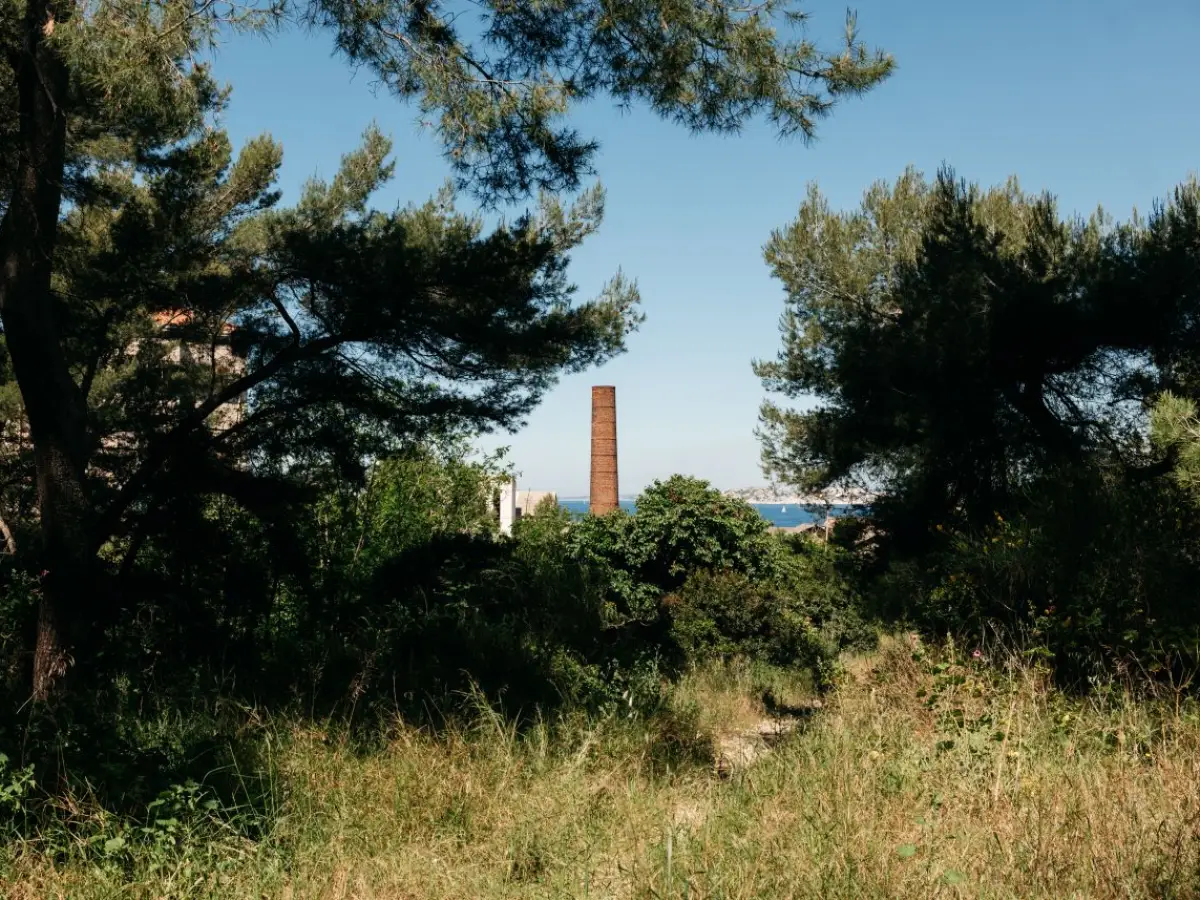
Nevertheless, the upheaval and the bubble of silence are also tied to another story: the story of those living in the Madrague neighbourhood of Marseille. Here, the Association Santé Littoral Sud (ASLS) has been campaigning since 2009 against heavy metal pollution caused by the Legré-Mante factory. François, a member of the ASLS and a long-serving worker at Legré-Mante, recalls how the workers only became aware of the pollution three years after the plant closed: “The owners should have warned us of the risks, made us wear protective gear and banned farming.”
The area is now at the heart of a major property development project owned by the Ginkgo fund, whose obligation to carry out the decontamination work began in 2024 following the administrative court’s ruling which confirmed the contamination of the land. The Calanchi National Park is turning into a state-run construction site as a result of this and other ongoing decontamination works. Moreover, as François points out, “if residents wanted to sell their contaminated properties, they would have to pay around 4,000 euros to decontaminate just 50 square centimetres of land”. After the ASLS sought compensation, which was rejected – on the grounds of a lack of causal connection to the ecological damage but upheld for emotional distress in the form of a symbolic one euro, as the court deemed they had not sufficiently justified the amount claimed – François and others joined a lawsuit against unidentified parties for endangering the health of others.
The shortcomings of the European principle have been recognised not only by citizens such as Guido, Toon and François but also by the European Court of Auditors, which, in 2021, found that the principle is still being applied inconsistently. Two years later, acknowledging these shortcomings, the European Commission initiated a comprehensive review of the principle, examining how it is implemented across 76 EU laws and financial tools covering key environmental policies, from industrial emissions and water use to deforestation and soil sealing. Nevertheless, the review, originally scheduled for publication in 2025, has not yet been published.
Delays persist, as do the doubts. Once published, the eligibility assessment is unlikely to address the key question regarding the critical issues of pollution in Europe, namely, what happens to those affected. It is no coincidence that the scope of the assessment, currently underway by the European Commission, includes the costs associated with pollution prevention and control, administrative obligations and compensation for environmental damage, covering activities such as industrial emissions, soil sealing, deforestation and water abstraction. That's all. In fact, when the principle alone is not enough, many communities seek justice elsewhere.

Increasingly, this path leads to the European Court of Human Rights (ECHR). Rather than establishing the liability of the polluting company, the ECHR judges assess whether the state has done everything possible to prevent the damage, monitor pollution, inform citizens and ensure effective remedies.
However, other avenues may also be worth exploring. One of these is the approach taken by lawyers from the NGO ClientEarth, who recently lodged a complaint with the European Committee of Social Rights. “We’re arguing that Belgium is violating the right to protection of health guaranteed by the European Social Charter,” they state. “The government’s systemic failure has resulted in public health and the environment being harmed, and disproportionate damage done to children.”
While the European Committee of Social Rights cannot enforce sanctions, its decisions carry significant political and legal weight and have led European governments to amend laws and public policies. “We expect to hear about the admissibility of our complaint in 2027,” the lawyers conclude. “This step is to confirm whether our complaint can be heard in court. We then expect a final result in two to three years’ time.” Meanwhile, the cost of pollution continues to fall on the shoulders of those living in those territories.
This investigative report was made possible thanks to the support of Journalismfund Europe
Cover: photo by Maïté Baldi