

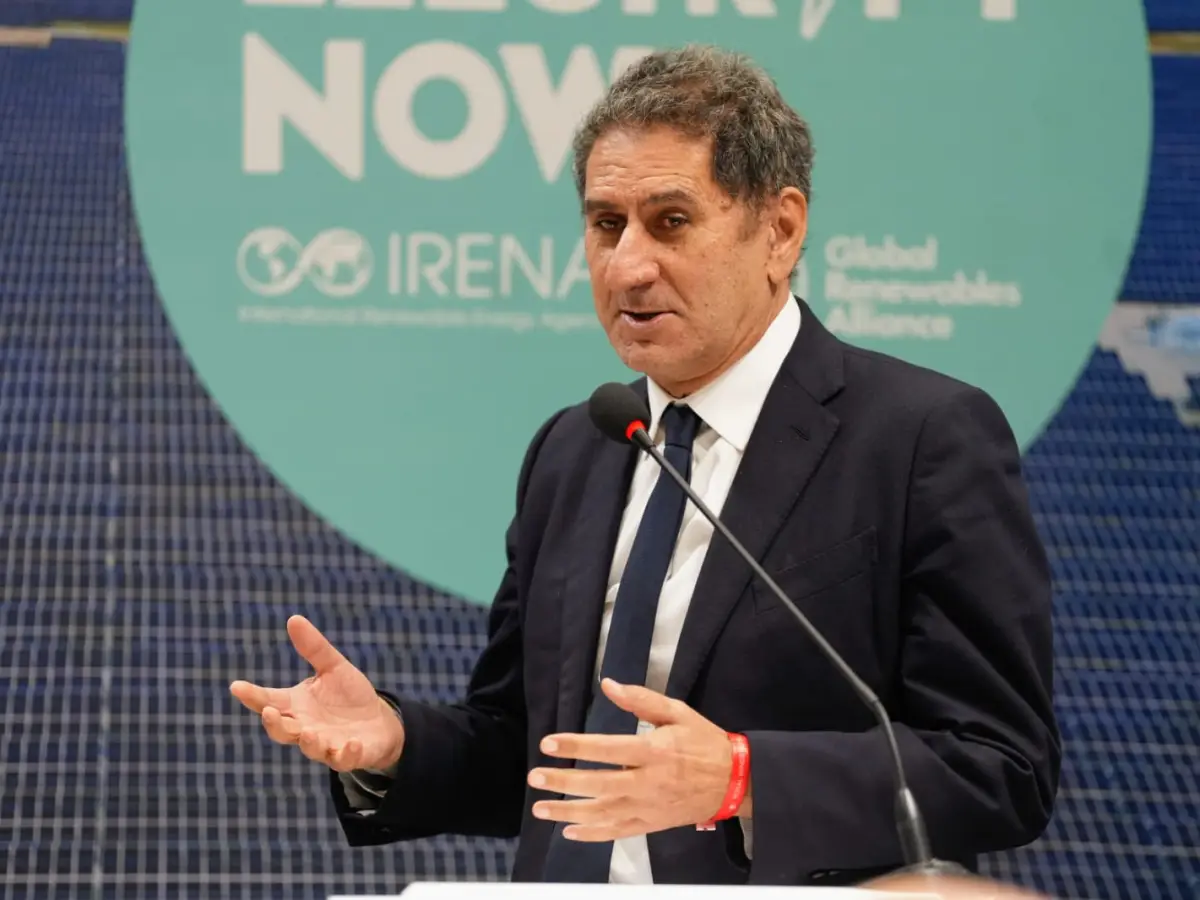

Antalya – At COP31, the talk is all about the Turkish presidency’s target to electrify 35% of the planet by 2035. We spoke with Francesco La Camera, Director-General of the International Renewable Energy Agency (IRENA), whom we met at the Global Renewables Hub at COP31 in Antalya. In our interview, we covered two key energy themes of this conference: electrification and the transition away from fossil fuels. We tried to understand their connection and how La Camera, consulted by all parties to provide the scientific basis for political decisions on energy, interprets the negotiations.
What is the atmosphere like in the negotiations?
The atmosphere is positive. I can say with absolute certainty that the call for 35% of the energy system to be powered by electricity by 2035 will be adopted. This COP will be remembered as the COP of electrification. As for the other pillar of this shift from negotiation to action – namely, Brazil’s pledge on the transition away from fossil fuels (TAFF) – the issue is certainly more complex. There will undoubtedly be a reference to it in the text of the final declaration, but what matters is that it is garnering a great deal of support.
What is the connection between the two initiatives?
At the heart of the Brazilian initiative and the Turkish pledge, 35% by 35, lies precisely the IRENA report on the transition away from fossil fuels. As we have provided the analytical basis for both, the initiatives are interlinked: the figures in the Turkish pledge are the same as those in the roadmap for the transition away from fossil fuels, which sets out a target of 35% electrification by 2035. That means, these are not two inconsistent documents: they are coherent and support one another.
The Brazilians have made the political side of the TAFF a rather tricky business. For the Turks, on the other hand, it has been easier to embrace the idea of an action plan to generate 35% of their electricity by 2035. From the discussions we’ve had over the last few days, it seems to me that there are no obstacles: the atmosphere strikes me as positive.
How does this fit in with Dubai’s (COP28) commitment to triple the share of renewables?
The roadmap we have drawn up for the transition takes into account the fact that we have already exceeded the 1.5-degree threshold; it therefore sets out a trajectory to get back on track to comply with the Paris Agreement. It also considers what will have been achieved by 2030: the data suggests that we will likely come very close to tripling our renewable energy capacity, reaching 11.2 terawatts. The models predicting an acceleration in electrification – to at least 35% by 2035 and more than 55% by 2050 – are based on this target. If we pursue these objectives, we will bring the world back into line with the Paris Agreement targets.
In this regard, it appears that the IRENA reports have played a crucial role.
I’m quite pleased. We had provided the material for the roadmap to triple renewables in Dubai; now we’ve provided the material for these two new roadmaps as well, which, in my view, are the most politically significant pillars of this COP. And as we built the analytical foundation ourselves, the two elements complement each other; their consistency gives them greater strength.
And how is the plan to triple the share of renewables by 2030 progressing?
As far as mitigation is concerned, we’ll get there. However, while renewable capacity and mitigation are progressing fairly well, energy efficiency is lagging. By 2030, even if we come close to tripling the share of renewables, it will still not be enough, because the gap between supply and demand – given that energy efficiency has improved less than expected – will widen. We therefore need a strategy to absorb this increase, because if it were to be met by fossil fuels, it would be a disaster from both a climate and an economic perspective. This is why this roadmap leads us to conclude that electrification is the most efficient solution.
How much does the new electricity demand from data centres account for?
This narrative about data centres has been put forward with a single aim: to argue that, because data centres require a stable power supply and renewable energy sources are variable, we need nuclear power to supply electricity to data centres. There is clearly an increase in demand for electricity driven by artificial intelligence, but at the same time, artificial intelligence is being used to make services more efficient. And in truth, the rise in demand for electricity is due more to changing lifestyles – probably in emerging or developing countries – starting with transport.
What do we need to keep an eye on to support the transition away from fossil fuels?
IRENA maintains that it is essential to focus on the grids, which must be interconnected and flexible. In China this year, we will see a decline in annual installed capacity, because while the capacity to generate electricity has increased significantly, the capacity to transmit and distribute it has not. This is therefore the only real bottleneck today when it comes to accelerating electrification. That is why we have been tasked with focusing specifically on the grids – something IRENA has, in fact, been doing for years. IRENA was the first organisation to sound the alarm on this: planning needed to consider that electricity must not only be generated, but also transmitted and distributed.
Which parts of the world are most in need of funding for their networks?
Clearly, developing countries need financial support: the cost is simply too high. We are calling for the multilateral financial system to focus its attention on and prioritise the financing of infrastructure that underpins the emerging new energy system.
But the market will drive this forward: we are moving towards a new energy system dominated by renewables, which are the most cost-effective source, the source that ensures energy security because it is decentralised, and the one that is more socially acceptable because it creates more jobs. Then there will be the sustainable use of biomass and, of course, hydrogen – particularly green hydrogen – to which IRENA’s next report will also be dedicated. But what I believe will remain the absolute top priority over the next ten years is the grid. Then there is the regulatory environment: the market is still geared towards price-setting based on marginal cost, while we need longer-term contracts. If we want lower energy costs, that is inevitably the way forward. Training is also very important, as is the removal of subsidies for fossil fuels within the regulatory framework.
How will it speed up the electrification of the Mediterranean?
The Mediterranean will increasingly become a regional network linking the northern and southern shores. Meanwhile, there are projects being developed by the Italian grid operator Terna, but they are progressing more slowly than necessary. I have always said that Italy is a natural hub for renewables. Unfortunately, one of the first major power lines runs through Greece and Cyprus, whereas I would like everything to pass through my country, including any potential hydrogen distribution networks.
In our study on the Mediterranean, we have shown that greater integration between the two shores would yield incredible results for the competitiveness of the European system – in terms of its impact on GDP – and for the African shore in terms of more jobs and greater added value. These figures are indisputable. These developments will inevitably take place too, but they need to happen sooner – which is possible – because we face an imminent threat: we must ensure Europe’s competitiveness vis-à-vis other countries around the world through renewable energy. Others are far more efficient than us today, and we cannot keep holding them back with trade barriers.
Cover: Francesco La Camera (IRENA/COP31) - da Flickr