


In this third week of November, whilst the final stages of COP31 are taking place in Antalya, the geopolitical spotlight has shifted to Shenzhen. Between 17 and 19 November, the hi-tech capital of southern China hosted the closing forum of APEC (Asia-Pacific Economic Cooperation), culminating on Thursday 19 in the much-anticipated trilateral meeting between Xi Jinping, Donald Trump and Vladimir Putin.
Presented by some pundits as “Yalta 2.0”, the historic summit was in reality more symbolic than substantive. Yet, even symbolism carries significant weight when it comes to the dynamics capable of shifting the global balance of power.
First, by hosting the summit, China reaffirmed its central role on the international stage, and Xi, almost certainly set for a fourth term, saw this as confirmation of his power as “master of puppets”. Then, despite being a declining power, Putin’s Russia saw its international standing restored, and elevated to the same status as the other two giants. Finally, after the defeat on home turf, Trump was seeking redemption on the international arena and was leaning (quite literally – as body language doesn’t lie!) on the unshakeable Chinese president.
The 90-minute closed-door meeting produced a brief joint “Declaration towards peace”. This contains a commitment to reducing nuclear risksthreat, a somewhat ambiguous call to reform the UN, and a surprising shared pledge to increase production not of renewable energy, but of petroleum products. It is almost a slap in the face for the climate conferences, increasingly shunned by heads of state.
The body language of power
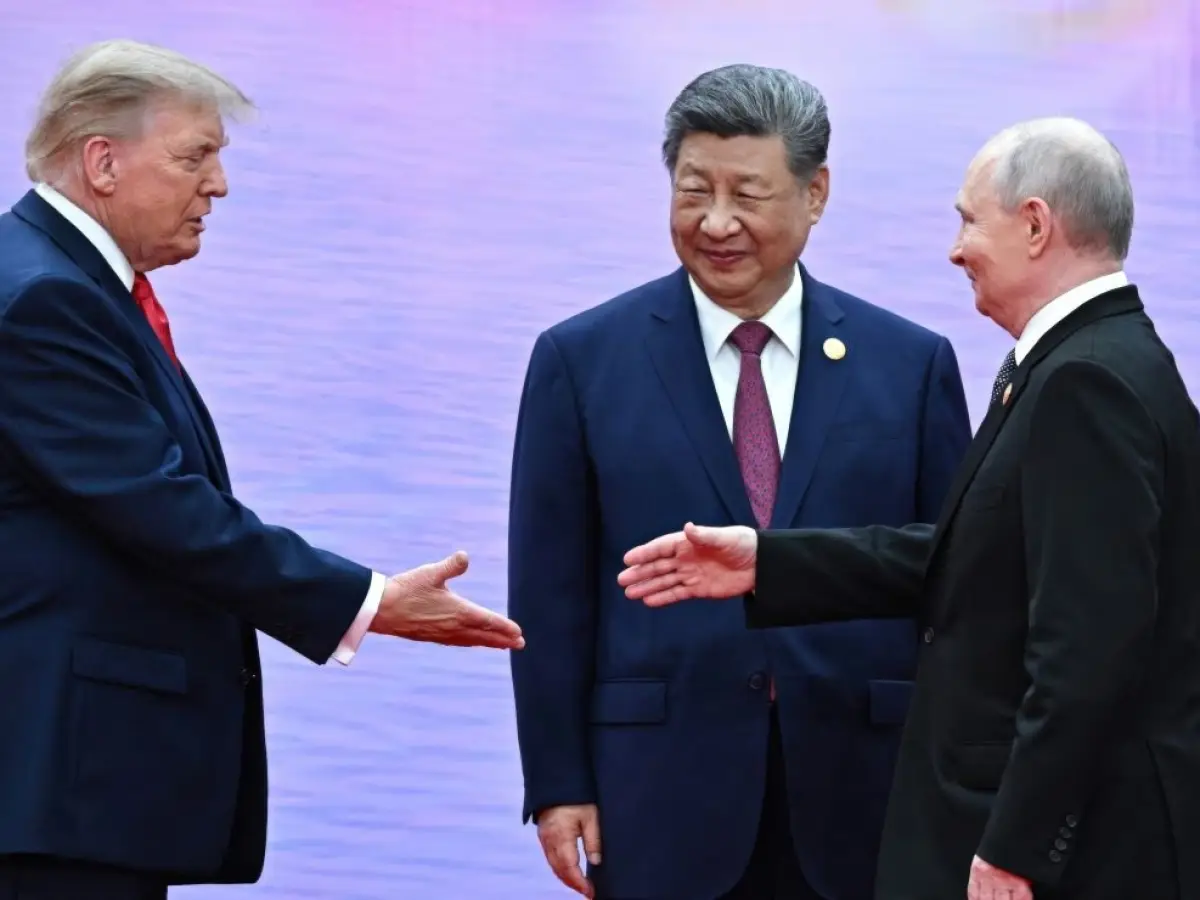
Two official images will stand out from this historic summit – it is worth repeating this, for it has been truly historic. The first is Xi Jinping’s welcoming embrace of Donald Trump. In an unusual gesture, the Chinese president personally received the US president upon his arrival at the airport, reciprocating the courtesy shown to him during his visit to the United States. The second is the handshake between Trump and Vladimir Putin under the watchful eye of Xi, seemingly pleased to act as broker of the global balance of power.
Finally, there is a third, unofficial image that went viral on social media and perhaps says even more than the “staged” pleasantries performed in front of the cameras. Standing on an escalator, a slightly unsteady Donald Trump, turns towards Xi reaching for his hand. The Chinese president supports his arm, reassuring him. The body language is crystal clear: the defeated president, having cast aside the arrogance of two years ago, is now leaning on the steadfast figure to shore up his own faltering power.
Statements and points of view
One could even argue that the joint declaration – not “of peace”, as reported, perhaps hastily, by some media outlets, but “toward Peace” – amounts to an exchange of courtesies between the three leaders. Published on the official channels of Beijing, Washington and Moscow, the China-Russia-US Heads of State Declaration toward Peace is a concise four-point document that addresses four important issues, yet with substantial ambiguity and without really dealing with the substance of the military and trade conflicts plaguing the world.
The first point is a call for reform of the United Nations. “As permanent members of the United Nations Security Council, the China, Russia and the United States committed to reform the UN so that the UN can respond more effectively to global challenges and conform to its fundamental mission of international peace and security”, the declaration states. The direction this reform should take is not specified, although in recent years Beijing has repeatedly called for a more prominent role for the nations of the Global South.
As early as the second point, the text mentions oil, and between the lines one can discern a reference to the Hormuz crisis and the war in Iran: “The three countries plan to increase the production and supply of refined petroleum products for the benefit of all nations. They reaffirmed the importance of stable energy flows”, the document states. There is not the slightest mention of renewables. However important they may be for the Chinese economy, they are certainly not at the top of either Trump’s or Putin’s agenda. The third point is clearly a concession by Xi to his two guests. In no uncertain terms, it calls on the “International Criminal Court and other similar bodies” to stay within their remit, to respect the principle of “immunities of State officials” and “not abuse their jurisdiction”.
Finally, the fourth statement addresses the summit’s most contentious issue: the nuclear arms race. The three heads of state reaffirm that “a nuclear war cannot be won and must never be fought”. They then commit to launching a “dialogue on reducing nuclear risks and preventing the proliferation of nuclear weapons”. It remains unclear when this will happen, and on what terms. Nevertheless, the statement represents at least a step forward compared to China’s alleged reluctance to address the issue. Of the three countries, China has the smallest nuclear arsenal with around 600 warheads, compared with over 5,000 each for Russia and the United States. Ahead of the summit, Xi Jinping called for nuclear weapons to be banned and progressively but completely destroyed, in his speech on the “four points of view” (4点看法). Once again, he cited the “Thucydides trap”, arguing that it can be avoided altogether if countries commit to cooperation and respect for mutual differences.
In short, those who feared a new Yalta, with spheres of influence carved up as at the end of the Second World War, were wrong in their predictions. But certainly, the spectacle of the Shenzhen summit, showcased the technological prowess of China, amidst parades of dancing robots and processions of international CEOs. It made clear how the global balance of power is shifting and, above all, who wants to take on the role of master of puppets. Europe, in the meanwhile, once again remains in the audience, watching on.
Cover: Donald Trump, Xi Jinping and Vladimir Putin © Vyacheslav Prokofyev/Kremlin Poo/Planet Pix via ZUMA Press Wire, IPA Agency