
Is Donald Trump creating a new international organisation in his own image, as an alternative to the United Nations? Over the past few days, the US president has sent invitations to a number of world leaders and other prominent figures to join his so-called “Board of Peace”. Initially conceived as a forum for managing phase 2 of the ceasefire in Gaza (and its reconstruction), the Board of Peace would – according to the documents analysed – represent a broader vision for a long-term body that responds to global conflicts beyond Gaza.
The documents sent by the White House state that the Board should ensure “the development of governance capabilities, regional relations, reconstruction, investment attraction, large-scale financing and capital mobilisation” in the enclave: it would therefore be a first test for something more than just a round table.
Argentinian President Javier Milei and Paraguayan leader Santiago Pena were the first to disclose the contents of the proposal on social media, posting the full version of the letter. In his letter to Milei, the US president said the board would seek to “consolidate peace in the Middle East,” adding that at the same time it would “undertake a bold new approach to resolving global conflicts.” Trump did not mince his words: this will be “the largest and most prestigious board ever assembled at any other time, in any other place,” he posted on Truth Social.
An invitation to join the Board of Peace has been sent to around 60 countries close to the administration, including Italy. And this is where the trouble begins. Members would have to pay one billion dollars in hard currency to join for a membership of three or more years, with the aim of creating an international peacebuilding body. In fact, it would be identical to the United Nations Blue Helmets, created in 1948. Without the values, however, that are the basis of the Blue Helmets: consensus of the parties involved, impartiality, use of force only for self-defence or to defend the mandate. Trump is known, after all, to hate the United Nations and its multilateralism. Better, then, a peacebuilding system that represents only the United States and its allies, cutting out countries such as China, Iran and, for now, Russia. A unilateral peace system, with no legal basis, founded on action and facts.
The preamble clearly sets out the justification: there is a need for “a more flexible and effective international peacebuilding organisation,” and he complains that “too many approaches to peacebuilding perpetuate dependency and institutionalise crisis rather than helping people overcome it.” Of course, the peacebuilding system has ample room for improvement. But it will certainly not be the Trump doctrine and the Board of Peace to resolve conflicts. Efforts could have been made to reform and support the United Nations. Instead, the aim here is to redefine the entire infrastructure of international organisations without critical thinking, study or simple planning.
The proposal for the moment was met coldly in Europe. According to a source in Time, “despite Europe's commitments to the Strip, there is little desire to significantly fund an organisation that promotes a Trump-led world order, amid speculation that the Peace Council was conceived as an alternative to the United Nations, towards which the White House is increasingly hostile.” Moreover, this comes in the midst of an unprecedented post-war Atlantic geopolitical crisis, with the US continuing to exert pressure and make threats in order to acquire Greenland, even leveraging new rounds of tariffs.
Since the beginning, Italy has been recruited to the Board of Peace (also due to its long-term commitment in Palestine and Lebanon), but at the moment it has not yet confirmed whether it would actually be willing to pay one billion dollars in cash to the US administration. Given the limited resources that the Foreign Ministry usually allocates to multilateral cooperation, it will not be easy to satisfy the US request without sacrificing funds allocated to the United Nations. If she pays, Giorgia Meloni (or whoever represents her) will sit at the table with Viktor Orban and Benjamin Netanyahu, along with Secretary of State Marco Rubio, Trump's envoy Steve Witkoff, Jared Kushner, President Trump's son-in-law and trusted adviser, as well as prominent figures in international finance and long-time friends of the tycoon, such as Marc Rowan, Ajay Banga and Robert Gabriel.
There are already tensions, however, over the inclusion in the committee of Ali al-Thawadi, a senior Qatari official, and Hakan Fidan, the Turkish foreign minister, both of whom are unwelcome to Israeli Prime Minister Benjamin Netanyahu. The latter has formally protested to Washington, explaining that the expansion of the board “was not coordinated with Israel and is contrary to its political interests.” Will this be a further step towards Trump's new world order? Or yet another jumble of confused and unrealistic ideas, in violation of law and civil decency, from the world's craziest administration, destined to disappear like snow in the sun in 2028?
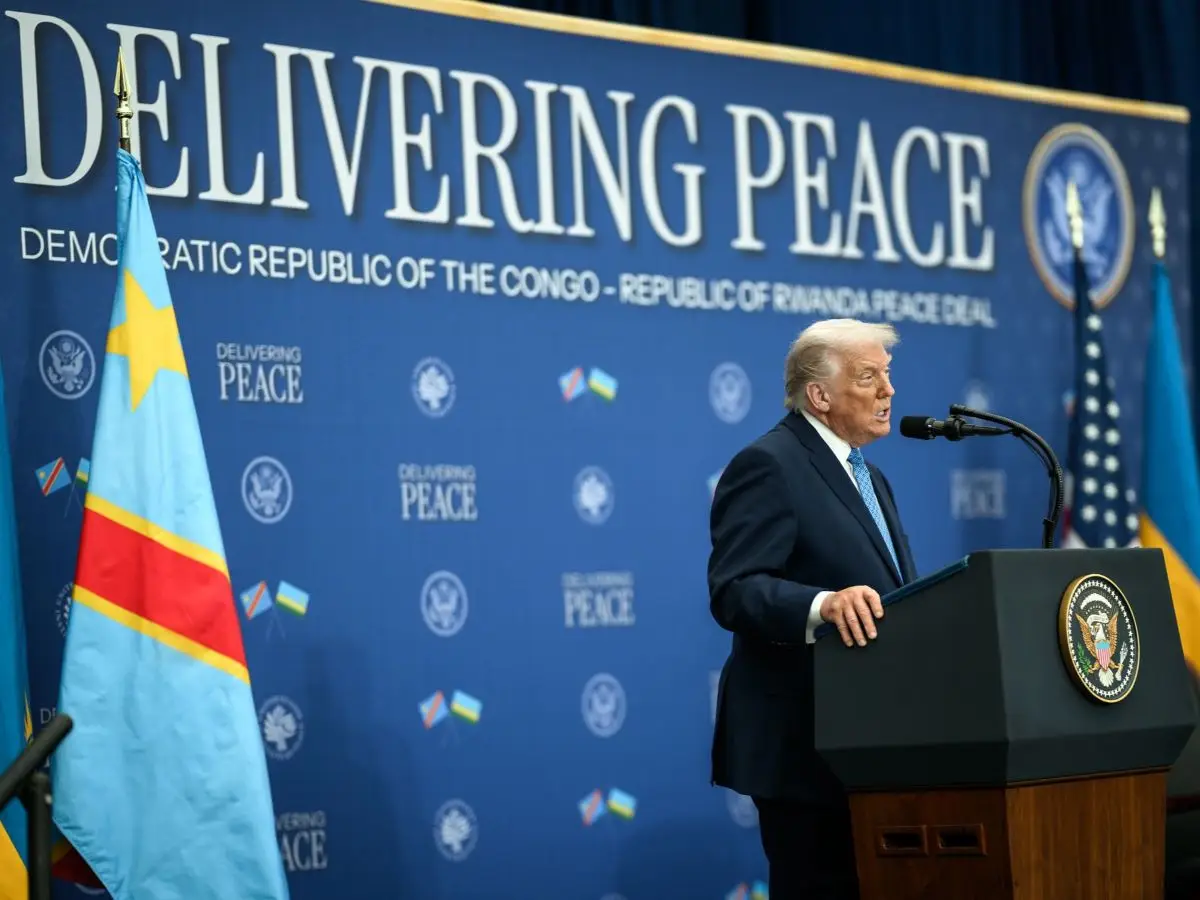
Cover: President Donald Trump participates in a trilateral signing ceremony of a peace and economic agreement with President Paul Kagame of the Republic of Rwanda and President Felix Tshisekedi of the Democratic Republic of the Congo, Thursday, December 4, 2025, at the United States Peace Institute in Washington, D.C.. Official White House Photo by Daniel Torok via Flickr