


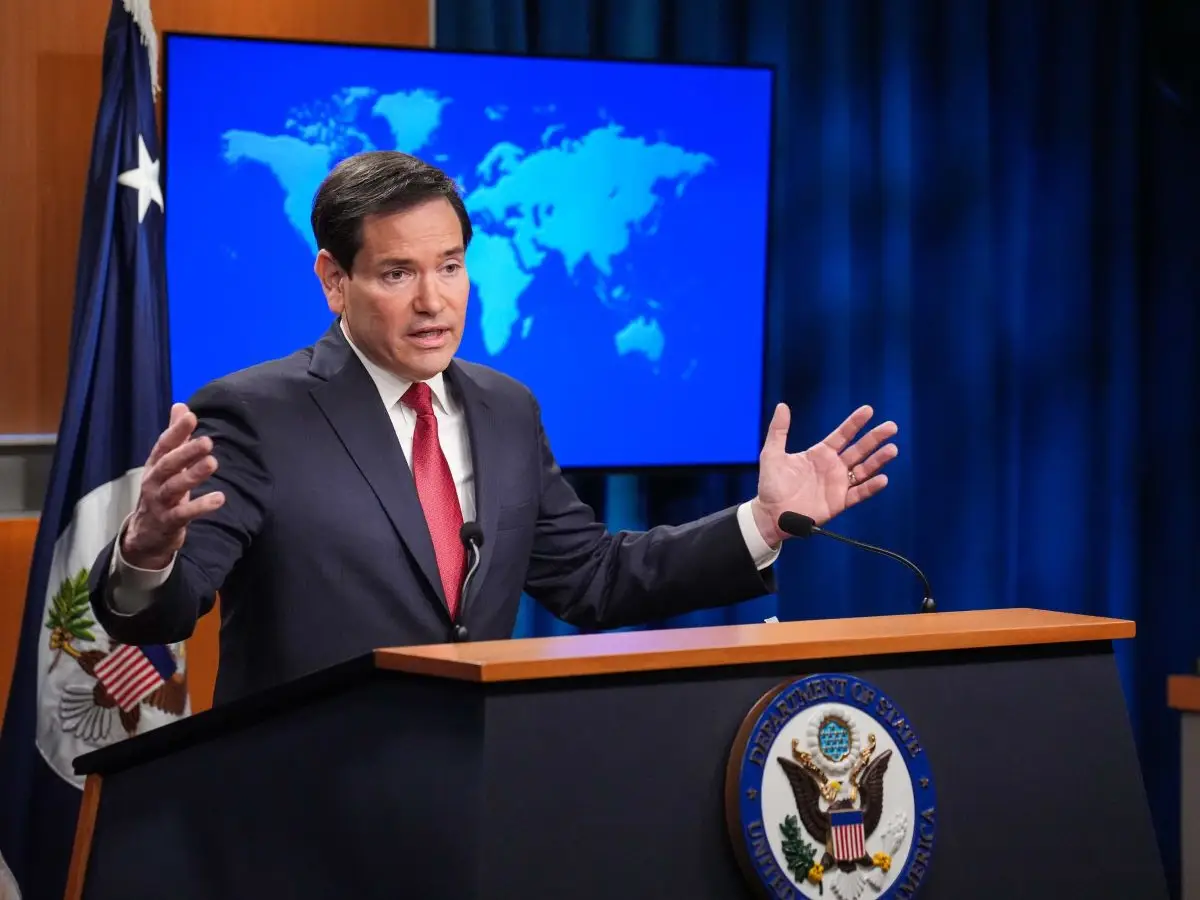

The Trump administration has launched yet another onslaught on international law and the fight against climate change. In a deeply troubling and unprecedented move, on Wednesday 7 January, Secretary of State Marco Rubio announced the US's withdrawal from the United Nations Framework Convention on Climate Change (UNFCCC), the climate change framework convention signed in Rio in 1992, which includes all countries in the world among its members. In addition to the UNFCCC, the US has withdrawn from 66 international organisations, including the IPCC, the Intergovernmental Panel on Climate Change.
“What began with a pragmatic framework of international organisations for peace and cooperation has evolved into a vast global architecture, often dominated by progressive ideology and detached from national interests,” said Secretary of State Marco Rubio. “President Trump is making it clear: it is no longer acceptable to give the blood, sweat and economic resources of the American people to these institutions with little or nothing to show for it in return,” Rubio added in a statement. “The days of billions of dollars of taxpayer money flowing to foreign interests at the expense of our people are over.” Furthermore, “Many of these organisations promote radical climate policies, global governance and ideological agendas that conflict with US sovereignty and economic strength,” according to a White House briefing note.
Among the most notable organisations that the US has withdrawn from are the International Union for Conservation of Nature (the equivalent of the IPCC for biodiversity), UN-Water, the International Renewable Energy Agency (IRENA) and the Intergovernmental Forum on Mining, Minerals, Metals and Sustainable Development.
Many environmental organisations have protested. “This was not billions spent with poor results. The UNFCCC's Paris Agreement alone has reduced the projected warming by 2100 from 3.6 °C to 2.7 °C thanks to international climate cooperation,” writes 350.org in a press release. This week marks the anniversary of the devastating Los Angeles wildfires, exacerbated by extreme weather conditions, which forced 100,000 Americans to flee their homes. A reminder that should serve to remind the US president what climate chaos means for his own citizens.
An unprecedented wound
Established in 1992, the United Nations Framework Convention on Climate Change is the treaty that defines the legal framework for international negotiations addressing climate change. Under the treaty, nations meet annually to determine how to collectively slow the warming of the Earth's atmosphere, primarily caused by the burning of coal, oil and gas.
Once the United States is out of the treaty, it may be difficult to return. It is unclear whether a future president could easily rejoin the treaty, or whether it would require new ratification by the US Senate, necessitating a two-thirds vote, a difficult task in the current polarised political climate, fuelled by reactionary Republican climate deniers.
According to Savio Carvalho of the climate association 350.org, “The United States is digging its own grave by becoming the only country in the world that does not want to participate in humanity's great race to save the planet and future generations. Renewable energy is rapidly transforming the global economy. Turning away from the UNFCCC in a desperate attempt to cling to a fossil fuel era that is now coming to an end will not bring economic strength, but weakness and isolation. This will not stop more than 80 countries that showed us at COP30 that they are determined to chart a course for a fossil fuel-free future.”
The reactions of Wall Street and the energy sector are still uncertain. One thing is for sure: Trump's new MAGA doctrine is just the beginning of the Copernican revolution that the US is seeking to impose on international law and organisations, attacking the ecological transition in particular.
Read also: Trump's energy imperialism is a danger to the future of the human species
Cover: Marco Rubio photographed by Freddie Everett, State Department official photo, via Flickr