Issue #61

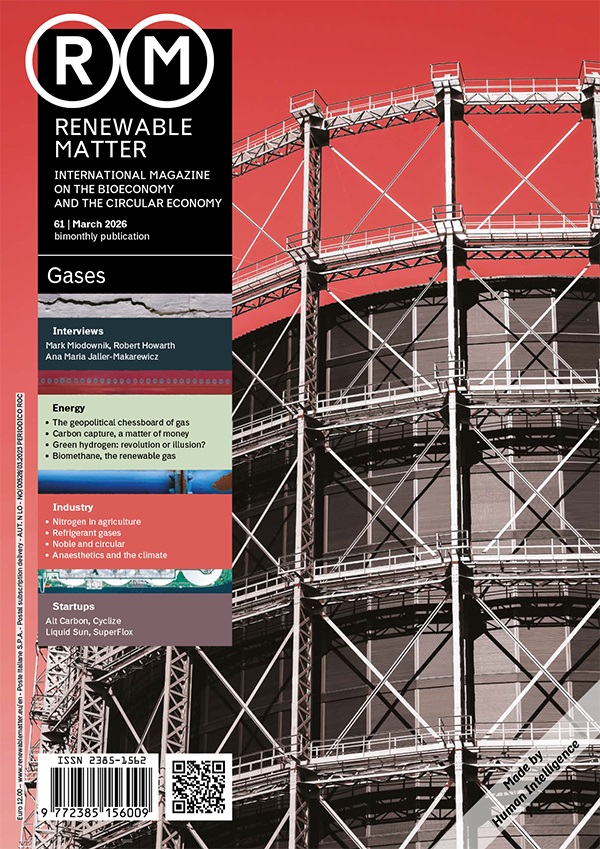
Gases are the invisible engine of the economy and modern civilisation: fundamental in every sector, from energy to chemicals, agriculture to industry, medicine to food. Their contribution, as well as their impact, determines our life on the planet. MR61 is therefore a journey into the world of gases, exploring geopolitics, science and technology.
Summary
EDITORIALS
An Orderly Chaotic World
Emanuele Bompan
To the ancients, gas had a divine origin; it was the element that derived from Kaos, the primordial place of formless matter from which the Demiurge drew to form the ordered world, the Cosmos.
Biomethane: The Key to Italian Energy Independence
Caterina Nigo
The production of renewable gas is now an undisputed cornerstone of European energy policy, a key priority set out in black and white in the RePowerEU strategy. But how does this continental vision translate into the Italian context?
THINK TANK
Making the Invisible Visible
Interview with Mark Miodownik
Giorgia Marino
Steam, methane, nitrogen, hydrogen, helium, carbon dioxide. Invisible and powerful, these and many other gases are the cornerstone of modern civilisation. But we often fail to realise how much we depend on them and the impact that uncontrolled exploitation can cause.
No, Natural Gas Is Not Better Than Coal
Interview with Robert Howarth
Marco Moro
Methane is responsible for about 30% of global warming, yet it is still considered a necessary “bridge fuel” in the transition from fossils to renewables. More and more scientists, however, are warning that natural gas may be even worse for the climate than coal.
Europe and the Geography of Dependencies
Interview with Ana Maria Jaller-Makarewicz
Emanuele Bompan
Following Russia's invasion of Ukraine, Europe has started adopting policies to reduce its dependence on LNG imports from abroad. Amidst the energy transition and the quest for new suppliers, here is how European and global gas markets are shifting.
INSIGHT
The New Geopolitical Chessboard of Gas
Stefano Vergine
Russia's invasion of Ukraine, Europe's energy transition, Trump's aggressive foreign policy and conflicts in the Middle East are reshaping the global natural gas market. With new players entering the scene and evolving scenarios, we tried to take stock of the situation.
In Europe, Carbon Capture Is Also a Matter of Money
Stefania Divertito
Many European countries and large companies are investing billions in Carbon Capture and Storage technologies. While bureaucratic and legislative setbacks are not helping, the biggest obstacle to the sector's development is the economic gap.
Green Hydrogen: Revolution or Illusion?
Simone Fant
Amidst broken promises, unrealistic targets and a market struggling to take off, is green hydrogen truly the path to decarbonisation or a gamble destined to lose out to fossil fuels?
Biomethane, the Renewable Gas Finding Its Place in the Energy Transition
Giorgio Kaldor
Biogas and biomethane convert waste into energy, integrated into existing networks and transport systems. While they still account for only a small portion of global natural gas demand, production is growing steadily almost everywhere.
Nitrogen In Agriculture: The Synthesis Of Abundance And Its Price
Giorgio Kaldor
Nitrogen has nourished the world, but at a rising cost: environmental, social and political. For this reason, from space to the Indian countryside, new solutions for nutrient management are now under consideration.
Cooling Down the Warming Planet Without Damaging It
Maria Carla Rota
Essential for refrigerators, heat pumps and cooling systems, refrigerant gases have in the past been a threat to the ozone layer. Today, however, new-generation refrigerants have another problem: their global warming potential.
Noble and Circular
Antonella Ilaria Totaro
Helium, neon, krypton, argon, xenon and radon are the basis of strategic industries, from healthcare to semiconductors. Yet despite their enormous economic and technological worth, rare gases remain difficult to extract and even more complex to recover and reuse.
Anaesthetics That Harm the Climate
Lucrezia Lenardon
As healthcare spending increases, so does the use of medical gases such as nitrous oxide. Known for over two centuries for its anaesthetic properties, it is also a potent greenhouse gas, the management of which should become more circular.
Radon, Indoor Enemy
Giorgia Marino
Invisible, odourless and asymptomatic, radon is a radioactive gas that can seep into buildings from the ground, causing serious health problems. It is a little-known problem, but more widespread than people think. And while laws are now in place, more information is still needed.
CASE STUDIES
Nippon Gases Italia: The Circular Transition of Refrigerants
Stefania Divertito
Unseen protagonists of everyday life, refrigerant gases nevertheless have an impact on the climate that can no longer be ignored. As Nippon Gases Italia explains, decarbonisation of the sector requires the creation of circular supply chains.
A New Technology Launched for LNG Transport
Valeriano Musiu
We headed to Genoa for the launch of the Green Pearl, the first European gas tanker that allows ship-to-truck transfers for LNG and bio-LNG. One of the key players in this operation is the energy company Axpo, increasingly interested in expanding the Mediterranean market.
Syngas, the Perfect Middleman
Emanuele Bompan
Synthesis gas, or syngas, today plays an important role as an industrial wild card in various supply chains, from aviation fuels to fertilisers and hydrogen. We discussed this with two experts from Nextchem, one of the leading players in the sector.
STARTUP
Antonella Ilaria Totaro
Alt Carbon: accelerated weathering that turns fields into carbon sinks
Cyclize converts complex waste and CO₂ into circular synthesis gases
Liquid Sun: clean aviation fuel from CO₂
SuperFlox: a new frontier in industrial emissions reduction
OUROBOROS
Why Ammonia Dominates Dutch Headlines, and What It Tells Us About Europe’s Food System
Ana Birliga Sutherland
Agriculture is responsible for 93% of all ammonia emissions in the EU, and livestock and manure account for the largest share. The most obvious case is in the Netherlands, an agricultural powerhouse where the “nitrogen crisis” has been the focus of media attention for over five years.
CIRCULAR FUTURES: DISPATCHES FROM TOMORROW
2058: Closing the Loops of the Invisible
Patrick Schröder
Throughout the 20th century, gases were treated as the ultimate externality. Invisible, widespread and difficult to control, they were released into the atmosphere with the idea that dilution would solve the problem. However, with the advent of climate science, that illusion has collapsed.
READING MATTER
Oxygen for Your Mind
Giorgia Marino
Gases move the world, shaping life on the planet, but they can also destroy it. Three books covering history, economics, geopolitics and science provide a better understanding of carbon dioxide, hydrogen and methane.