


A human-centred approach, worldwide cooperation, and wider access to artificial intelligence technologies. The AI Impact Summit 2026 – the fourth, held this year in New Delhi from 16 to 20 February – wrapped up with the usual, and vague, statement of good intent signed by 89 countries.
However, beyond the commendable slogan “AI for all” promoted by the Indian government, the significance of the event lies primarily in its context: India’s ambition to present itself as an emerging technological power and its commitment to the Pax Silica, the US-led coalition for the security of artificial intelligence supply chains.
What is the Pax Silica
Unveiled in Washington on 12 December, Pax Silica was strongly supported and orchestrated by Jacob Helberg, the Trump administration's Under Secretary for Economic Affairs, whose background is in the hi-tech world. The initiative is not a trade agreement, but rather a pact for economic and military security, which, according to the White House, will depend increasingly on who is able to control the artificial intelligence value chain and how.
The pillars of Pax Silica are therefore fourfold: computational power, now increasingly linked to developments in quantum computing; the semiconductor supply chain (and therefore silicon, hence “silica”); critical minerals and rare earths; and energy, for which demand will only increase due to data centres and ever more complex computing operations. “If the 20th century ran on oil and steel, the 21st century runs on computing and the minerals that feed it,” Helberg said.
Ensuring the stability of supply chains is therefore becoming strategic, and Pax Silica, as intended by the US government, was created precisely to remedy the vulnerabilities that certain parts of these chains present: production concentrations in a few regions, monopolies and dependencies that expose the entire sector to systemic risks. And even though China is never explicitly mentioned in the initiative's official statement, it is clear that Washington has in mind China's near-monopoly on rare earths, which Beijing has used as a weapon in the tariff war over the past year.
When the initiative was launched in December, the main strategic partners of the US were in attendance: Japan, South Korea, Singapore, the Netherlands, Israel, the United Kingdom and Australia. Qatar, the United Arab Emirates and Greece subsequently joined the coalition. Finally, India also officially accepted the invitation.
Why did India adhere to Pax Silica
India's entry into the US initiative “was not a given,” wrote the Times of India immediately after the announcement on 20 February. After all, the Indian government was not present in Washington in December: no ministers, no delegates. “The initial roster was largely made up of US treaty allies and high-income nations,” the Mumbai daily noted.
Then, however, Washington began to “woo” the Indians. And certainly not out of pure fondness: India has one of the world’s largest reserves of rare earths, amounting to 8.52 million tonnes, most of which remains unexploited, as domestic production is still very low. In addition, the semiconductor manufacturing sector is booming, with a dozen large plants under construction.
But if keeping India close is a sort of insurance for the future of hi-tech supply chains for the United States, India also stands to gain from joining the Pax Silica. For example, increased access to the most advanced know-how in the field of artificial intelligence and, above all, to GPU infrastructure, essential for AI development and whose global supply has been limited by the United States.
Furthermore, like the US, the Indian government also wants to reduce its dependence on Chinese supplies, but to do so, it requires substantial investment to build a true production ecosystem, from raw material processing and semiconductor manufacturing to research and development of the most advanced AI models.
IT Minister Ashwini Vaishnaw had already given a figure for realising India's technological ambition: $200 billion to be raised in two years. At the end of the AI Impact Summit, Vaishnaw himself triumphantly announced investment commitments of $250 billion.
AI Mission
“India’s going to have an extraordinary trajectory with AI and we want to be a partner.” This is how Google CEO Sundar Pichai announced, on stage at the AI Impact Summit, the development of a large submarine cable infrastructure from India to Singapore, Australia and South Africa to increase connection speeds and data traffic. The project is part of a massive investment already revealed by Google in October: $15 billion to build its largest artificial intelligence hub outside the United States, in Visakhapatnam in the state of Andhra Pradesh.
Pichai was certainly not the only Big Tech CEO attending the summit in New Delhi, where, in addition to around twenty heads of state and dozens of ministers, there were around 500 global technology leaders, including the heads of OpenAI and Nvidia. So, while India is looking at the hi-tech sector with growing ambition, the tech world is also beginning to look at the Indian subcontinent with increasing enthusiasm. Indeed, India is an attractive destination for AI investment thanks to its large pool of software and IT professionals and the wealth of data generated by its inhabitants, essential for training artificial intelligence models.
For its part, Narendra Modi's government is strongly committed to the development of artificial intelligence, as demonstrated by the IndiaAI Mission launched in 2024. “There is huge optimism, driven by the government, about India being at the forefront of the defining technology of this century,” reads The Diplomat on the eve of the summit.
Nevertheless, some significant issues need to be taken into consideration. First and foremost is the sustainability of the infrastructure required for AI development. Will India, currently grappling with the challenge of energy transition, be able to support the water and electricity consumption required by highly energy-intensive facilities such as data centres?
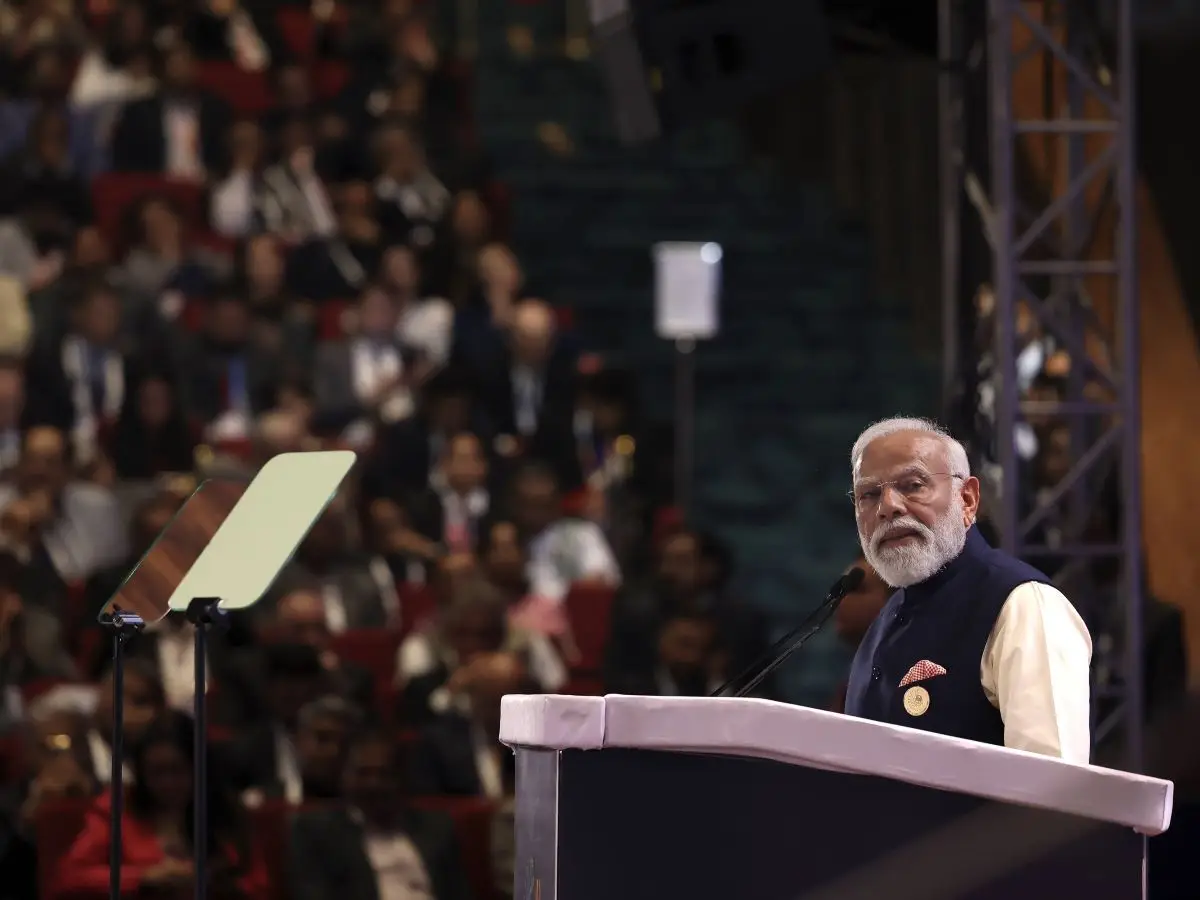
Cover: Narendra Modi at the AI Impact Summit, Stephane Lemouton/SIPA, IPA Agency