


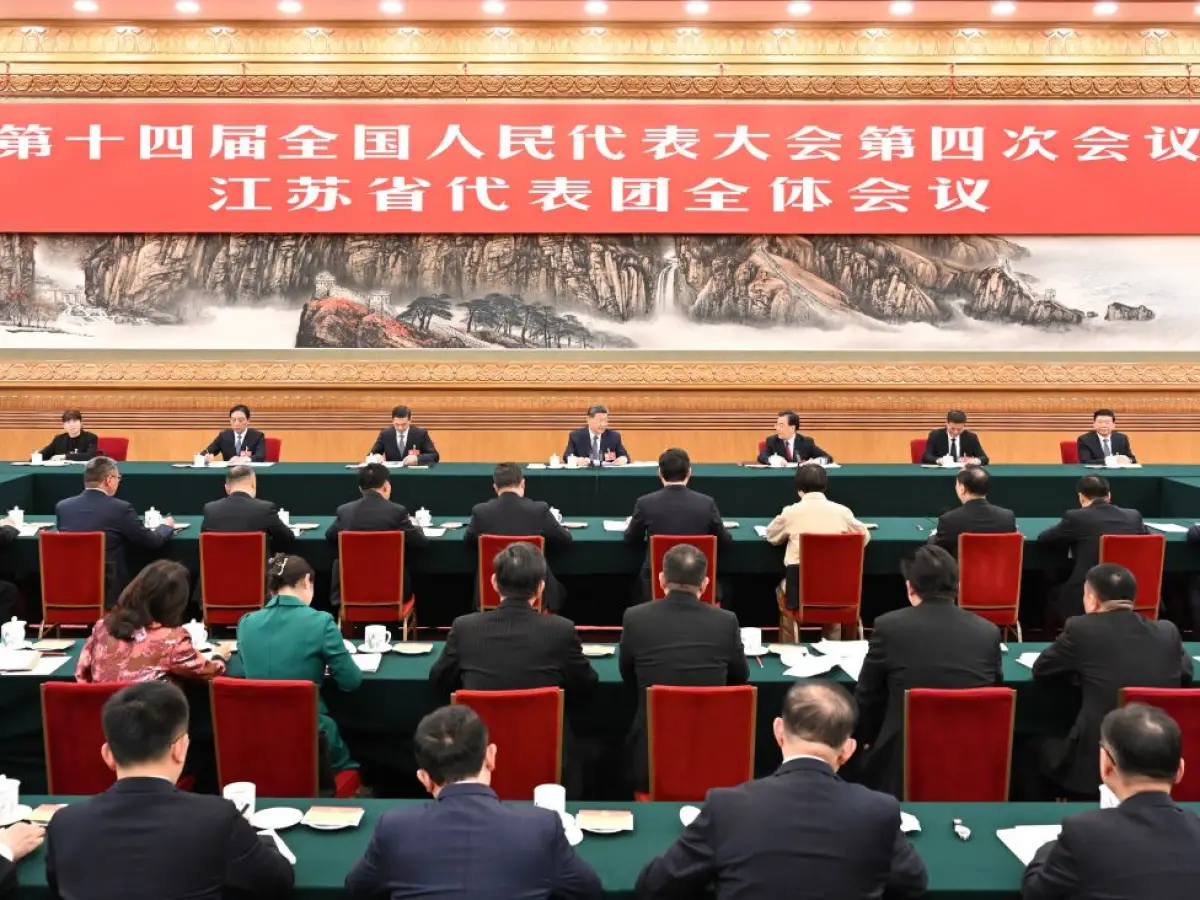

On 4 and 5 March, Beijing has begun the Two Sessions, or Lianghui (两会), the key event in the Chinese political calendar, eagerly awaited this year for the official unveiling of the 15th Five-Year Plan.
On the morning of Thursday 5 March, following Premier Li Qiang's official speech to the National People's Congress, the central government released the draft of the “15-5” (十五五), as the Chinese call it for the sake of brevity. The document, far from concise (as well as being very heavy), consists of 18 chapters spread over 140 pages. But boiling it down, we can summarise it with two percentages: +4.5% and -17%.
The first is the GDP growth target, revised downwards for the five-year period 2026-2030: instead of the ambiguous “around 5%” that had been the compass (and cross to bear) for the last three years, Beijing chose to widen the range of possibilities, giving a reference range of between 4.5% and 5%.
The second percentage is the target for reducing CO₂ emissions per unit of GDP (carbon intensity) by 2030. Once again, there has been a cautious step backwards, considering that the previous target was -18%: a disappointment for observers of China's transition, who were hoping for greater climate ambition.
Beijing, however, is reluctant to overreach and, considering the geopolitical and energy circumstances, has opted for more achievable targets. To cut a long story short, today the Global Times, the CCP's English-language daily newspaper, appeals to popular wisdom: “the peach can be reached by jumping”.
Slower growth, but quality development
In keeping with folk wisdom, the new chapter in China's economic development seems to have adopted the principle of mànman lái, or “take it easy, take your time”. As already announced in October, Beijing now prefers “quality development” focused on stability, security and a better quality of life to rapid growth at any cost.
In any case, it has no other choice. While China has accustomed us to unattainable rates of growth over the last twenty years, we have recently seen the struggle to achieve the established growth targets. And when the Global Times writes, “Can we go even faster? It's not that we cannot; it's that we choose not to”, it sounds a lot like this fox believes the grapes to be too sour.
The fact is, however, that slowing economic growth is an inherent part of being a fully developed nation, which is what the People's Republic is today (even though it does not want to admit this in international forums). Therefore, the time had to come for Beijing to face this reality, and the gradual lowering of development targets is a first sign of it.
That said, there is no lack of ambition to do more. The Global Times explains this further: the range between 4.5% and 5% “sets a lower bound for growth while preserving upward flexibility”. In any case, 4.5% is not inconsiderable, especially for a mammoth economy like China's, with a total output of 140 trillion yuan ($20.4 trillion). According to an analysis by the International Monetary Fund, a 1 percentage point increase in China's growth rate would contribute to an average increase of 0.3 percentage points in the GDP of other economies. “Especially when compared with other major economies, growth of such magnitude is neither ‘low’ nor ‘slow’,” points out the Global Times.
The 15th Five-Year Plan's goals
What are, then, the priorities of 15-5? A useful compass for understanding what Beijing will be focusing on over the next five years are the recurring terms and slogans in the new Plan (a Chinese interpreter has compiled a fantastic glossary on LinkedIn). The most important ones relate to the (already known) new quality productive forces, to which are added particular focuses on technological self-sufficiency; the development of the domestic market and consumption; the environment and energy transition; security, in all its forms; and, as a new entry, demographics.
We have been hearing about Xīn zhí shēngchǎnlì (new high-quality productive forces) for a couple of years now. These are all future-oriented sectors such as new energies, electric vehicles, aerospace and the digital economy, recently joined by the rapidly developing sectors of quantum technologies, the low-altitude economy (drones, etc.) and, of course, artificial intelligence and embodied AI (intelligent robots). In order to fully develop all these industries, Beijing is focusing on greater technological self-sufficiency, starting with supply chain security: not so much for raw materials, which it already controls, but for high-tech components such as advanced chips. This issue is also reflected in the focus on security, which is military security, but above all supply security.
The evolution of domestic demand and the demographic issue are closely linked. The Chinese population is facing progressive ageing, and at the same time, younger people are suffering from the economic slowdown, unemployment and, in general, a lack of prospects. In order to boost domestic consumption, China must therefore, first and foremost, lift the spirits of its citizens and combat the so-called “involution” (nèi juǎn). The intention is therefore to focus on education, the creation of quality jobs (a considerable challenge, given the trend towards replacement by AI), the reduction of working hours and the fight against the overtime mentality (the infamous 9-9-6), housing policies, healthcare and the silver economy.
The disappointment of climate targets
Last but not least is the climate. All climate policy analysts and enthusiastic observers of China's transition were unable to hide their disappointment at the lack of ambition in Beijing's new five-year targets.
Although the economic strategy remains focused on clean tech, electric vehicles and new energies (the aim is to double energy from non-fossil fuels over the next ten years), emission reduction targets have been scaled back. The carbon intensity reduction target, reportedly, has been lowered from -18% to -17%, despite China's failure to achieve the previous target, stopping at only -12%. Logic would have demanded greater ambition to compensate for the deficit of the last five years, but this has not been the case. Indeed, no cap has even been set on total emissions.
With regard to coal, the real thorn in the side of China's transition, there is no talk of phase-out nor even of phase-down, as Xi Jinping had promised in 2021: the aim is rather to reach a peak in consumption and then stabilise. This leaves room for a further, and absolutely detrimental, increase in the coming years.
“I’ll admit I’m a little disappointed,” Belinda Schäpe, Chinese climate policy analyst for CREA (Centre for Research on Energy and Clean Air), one of the most authoritative think tanks on the subject, tells us via Zoom. “The Chinese government has once again redefined its target. This is rather worrying, as it seems they are less confident about achieving it. In particular, the carbon intensity target is far from what would be necessary to meet the targets promised for 2030. But the carbon budget we still have available will certainly not increase, so commitments should be strengthened, not weakened as Beijing has done.”
More optimistically, some analysts note that the targets set for the five-year plans are always more “restricted” than the yearly ones. According to Schäpe, however, a strong signal from above would have been crucial at this point: “Given the economic slowdown, they did not feel comfortable giving clear direction to industries and provinces. This is very risky, however, because it could lead to an increase in the construction of fossil fuel infrastructure and consumption for as long as it is still permitted.”
The hopes are that China, as it already has in recent years, will surpass itself, going well beyond the targets set. “We have seen this in the field of clean energy,” recalls Schäpe. “The solar and wind energy installation targets set for 2030 were already achieved in 2024. Developments in the field have been much faster than the political targets would have suggested.”
The problem arises when Beijing fails to achieve the targets set, and then changes their definition. “It has already done so, for example, with the definition of carbon intensity, initially intended to cover only emissions from the energy sector, but now also including industry,” concludes Belinda Schäpe. “This makes it easier to achieve the target, given that emissions in the cement sector have fallen dramatically due to the property crisis. The balance sheet is positive as a result. But this means fudging the accounts, and the climate can no longer afford that.”
Cover: Beijing, President Xi Jinping at a meeting of the fourth session of the 14th National People's Congress, CHINE NOUVELLE/SIPA, IPA Agency