

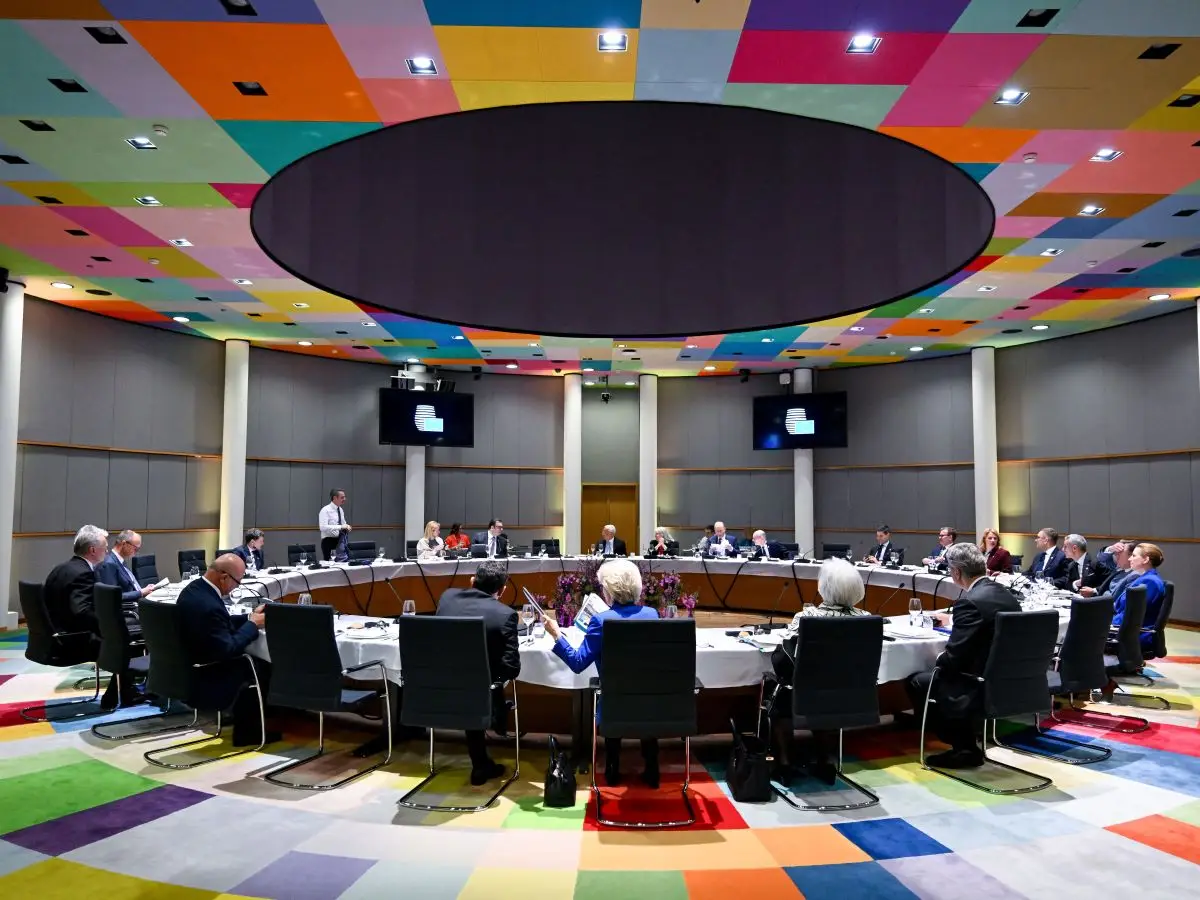

The European Council was adjourned during the night of 19–20 March after a much broader debate than anticipated. What was supposed to be a summit on reviving competitiveness instead turned into a moment of great tension for Europe, caught between the Middle East crisis, the rise in energy prices and internal political divisions, from Hungary’s veto on the 90 billion for Ukraine to the controversy over the ETS.
The most sensitive issue still remains the ETS, the European system for pricing CO2 emissions. With Italy’s call for its dismantling rejected, the Commission reaffirms the ETS as a central tool of the transition, to be strengthened or, at most, revised. The idea launched on 19 March by President von der Leyen of a €30 billion “ETS investment booster” to assist industry in decarbonising also follows this direction. This would be financed by 400 million allowances, i.e., ETS emission quotas that can be auctioned off or allocated to this fund.
Meanwhile, the Council has also revived the single market as a driver of competitiveness. No decision was made on the next Multiannual Financial Framework (MFF), the EU’s long-term spending plan covering a seven-year period and defining the financial framework within which many of Europe’s priorities operate. The issue was discussed on 17 March by ministers at the EU General Affairs Council, which, in a public session, kicked off a debate on the MFF 2028–2034, focusing primarily on governance aspects.
The war in Iran and Europe’s energy vulnerability dominate the agenda
In its conclusions, the EU Council states that “Developments in Iran and the wider region threaten regional and global security” and demands “de-escalation and maximum restraint, the protection of civilians and civilian infrastructure and full respect of international law by all parties.”
It is in this context that the request of “a moratorium on strikes against energy and water facilities” fits in.
The document’s political framework, however, shows a clear hierarchy of responsibility and language: ample space is devoted to condemning the Iranian regime and its proxies in the region (Hezbollah in Lebanon, in particular), while Israel is only mentioned in the context of the humanitarian crisis in Gaza, the unilateral expansion in the West Bank and the escalation in Lebanon. No reference to the United States appears in the document.
The European Council also highlights the role of the EU’s naval operations, Aspides and Atalanta, calling for their reinforcement with additional resources, “in line with their respective mandates”, thereby confirming that it does not wish to extend these missions beyond Suez and the coast of Yemen.
At the same time, the EU Council welcomed the member states' efforts – including enhanced coordination with partners in the region – to ensure freedom of navigation in the Strait of Hormuz, “once the conditions are met”. This refers to the six countries – France, the United Kingdom, Germany, Italy, the Netherlands and Japan – already dubbed the “Hormuz Volunteers”. These are the European actors best equipped in terms of naval capabilities, who on Thursday 19 March declared themselves ready to contribute to safe passage through the Strait, which handles a fifth of the world’s crude oil.
On the subject of energy security, a recent study by Zero Carbon Analytics shows that the growth of wind and solar power between 2022 and 2025 has saved the EU €58 billion in additional imports of coal and gas for electricity generation – more than the Union spent in 2022 on energy subsidies for industry, in an attempt to shield it from price rises. This data supports a view not currently central to the European debate: renewables are not only a tool for decarbonisation but also a tangible safeguard against geopolitical shocks and price volatility.
ETS: the Council is not backing down but is open to a review
As reported by Reuters, on the eve of the Council meeting, eight governments, including Spain and the Netherlands, had warned that weakening the mechanism could be detrimental to competitiveness, energy security and strategic autonomy. However, support for the ETS is not limited to governments: in the business sector, nearly 150 major companies and investors have signed an appeal to maintain a robust system capable of providing a stable signal for investment and innovation. Among the names: Unilever, IKEA, Amazon, Google, SAP, Tata Steel, Heidelberg Materials and SSAB.
On the ETS front, the European Council has therefore chosen not to accept Italy’s request to suspend the system, but to postpone its review until July 2026, aiming to reduce carbon price volatility and mitigate its impact on electricity, industrial supply chains and the risk of relocation. “In the medium term, I expect the next review of the ETS to address issues relevant to Italy, such as the extension of free allowances for energy-intensive industries or the volatility of ETS prices,” said European Commission President Ursula von der Leyen at the end of the summit.
Matteo Leonardi, Co-founding Executive Director of ECCO, the Italian climate change think tank, reads the excerpt very clearly: “The outcome of the Council is positive. Brussels has confirmed that emergency measures must be aligned with the European Union’s energy security strategy, through renewables and investments capable of restoring Europe’s competitiveness”. Leonardi adds that the decision not to suspend the ETS confirms the system as “a central tool of European transition policies”, while for Italy the real issue remains the energy decree: if the tax burden and the costs on energy bills are not reduced, he warns, the legislation will not provide practical answers to the crisis and risks leaving households and businesses exposed to severe economic consequences.
On the subject of the Energy Decree, Giorgia Meloni explained that “there will be negotiations, but I am optimistic”, emphasising that the discussions on the ETS had been “useful”. On 20 March, it was also reported that at the end of March the Prime Minister will personally travel to Algeria to request an increase in natural gas supplies to Italy in order to replace the volumes that will not be arriving from Qatar.
One Europe, One Market
In terms of competitiveness, alongside energy, the EU Council is relaunching the One Europe, One Market agenda, aiming to implement it by 2026 where possible and, in any case, by the end of 2027. Among the priorities is a “28th regime” for company law (“EU Inc.”, presented by EU Commission President von der Leyen on Wednesday 18 March), intended to enable innovative businesses, SMEs and start-ups to operate and grow within the single market under simple, digital rules, alongside a unified and voluntary e-declaration system for cross-border services.
The EU Council is once again pushing the simplification agenda, launched by the EU Commission through the so-called Omnibus packages, asking for administrative burdens to be cut at all levels but without undermining predictability, European policy objectives, high standards and the integrity of the single market. However, the EU Council’s enthusiasm seems to mask imbalances in the decision-making process, observes Alberto Alemanno, Jean Monnet Professor of European Union Law and Policy at HEC Paris, on LinkedIn: “The EU Council has quietly taken control of the competitiveness agenda, doubling down on deregulation as the privileged strategy, with little fanfare, and conveniently shielded by the geopolitical crisis. No draft single market roadmap has been shared with Parliament. Instead, leaders received an aide-mémoire, another informal non-binding document, another opportunity for capitals to steer the direction themselves and bypassing the EU institutions. And for industry lobbyists to fill the vacuum.”
Cover: EU Council