


The recent wave of strikes in the Third Gulf War is not only ravaging refineries and crude oil depots; it is exposing the region’s most critical infrastructure – the system that supplies water to its cities – to crossfire.
Tehran, unlawfully targeted by the United States and Israel, has entered this phase of the conflict in a state of outright water bankruptcy, with dams at record lows, over-exploited aquifers and a capital that analysts now describe as being on the brink of “Day Zero” – the projected date on which the city’s water supply becomes so scarce that it will require the suspension of normal distribution.
On the other side of the Gulf, however, countries rich in oil but poor in drinking water depend almost entirely on over 400 desalination plants, which convert seawater into drinking water and account for around 40% of the world’s total production of desalinated water.
It is thus becoming increasingly clear how the war is eroding the physical foundations of life in a region reliant on fossil fuel infrastructure and a resource – water – that is becoming ever scarcer. In this context, inducing toxic rainfall and bombing desalination plants have become actual strategies of war.
Tehran: war looms over a city nearing “Day Zero”
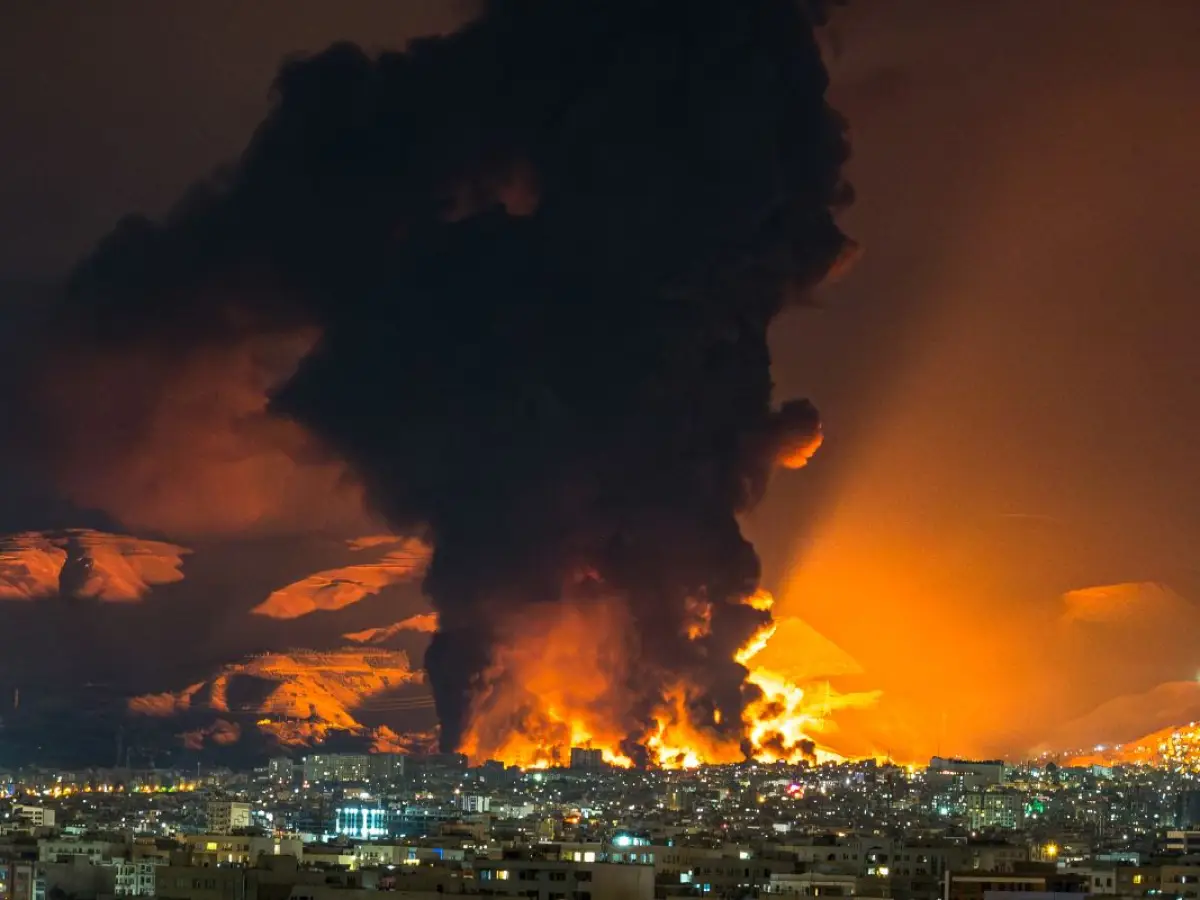
Starting on 7 March, Israel and the US have carried out multiple strikes on Iranian oil storage facilities. Many have been killed or injured, but the damage does not end there. The black cloud billowing from the explosions has made the air unbreathable, while numerous videos show streets lit up by flames and manhole covers and drains spewing dark liquid – highly flammable oil.
The Iranian Red Crescent Society (a humanitarian organisation equivalent to the Red Cross) has repeatedly warned that the toxic substances released by the fires could turn into acid rain, with harmful effects on the skin and lungs, urging the population not to turn on air conditioners, avoid going outside immediately after rainfall, and protect food exposed to it. The authorities have advised citizens to wear face masks, while residents affected report headaches and breathing difficulties, describing oily droplets settling on buildings and cars. The World Health Organisation has also issued a warning: according to Director-General Tedros Adhanom Ghebreyesus, the damage to Iran’s oil infrastructure “risks contaminating food, water and air”.
Exacerbating this “black rain” and the heavy metal contamination caused by the bombings is the fact that the rain falls on a city that has almost exhausted its water reserves. Tehran relies on five major dams which, following more than two decades of drought and inefficient management, are currently operating at levels close to 11% of their capacity, to the extent that in the southern parts of the capital, water has already stopped running from the taps in the winter of 2025. Tehran is running out of water: a historic drought has driven rainfall to record lows, and reservoirs across the country are drying up. Experts warn that the country is approaching “Day Zero”, at which point municipal water systems could collapse entirely. Last December, the government even went so far as to consider relocating the capital’s inhabitants, as the city is sinking as the dried-up aquifers give way.
In Iran, military attacks are in fact intertwined with an internal crisis that has been eroding the country’s ecological foundations for years. Water has been one of the silent driving forces behind the recent protests – the largest in recent years – which have spread to rural areas and turned deadly. As Nima Shokri, director and lecturer in geo-hydroinformatics at Hamburg University of Technology, explained to us in an interview for the specialist channel The Water Observer, “the scarcity of water has never been treated as a national priority”. Shokri believes the crux of the matter lies in the priorities set by the government, which has chosen to pursue a foreign policy so costly that “the environment, water, soil and natural resources were forced to subsidise this strategy so that the system could survive”.
The Gulf countries: rich in oil, poor in drinking water
On the very same weekend that Tehran was choking on smoke and black rain and Israeli-US strikes hit the desalination plant on the Iranian island of Qeshm, Bahrein accused Iran of damaging one of its own desalination plants. Along the Persian Gulf coastline, there are hundreds of desalination plants supplying water to millions of people, and today they lie within the range of missiles and drones: without these “water factories”, the region’s major cities simply could not survive. As Javier Blas reported on Bloomberg, quoting declassified CIA documents, as early as the 1980s, “senior government officials in certain countries” believed that water was “more important than oil for national well-being”.
Al Jazeera points out that, according to a 2023 paper by the Arab Center in Washington, DC, the Gulf Cooperation Council states account for around 60% of the world’s desalination capacity and produce nearly 40% of the planet’s desalinated water. This reliance is almost total – in Kuwait, around 90% of drinking water comes from desalination; in Oman, around 86%; and in Saudi Arabia, around 70% – and it is on the rise. Arab News highlights that Saudi Arabia, the world’s largest producer of desalinated water, intends to increase capacity from around 4.16 to over 6 million cubic metres per day by 2028, while in the Emirates, the Taweelah plant alone can produce more than 900,000 cubic metres per day, and new projects in Kuwait, Qatar and Oman are consolidating desalination as a key and increasingly automated infrastructure.
This network of “water factories” is almost entirely powered by fossil fuels: most of the Gulf’s plants are connected to oil- or gas-fired power stations, providing the energy needed to pump, pressurise and filter seawater through ultra-thin membranes in modern reverse osmosis systems or in older thermal plants. The end result is a perfect paradox: the very same fossil fuels that drive conflict and global warming also power the water infrastructure that keeps cities, hotels, industry and part of the agricultural sector alive in one of the world’s driest regions. This is a clear demonstration of what truly underpins the whole of human civilisation.
Cover: Smoke and flames billow above Tehran after Israeli-US air strikes hit an oil depot on 7 March 2026. Photo by Sasan/Middle East Images/ABACAPRESS.COM, IPA Agency