


Despite the current period of great international instability, Europe now holds a unique position: it is the continent that has produced the most ambitious regulatory framework for the ecological transition – the Green Deal, the Farm to Fork strategy, and the Carbon Removal Certification Framework currently under development – while also being home to some of the most creative and community-rooted experiments in urban carbon farming.
It has billions of euros in structural funds allocated to urban greening and sustainable agriculture, and, with the help of EU funding, exciting grassroots projects are emerging for the construction of regenerative urban food systems in Warsaw as well as in Paris and Antwerp. These projects are working, have established a replicable model, and together outline a practical vision of how European cities can become an active part of the climate solution.
Warsaw: the cooperative that returned land to the city
On the outskirts of Warsaw’s Siekierki district, a 3.6-hectare plot of land has remained unused for decades after a bridge-building project levelled the vegetable gardens growing there. Today, that land has become MOST, which means “bridge” in Polish but is also an acronym for Miejski Ogród Społeczny i Technologiczny, or “urban social and technological garden”, a model within the European landscape of community urban farming.
In 2020, a group of residents transformed that plot into a community farming project with no fences or hierarchies, where decisions are reached in assembly, work shifts are allocated on a quota basis, and surplus produce is shared among members or donated to local families.
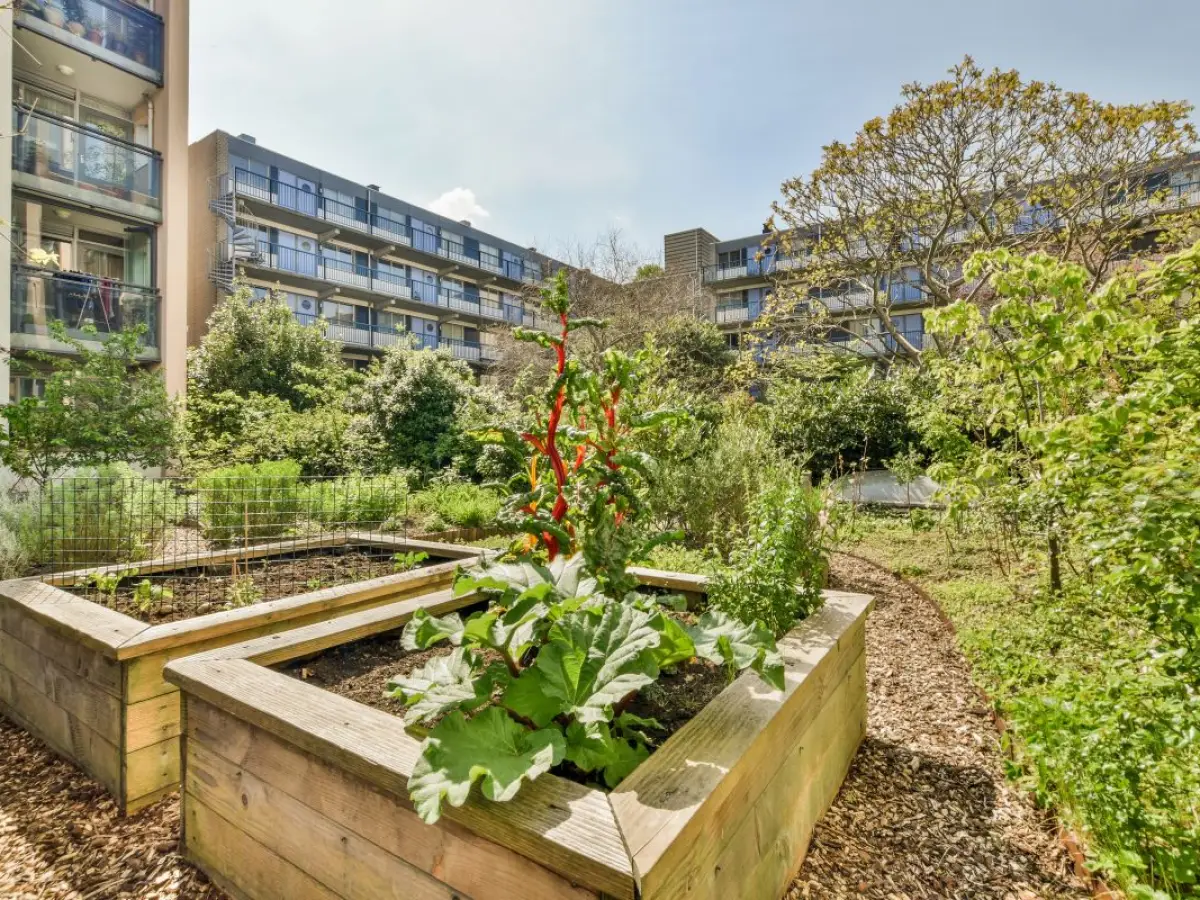
On a technical level, MOST works with simple, low-cost tools: elevated beds with compost-enriched substrates made from members’ organic waste, rainwater collection, and solar panels to power agricultural equipment. The result is a landscape that combines seasonal vegetables, aromatic herbs and nectar-producing plants and creates an urban ecosystem in which food production and biodiversity support one another.
In 2025, the cooperative joined EIT Food’s AMPLE Warsaw programme, which works with disadvantaged communities through food, culture and education. Participants grew, fermented and marketed a drink called Holobiont, with ingredients grown at MOST and packaging designed by the participants themselves. Mentioned as a best practice in the Interreg Europe CityZen programme, MOST serves as a model by offering a practical answer to a difficult question: how do you build an urban food system that truly belongs to the people who use it?
Paris, where waste fuels the field
In Paris’s 19th arrondissement, on a former disused railway site, La Ferme du Rail farm was established in 2019 on a 2,800-square-metre plot. Run by a social cooperative, it is supported by the local council as part of the Paris en Commun initiative. The farm grows vegetables using agroecological practices, provides training for workers in the process of reintegration, and carries out applied research with INRAE, the French National Institute for Agricultural, Food and Environmental Research.
The model is entirely based on circularity. Organic waste from eighty Parisian restaurants, produce market leftovers and municipal prunings are turned into compost and used as a substrate for producing organic food. Every week, La Ferme du Rail produces between three and four tonnes of compost and distributes its vegetables via a short supply chain to restaurants, local markets and families in the neighbourhood.
At the same time, more than thirty people are trained each year in the principles of regenerative agroecology. Research conducted in collaboration with INRAE has measured carbon sequestration – estimated at between 0.8 and 1.2 tonnes of CO₂ equivalent per hectare per year – and soil biodiversity, supplying scientific data that can be used by policymakers. La Ferme du Rail is at once a social enterprise, a research laboratory and a bastion of food justice and sovereignty, a practical example, especially given its location in a densely populated urban setting such as Paris.
Antwerp: a farm that created a supply chain
Formerly an industrial warehouse situated between the centre of Antwerp and an old military hospital, PAKT is a hybrid space: a restaurant, community centre and cultural hub, with, on the upper floor, almost 2,000 square metres of rooftop garden growing vegetables, herbs and fruit for local restaurants and residents.
This farm serves as the operational base for De Volle Grond, which translates to “fertile soil” in English, a cooperative of local farmers that distributes its produce throughout Antwerp, bypassing large-scale retailers entirely. The restaurants purchasing from PAKT know exactly who grew the food and how, thanks to the transparency of the supply chain, including the nutrient cycle.
Kitchen waste from the restaurant below is composted for the vegetable garden above. Rainwater is collected and reused for irrigation. The varieties grown are local and heritage, chosen for their resilience and to support the microbial diversity of the soil. The distance between those who cultivate the land and those who cook its produce is just a few metres.
The European framework
Behind these projects lies a regulatory framework that Europe has developed in recent years. In addition to recent legislation – notably the Carbon Removal Certification Framework and the Nature Restoration Law – two more projects are worth mentioning: the EU's A Soil Deal for Europe, a mission to establish one hundred Living Labs to carry out field experiments linked to research centres; and Lighthouses, that is, sites for the demonstration and dissemination of best practices by 2030, to lead the transition towards healthy soils in rural and urban areas, with Horizon Europe funding dedicated to research on carbon sequestration in urban soils.
In addition to these, the European Regional Development Fund, which finances urban green infrastructure and has been extended to cover peri-urban and urban agriculture, the Life programme, and the European Investment Bank, offering subsidised loans for nature-based solutions, also play a role.
These initiatives, however, are still largely inaccessible to small-scale community urban farmers. Funding applications are complex, the processes are lengthy, and the necessary administrative expertise is often beyond the reach of a neighbourhood cooperative. Municipalities, by acting as intermediaries – collecting applications, offering procedural support and ensuring the continuity of spaces – are investing in a long-term vision and creating successful best practices, proving how crucial governance is to success.
The key factors
Looking at MOST, La Ferme du Rail and PAKT, we observe a European model of urban carbon farming characterised by a number of specific features. The first is the centrality of cooperation: the most robust projects are those in which ownership and management are distributed among multiple stakeholders – farmers, local authorities, universities and associations – creating interdependent networks that make the projects resilient to political upheavals and changes in funding. The second is the incorporation of research: Europe has a system of universities and applied research that engages with local communities, and projects that leverage its measurement and documentation capabilities succeed in building scientific credibility and attracting resources in the long term.
The third characteristic is the availability of a regulatory framework that recognises the value of ecosystem services and sets the conditions for monetising them. The Carbon Removal Certification Framework could become a valuable tool in this regard, and its full implementation in the coming years will open up possibilities that are barely visible today. European cities that position themselves early on, building carbon monitoring systems, training certified operators and integrating urban carbon farming into their climate plans, will have a real competitive advantage in accessing carbon markets and the public funding that will support them.
Cities are not doomed to be passive sources of emissions; they can choose to become productive, resilient and climate-active ecosystems. Provided that the cases of Paris, Warsaw and Antwerp are not seen as virtuous exceptions to the rule, but become the new standard.
Cover: Envato image