

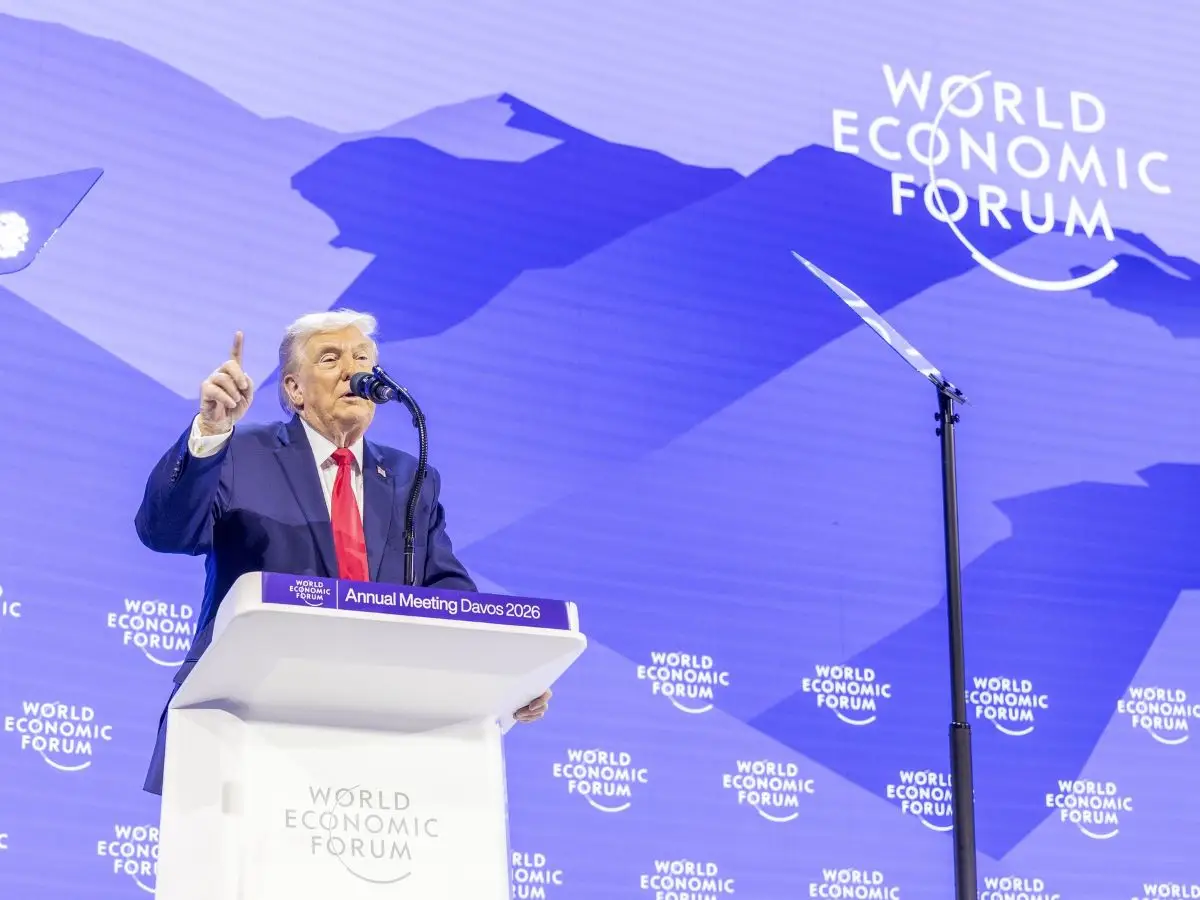

“Who the hell wants to defend a licence agreement for a piece of ice?” This may not be the most important sentence in Trump’s long speech in Davos today, 21 January, but it is perhaps among the most revealing. He uttered it in reference to Greenland, exposing his view that everything can be reduced to a business transaction. He showed up in Switzerland with a list of good guys and bad guys, and he didn't always make sense when he was talking about it.
The good guys are the customers who please him, and he mentioned few names on this list; the bad guys, on the other hand, are numerous: Denmark, ungrateful; Europe, losing its way and spending too much money on green policies; his arch-enemy Powell, chairman of the Federal Reserve, whose days are numbered (in that role, that is); Macron, mocked for his sunglasses (“What's going on?”, he said, hypothetically addressing him while the crowded room laughed); even Somalia, which “is not a country” and is home to “low IQ people”.
The Trump Show is taking centre stage today in Davos. The US president arrived two hours late due to a malfunction (a “minor” one, his staff is quick to clarify) on Air Force One, which compelled him to return and depart again on Air Force Two. His helicopter was waiting for him at the airport, along with the other security personnel and the rest of the delegation, and then his car (the heavily armoured “The Beast”). During the descent, the convoy of presidential helicopters flew over a message written in the snow on a nearby hill that read, “Stop wars now”.
The economic self-celebration
Trump spoke for over an hour and a half, beginning with a statement of intent in his opening remarks: “It’s great to be back in beautiful Davos, to address many friends, a few enemies.” He then moved on to his first point, which he dwelled on at length and also touched on at other points in his speech: “The US economy has never been so strong.” To be precise, he stated that “it’s booming” and that “after one year of my presidency, the US economy is booming” and “the borders are impenetrable”. In fact, he reiterated, “There is a reverse migration; we are sending back people with criminal convictions and mental health issues.” He then added, “One year ago, under the radical left Democrats [he's talking, however, about Biden, ed.], we were a dead country. Now we are the hottest country with a booming economy. If the Democrats had continued to run the country, we would be dead.”
According to the president, Americans are happy: “We have eliminated the queues at soup kitchens, we are helping property owners with cheaper mortgages, and wages have increased.” And it's all thanks to his draconian choices: “We cut bureaucrats and unnecessary regulations; 129 regulations cut for every new regulation.” In short, his first presidency was the “most financially successful ever” in US history, and with his second term, things are going even better.
Trump has claimed a long series of economic “successes”, from lowering inflation to attracting “18 trillion in investments” in one year, from natural gas production “at historic highs” to a reduction in the deficit of “27% in one year” with “federal spending reduced by $100 billion”. Not only that, but “we are leading the world in AI”, boasting an alleged US lead over China in the sector.
Criticism of Europe
When he looks beyond the confines of the United States, however, there are only reprimands and sad faces for those who disappoint him, reserving gratitude for those who have proven themselves to be cooperative, such as the Venezuelans: “Venezuela is going to make more money in the next six months than they’ve made in the last 20 years. […] We appreciate all of the cooperation” with the new Venezuelan leadership “and we’ve been given great cooperation. Once the attack ended, they said ‘Okay, let’s make a deal’. Other people should do the same.”
Then, he addresses Europe: “Certain places in Europe are not even recognisable, in a very negative way. I love Europe and I want to see Europe go good, but it’s not heading in the right direction. There are unchecked mass migrations.” He then proceeds to quote, without naming names, some friends of his who, returning back home from their travels, state that Europe has been getting worse, talking about the continent in a negative light.
Energy transition choices are also under scrutiny: “The dollars spent on wind farms are wasted, whereas in the US, we have shut down wind energy programmes and will not approve any new ones.” He has spared the United States the “energy catastrophe that has occurred in Europe” due to the “Green New Scam, the greatest hoax in history.”
“I stopped destructive energy policies that drove up prices and pushed jobs and factories to the world’s worst polluters,” Trump said in his speech, pointing the finger once again at the Biden administration.
Trump in Davos about Greenland
And finally, we reach the elephant in the room, Greenland: “I have tremendous respect for both the people of Greenland and Denmark, no nation or group of nations is in any position to secure Greenland other than the United States. Every NATO ally has an obligation to defend their own territory, so, even if I have tremendous respect for the Greenlanders, only the United States can defend those territories,” he declared to the completely silent room. Then, he adds, “I don’t have to use force. I don’t want to use force.” For now, the chosen path appears to be negotiation: “Greenland is a defenceless island in a strategic area, which is why I want negotiations to start immediately to discuss the United States buying it, as we have done in the past and as some European countries have also done in the past.” So, acquisition, ownership, not leasing.
“Greenland is in the middle of three giants, the United States, Russia and China,” Trump said, specifying that it “did not have the same value” as it does now when “we gave it to the Danes” and now “Copenhagen is ungrateful.” And as if to clarify a concept, or to answer the questions that many are asking, he reiterates that “there is nothing wrong with wanting to acquire territories.”
He is clearly less interested in Ukraine, arguing that Europe and NATO must resolve that war, while he has resolved eight others: “I have been working on the war in Ukraine for a year, and in the same period I have resolved eight wars. Putin called me to say he couldn't believe I had resolved the conflict between Armenia and Azerbaijan in one day, while he had been working on it for ten years. “A conflict that, among other things, he claims ’would not have started if the US elections had not been rigged.”
It is definitely Greenland, however, that keeps us at the edge of our seats. Because it also calls into question relations within NATO: “I don’t know if we can count on the support of our allies,” Trump confides. “We will be 100% committed to NATO, but I don’t know if NATO will be there for us. It’s a kind of wake-up call.” He wants that land, he says so several times in his speech: “The only thing we want from Denmark is this land where we are going to build the biggest Golden Dome ever built”. Golden Dome that will “defend Canada. Canada gets a lot of freebies from us, by the way. They should be grateful also, but they’re not. I watched their prime minister yesterday. He wasn’t so grateful, but they should be.” Canada ended up on his black list as well, then. In short, the US wants “this big chunk of ice called Greenland” and “if the Europeans say yes, we will appreciate it very much” and “if they say no, we will remember it”.
“It’s cold and poorly located, but it can play a vital role in peace and protecting the world,” Trump said. Incidentally, he said Iceland five times instead of Greenland, possibly because he got confused by repeating “ice” so often and called it “Ice-land”. In any case, thousands of memes were immediately produced on the web. He did not correct himself, but NBC was the first to notice. Trump went on to say, “It’s a very small ask. I just want a piece of ice for world peace.” He was undoubtedly referring to Greenland, so the Icelanders will have calmed down.
The end of transatlantic diplomacy
The room was filled with more than 5,000 people, with two notable absences, von der Leyen and Macron, prompting Trump's sarcasm: “I see that some prefer to stay at home and watch the decline from their windows, rather than sit at the table where the future is being written.” As for Italy's silence, having not yet formally rejected the Board of Peace, this seems to have been interpreted by Trump as an opening, as he hinted that “some smart partners are beginning to understand that the wind has changed”. This speech probably marks the end of transatlantic diplomacy as we knew it. For Europe, the message is clear: either accept US leadership on the Board of Peace and Greenland, or face a full-blown trade war.
At the same time, a survey was circulated in Davos: six out of ten millionaires from G20 countries believe that Trump's presidency is having a negative impact on global economic stability and the living conditions of ordinary people. 77% think that the super-rich exert excessive political influence, while 71% believe that extreme wealth can be used to significantly influence elections. The survey was conducted by Survation on behalf of Patriotic Millionaires International and accompanies the open letter Time to Win, signed by nearly 400 millionaires and billionaires from 24 countries.
Directed at world leaders gathered in Davos, the letter calls for action to counter the enormous concentration of wealth, starting with higher taxation of the super-rich. Among the signatories to the appeal – coordinated by Patriotic Millionaires International, Oxfam and Millionaires for Humanity – are Mark Ruffalo, Brian Cox, Brian Eno and Abigail Disney. “When even millionaires like us recognise that extreme wealth is detrimental to everyone else, there is no doubt that society is dangerously teetering on the brink of collapse,” the letter reads. “We are tired of watching it all happen. We must mobilise for our democracies, our communities, our future.” But these millionaires do not seem to be on Trump's list of good guys.
Cover: Donald Trump photographed by Benedikt von Loebell © 2026 World Economic Forum, via Flickr