
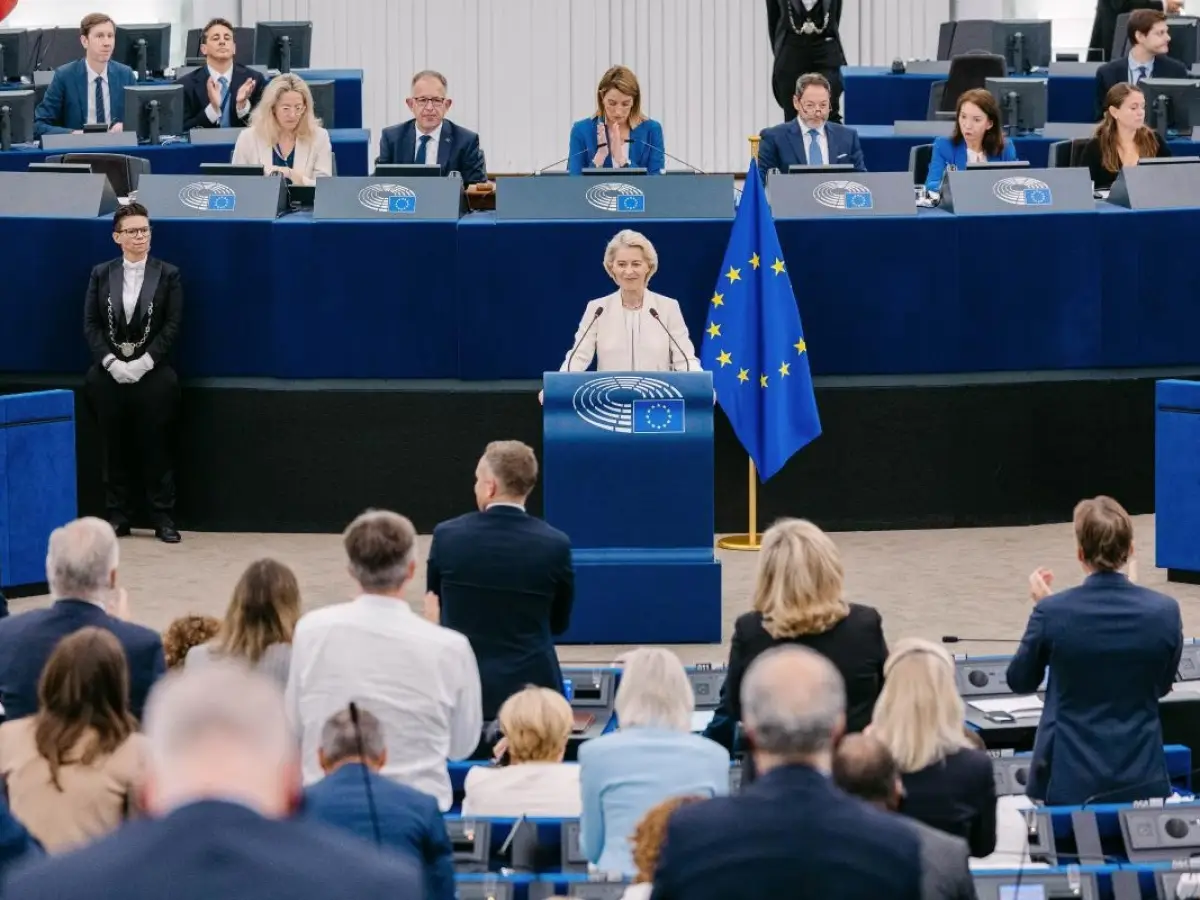

“It was the best of times, it was the worst of times”: Ursula von der Leyen quoted Dickens’s words describing the period of the French Revolution at the opening of her State of the Union address, delivered on Wednesday 16 September, at the European Parliament. “And it is also a fair description of the world we live in,” she added, emphasising the speed of change and the unprecedented nature of the challenges Europe is facing.
In the first part of her speech, von der Leyen immediately turned her attention to the issues closest to her heart, highlighting the EU’s success in freeing itself from its “toxic” dependence on Russian fossil fuels and the increase in military spending of almost 80% in the last five years alone – a move she described as essential for survival in a world she claimed had become “openly hostile”.
Canadian Prime Minister Mark Carney was also present in Strasbourg today, having distanced himself increasingly from Trump and the United States. “We see the world with the same eyes,” stated von der Leyen, who then added, taking the opportunity to strengthen ties with Ottawa, that she would like to work with Carney to ensure that Canada becomes the EU’s first associate member (a proposal that is, for the time being, purely political).
Von der Leyen also emphasised that Europe and Canada share a commitment to democracy and the freedom to choose who to collaborate with. Thanks to the Comprehensive Economic and Trade Agreement (CETA), goods trade between Canada and the EU has already grown by 75% in less than a decade, but the focus will now shift to the creation of a shared space of prosperity and economic security. The partnership will cover several strategic sectors: energy, critical raw materials and batteries, artificial intelligence, quantum technologies, and cyber and economic security.
An update on energy and critical raw materials
“Europe cannot remain an industrial powerhouse if its energy prices are structurally too high,” the President stressed. The war in Ukraine has already prompted the EU to diversify its supply sources, but for Brussels, dependence on fossil fuel imports remains a problem. Since the start of the conflict, von der Leyen noted, these imports have cost Europe an additional 90 billion euros, with no new energy being added to the system. Furthermore, the recent crisis in the Strait of Hormuz has shown once again just how exposed the European economy remains to external shocks affecting fossil fuels.
The Commission’s proposed response therefore centres on electrification and increasing domestic energy production. The aim is to double the share of electricity in the European energy mix by 2040, adopting a “technology-neutral” approach that encompasses renewables, nuclear power, biomethane and other sources. Greater electrification could, in fact, reduce Europe’s expenditure on fossil fuel imports by 260 billion euros a year.
By 2025, the EU had installed over 80 gigawatts of new renewable capacity, and a capacity six times greater is still awaiting connection to the grid. This, according to the Commission, highlights the need to accelerate the European Networks Package, speed up connections and increase storage capacity.
The same logic of reducing dependencies applies to critical raw materials. For certain strategic materials, Europe relies on China for over 80% of its supplies, while for some rare earths, the figure exceeds 90%. To reduce this vulnerability, Brussels will therefore establish a new European Critical Raw Materials Corporation, responsible for contributing to the supply and stockpiling of raw materials deemed strategic and capable of guaranteeing supplies for all relevant sectors, from electric cars to microchips, including defence.
The climate after a summer of extreme weather events
Towards the end of her speech, von der Leyen also included climate change within the central framework of vulnerability. “This summer was the summer of truth,” she said, recalling the more than 35,000 additional deaths linked to heatwaves and noting that Europe is warming at twice the global average rate. “These were the hottest summer months ever – but probably the coolest of the years to come.”
The President then emphasised the need to combine mitigation with a more structured strategy for adaptation. Next month, the Commission will present a new framework for climate resilience, which will identify the 100 most vulnerable areas in Europe and, for each one, assess the main risks and the most appropriate way to address them.
Among the measures announced is a Climate Insurance Alliance, intended to address the so-called protection gap: to date, only around 25% of losses caused by disasters in Europe are covered by private insurance. The Commission hopes, therefore, to prevent public budgets from ending up acting as the insurer of last resort.
A European Heatwave Plan will also be introduced, focusing on early warning systems, health preparedness, urban adaptation and cooling systems, paying particular attention to the most vulnerable people.
Von der Leyen then turned her attention to water. Europe’s water infrastructure loses almost one litre for every four, mainly due to leaks in the networks, while droughts and low rainfall are increasing pressure on agriculture, industry, energy and supply chains. The response will be a new European Water Initiative, which the Commission hopes will address the efficiency and security of water resources.
Finally, forest fires: following a summer in which civil protection services were mobilised on an unprecedented scale, von der Leyen announced a group of experts tasked with examining prevention and preparedness, from civil-military coordination to strengthening operational capabilities. Among the proposals on the table is a future European fire-fighting corps. As early as the summer of 2026, the EU had organised the largest coordinated response operation to date, with nearly 800 pre-positioned firefighters and aircraft ready to intervene in the most vulnerable areas.
AI as new strategic infrastructure
For the Commission, artificial intelligence is a key infrastructure for both the economy and security. While the AI Act is cited as the key instrument for introducing safeguards and addressing potential risks (such as more sophisticated cyberattacks), Brussels also aims to boost Europe’s computing capacity, including by means of new public and private funding schemes for start-ups and businesses deemed strategic, since, as von der Leyen reiterates, “Europe will need its own capabilities – in particular to protect our national security”.
Significant contradictions are emerging on this front, which were not fully explored in the speech: namely, that increasing computing capacity actually entails a growing demand for energy, water, land and infrastructure.
Reactions from the European environmental movement
The European Environmental Bureau (EEB), an organisation bringing together over 190 environmental associations in 41 countries, has recognised the importance of efforts to phase out fossil fuels, but has raised concerns that climate resilience is being treated separately from policies that continue to put pressure on ecosystems.
“President von der Leyen is right to call this Europe’s ‘summer of truth’,” said Patrick ten Brink, Secretary General of the European Environmental Bureau. “Europeans have lived through another summer of heat, drought and devastating fires. The question now is what we do with that truth. Climate resilience cannot be one chapter of Europe’s strategy while other policies continue to deepen the risks we face.”
On the subject of artificial intelligence, the EEB has highlighted an aspect still in the background in the Commission’s discourse: the material footprint of digital infrastructure. “Europe’s race for computing power will require energy, water, land and infrastructure. Building it in a ‘clean and efficient way’ must mean respecting environmental limits, proper impact assessments, permitting safeguards and access to justice. Europe should lead on AI – but it should also lead on making AI genuinely sustainable, transparent and democratic,” highlighted Patrizia Heidegger, Deputy Secretary General of the EEB.
The point of contention, therefore, does not so much relate to the need to strengthen European resilience but rather to the way in which this is defined. In von der Leyen’s speech, energy security, industrial competitiveness, critical raw materials, climate adaptation and artificial intelligence are all linked to the – legitimate – need to reduce external dependencies and increase Europe’s capacity to control its own strategic infrastructure. However, this strategy risks being incomplete if it relegates environmental protection to a marginal role.
Faustine Bas-Defossez, Policy Director at the EEB, reminds us of this in no uncertain terms: “While President von der Leyen talks about a ‘summer of truth’, today’s speech offered a contradictory response: treating some of the symptoms of our environmental crisis while weakening the protections needed to tackle its causes. Nature and pollution were conspicuously absent from today’s State of the Union. The ambition to stay the course on our climate targets cannot sit alongside a competitiveness agenda that treats environmental protections as obstacles to be removed.” Then she concludes: “Europe cannot build competitiveness, security or prosperity on collapsing ecosystems and escalating climate disruption. The human and economic toll of this summer was a stark reminder of that.” Bureaucratic procedures can be simplified, but they cannot be streamlined to the point of making a drought or a flood disappear.
Cover: Ursula von der Leyen photographed by Christophe Licoppe © European Union 2026