


Three billion euros towards diversifying the supply of critical materials such as rare earths, cobalt and lithium: this is what the European Commission will be putting on the table over the next 12 months in order to reduce dependence on China and protect European industry from the volatility of critical raw material prices and geopolitical tensions. It will happen via the RESourceEU Action Plan, an initiative approved on Wednesday 3 December in support of the Critical Raw Materials Act.
Geopolitical tension over critical minerals is growing
By this measure, the EU Commission plans to design financial de-risking tools, remove bureaucratic obstacles, and fund mining projects that will support strategic sectors, including the net-zero and digital industries, aerospace, and defence.
“This is a necessity, as the situation remains alarming today,” Stéphane Séjourné, Head of EU Industry, stated at the press conference. “Export licenses are granted sparingly, and at the cost of information that is often considered an industrial secret. One thing is certain: tension over raw materials is here to stay. That is why we need a systemic response.”
The €3 billion will be mobilised from EU funds and the European Investment Bank, which declared earlier this year that it would allocate €2 billion in financing to critical minerals made in Europe. The EU executive will also allocate resources from the InvestEU fund, the Innovation Fund, the Battery Booster, the European Defence Industry Programme and the Horizon Europe research programme.
Two mining projects are being prioritised: from 2028, Greenland Resources will begin extracting pure molybdenum (Malmbjerg project), with magnesium as a by-product. Meanwhile, in the Upper Rhine Valley in Germany, Vulcan Energy Resources has secured €2.6 billion in funding for the extraction and annual production of 24,000 tonnes of lithium.
How to reduce dependence on China
China presently covers approximately 98% of the European Union’s rare earth requirements and 60% of its critical minerals. As an indication of the extent of dependence on Beijing, Brussels officials have revealed that, of the 20,000 tonnes of permanent magnets purchased annually by the 27 member states, 18,000 tonnes come from China and only 1,000 are produced in Europe or the rest of the world. Permanent magnets are used everywhere: from car doors and refrigerators to magnetic resonance imaging machines.
In order to cut this dependence by 50% by 2029, one of the targets listed in the RESourceEU Action Plan, the European Union is taking a look around, by seeking industrial cooperation with like-minded countries, that is, countries that share the same “ideals”. In addition to a strategic partnership already finalised with South Africa, EU officials will negotiate with Brazil and evaluate possible investments in Ukraine and the countries of the Balkan Peninsula.
At the beginning of 2026, the Commission will establish a European Critical Raw Materials Centre to deliver market intelligence, guide and finance strategic projects with private and public partners. In addition, a “raw materials platform” will be established to pool orders from companies and create joint stocks.
Brussels is also announcing new restrictions on the export of permanent magnet scrap and waste, along with targeted measures on aluminium scrap. A focused amendment to the Critical Raw Materials Act strengthens product labelling requirements and incentivises the recycling of pre-consumer permanent magnet waste by introducing recycled content quotas that will support continental recycling capacity.
Finally, a separate plan scheduled for mid-2026 will promote domestic production of recycled fertilisers and nutrients, with the aim of reducing dependence on fertilisers based on critical raw materials.
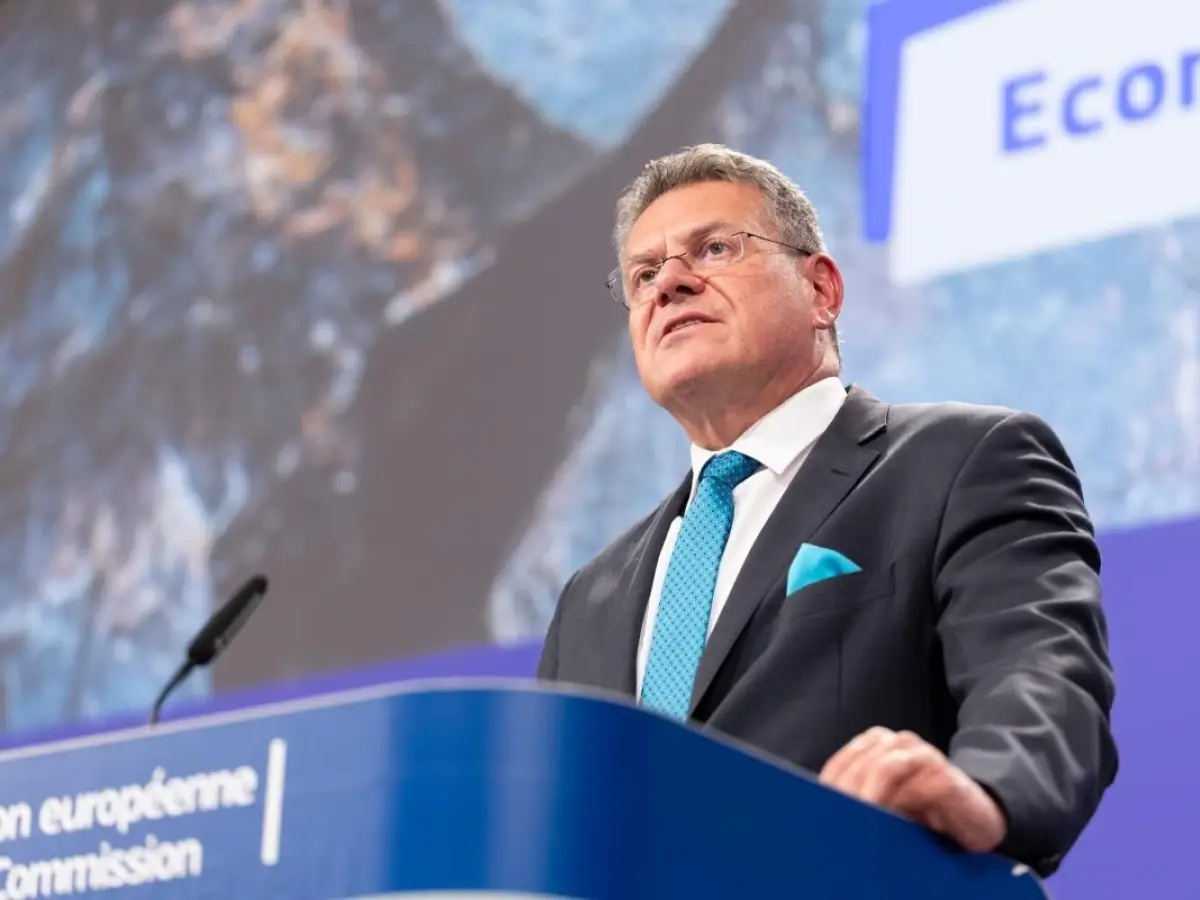
Cover: Maroš Šefčovič at a press conference, photographed by Lukasz Kobus © European Union, 2025