


E-waste is not just a recycling problem. It is a consumption problem, a governance problem, and ultimately a responsibility problem that Europe quietly and efficiently outsources. Not into statistics, not into political speeches – but into shipping containers. And into countries that neither benefited from the original value creation nor have the means to safely manage the consequences.
The figures are well known, but their implications are pushed aside: The latest Global E-waste Monitor of the United Nations estimates global e-waste generation in 2022 at 62 million tonnes – the fastest-growing waste stream worldwide, growing three times faster than household waste. And while volumes continue to rise, only 42.8% of Europe’s e-waste is officially documented, collected, and recycled.
In 2025, 14.4 million tonnes of electronic equipment were sold in the EU – an increase of 8G% since 2012 – resulting in per-capita consumption of 33–45 kg in countries such as Germany, France, Austria, and Italy. Yet only 5.2 million tonnes of e-waste were collected and routed through official recycling systems. The rest disappears into informal structures, landfills, or export chains that do not solve the problem but merely relocate it.
This is not a technical mishap. It is a political and societal pattern: growth without strategy and unchecked consumption without consequences.
The blind spots of Europe’s self-image
Europe generates more e-waste per capita than any other region in the world. And yet the belief persists that the problem is “under control” as long as citizens drop devices at the correct collection points or use initiatives like repair bonuses. The symbolic act – proper disposal – becomes moral relief for consumers and policymakers alike.
But this is precisely where the real discomfort begins: A significant share of what Europe classifies as “treated” is not processed within Europe. It is exported – often declared as “used goods”. In practice, the boundary between reuse and waste is fluid. And this grey zone is no accident; it is a systemic effect. It allows risks to end up where regulation is weaker and resistance costs less. Europe separates waste – and separates responsibility.
West Africa is not an outlier, but a mirror
When cables are burned in informal recycling sites and dumps in Ghana to extract copper (Environmental Health News, 2024), European debates often frame this as a local problem: inadequate infrastructure, weak regulation, informal labor. This narrative is convenient because it reverses cause and effect.
Places such as the former Agbogbloshie site do not show that “Africa” cannot recycle. They show what happens when European overproduction, short product lifecycles, and deliberately tolerated regulatory grey zones in export controls collide with global inequality.
According to the Center for International Environmental Law, this grey zone – or “loophole” – allows the EU and the US, which together generate nearly 50% of global e-waste, to export it easily by declaring it as second-hand goods, under the pretense of repairability.
Informal recycling structures are not weaknesses in the system. They are an economic response to a global material flow whose value Europe captures and whose toxic costs are borne elsewhere. Many African countries have made enormous progress in recent years, developing creative and efficient solutions – not out of comfort, but out of necessity, because the Western consumer economy left them no alternative. Initiatives such as those by GIZ (German Agency for International Cooperation), as well as NGOs and impact-driven companies supporting this transition, are undoubtedly valuable. And yet consumption as the root cause of the problem must change.
The wrong debate: it’s not just about smartphones
Public discussions still tend to reduce e-waste to phones and laptops. In reality, the largest share comes from a far less visible stream: household appliances, toys, tools, chargers, cables, smart small devices – in short, the electronic background noise of everyday life (E-Waste Monitor, 2025).
Many of these products are not designed for longevity. They are difficult to repair, glued instead of screwed, and spare parts are missing or prohibitively expensive. The result is a culture of rapid replacement – and a recycling system that has never caught up with the reality of product design.
Recycling as a moral alibi
The EU has a clear waste hierarchy: prevention, reduction, reuse, repair – and only once the higher-value potential of a product has been exhausted does recycling follow. In practice, however, e-waste is treated almost exclusively as an end-of-life issue. As a question of collection rates. The container becomes the symbol: once it is picked up, the problem is considered solved.
But this is a fallacy. A policy that raises recycling targets without changing production and product design mainly produces one thing: good PR alongside an unchanged flood of materials. It allows Europe to present itself as sustainable while shifting the uncomfortable parts of the value chain out of sight. What is needed are solutions that are economically viable – both for the EU and for the Global South.
Europe’s prosperity has a material side
E-waste exposes a deeper tension within Europe’s sustainability project. An economic system built on ever-shorter product cycles cannot be repaired at the end of the chain. And a continent that preaches global standards loses credibility when it exports the consequences of its own consumption.
As long as prevention, durability, and reduced consumption remain politically inconvenient, recycling will serve as a moral excuse: Europe can preserve its self-image – while the material consequences appear elsewhere.
This is not a failure of technology. It is a failure of honesty. What we need are clear rules for companies, manufacturers, and exports – and a different way of viewing our everyday products as consumers. Because only if we rethink and reduce consumption, repair products, keep them in circulation, refurbish them, and finally recycle them properly, can Europe truly speak of progress in the circular economy.
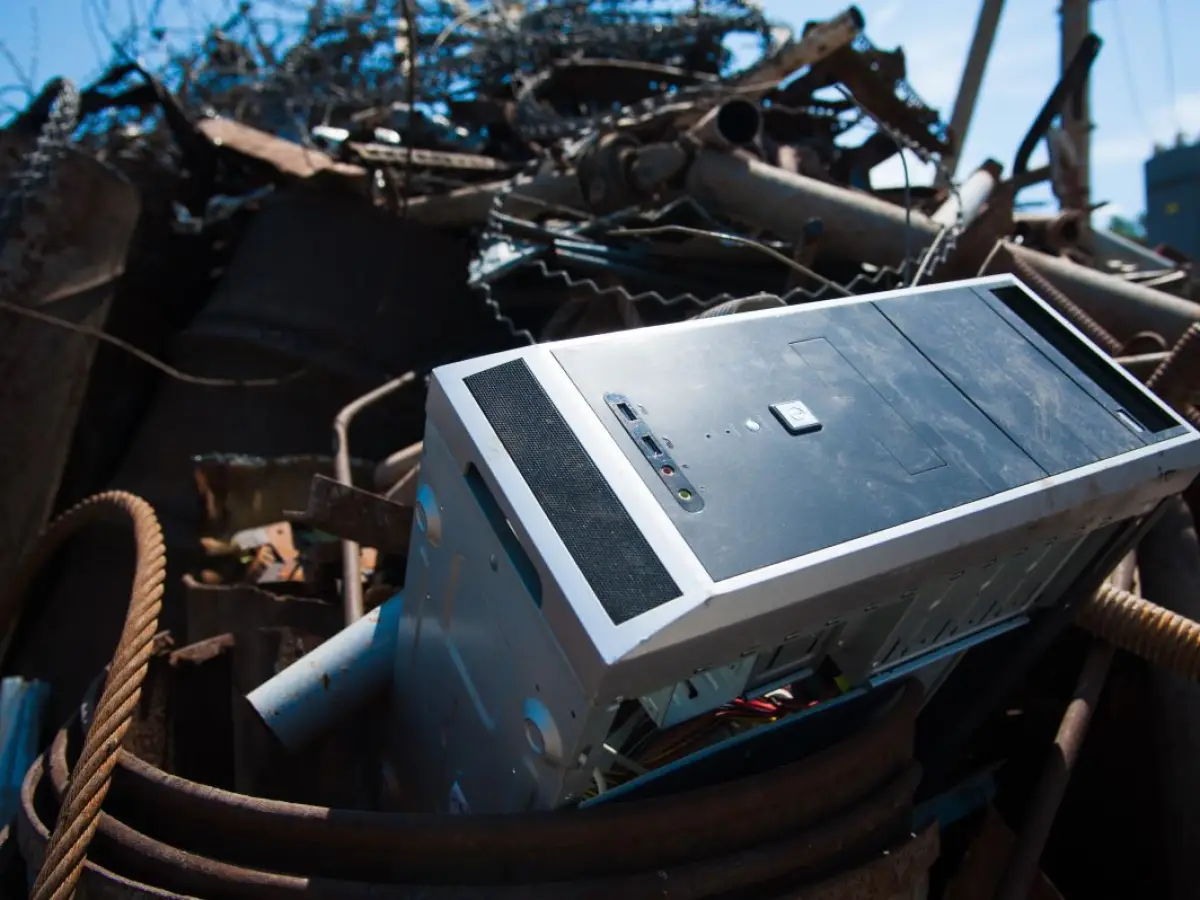
Cover: Envato image