

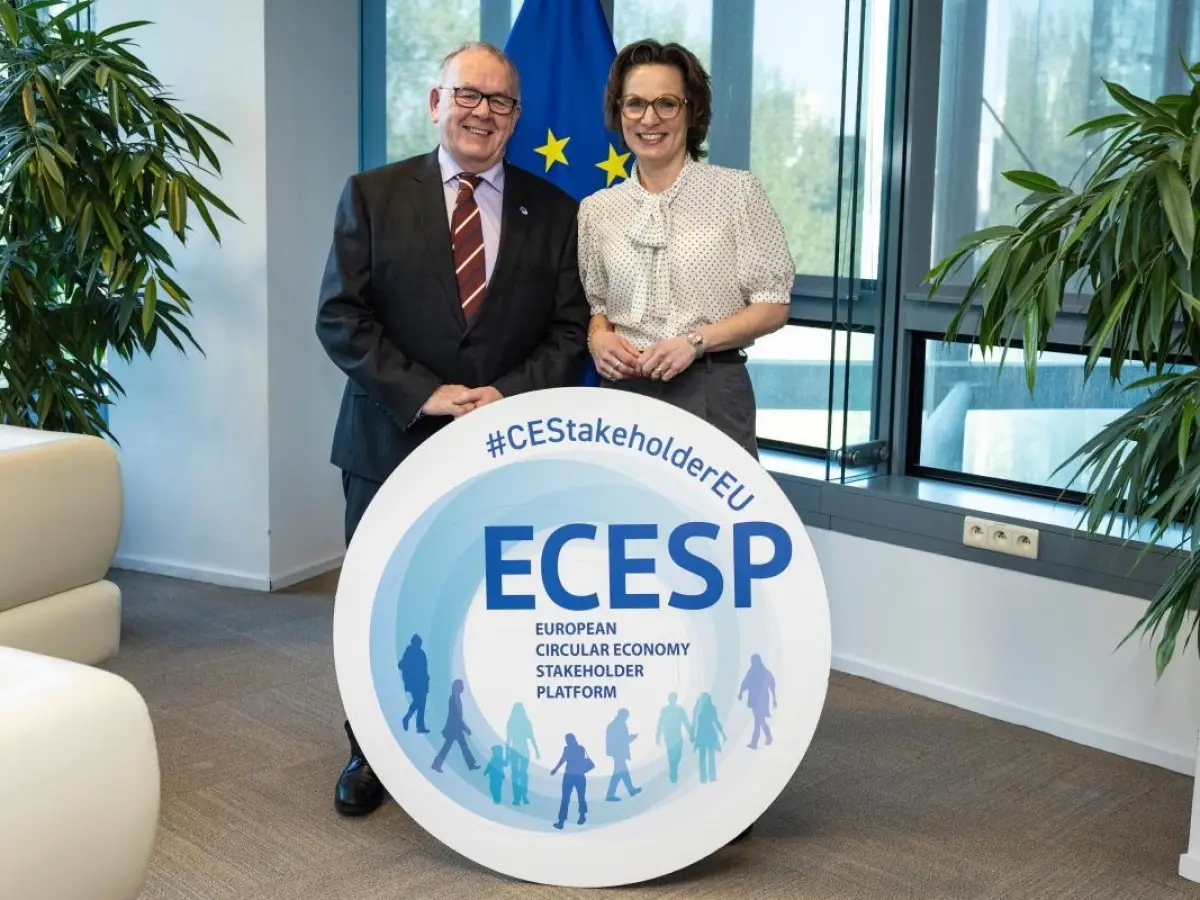

Brussels – “In times of instability, circular economy is not a choice, it’s a necessity.” With these words, European Commissioner for the Environment Jessika Roswall kicked off the 2026 edition of the annual conference of the European Circular Economy Stakeholder Platform (ECESP), emphasising the connection between circularity, economic security and the Union’s strategic autonomy. The event, a joint initiative of the European Commission and the European Economic and Social Committee (EESC), took place on 22 and 23 April in Brussels, gathering policymakers, businesses, financial operators, civil society and regional representatives for a debate already looking ahead to the Circular Economy Act, anticipated in the third quarter of 2026 in the Commission’s work programme.
“A sense of urgency is fundamental; we cannot afford to wait. The Circular Economy Act is part of the European Union's strategic autonomy. Without an effective circular economy, we will be more dependent on others,” Enrico Letta, author of the Report on the Future of the Single Market and president of the Jacques Delors Institute, warned from the stage.
While the message is to not wait for the “circle to be squared” before finalising and moving forward with it, it is becoming increasingly clear that the circular economy represents a stress test of Europe’s ability to overcome still unresolved historical and regulatory fragmentation. This ranges from the differing definitions of waste, by-products and secondary raw materials to the creation of a true single market for circular materials. Without counting other decisive levers, such as shifting taxation from labour to the use of materials and energy (in particular virgin materials and polluting energy sources), the strategic use of public procurement, and the introduction of standards and liability regimes capable of making the linear model progressively less viable, even from an economic perspective.
Circularity as a security policy
According to the European Environment Agency, the EU’s circularity rate stood at 11.8% in 2023: higher than other regions of the world, but virtually stagnant in recent years. The policy objective, within the framework of the Clean Industrial Deal, is to double it to around 24% by 2030, turning circularity into a driver of competitiveness, resilience and reduced resource dependency.
Enrico Letta’s speech, however, placed the Circular Economy Act within a broader trajectory: the transition from the current “single market” to the “One Europe, One market”. Recounting the history of EU integration, Letta identified three areas that have remained “neglected” since the era of the single market in the 1980s and 1990s: energy, connectivity and the financial market, today at the heart of Europe’s vulnerabilities in terms of competitiveness and security.
In this context, circularity would not be a sector-specific issue, but rather one of the pillars for strengthening the EU’s economic foundations. Letta emphasised various points, starting with “scale”: without a genuine single market for energy, finance and transition technologies, Europe will continue to fragment its industrial potential, while around €300 billion of European savings flow to the United States, fuelling US companies’ ability to acquire European assets. To speed up the process, according to Letta, a change in regulatory approach is also necessary: moving, where possible, from directives to regulations in order to ensure directly applicable and uniform rules within the single market, thereby reducing the scope for national discretion and legislative fragmentation.
A single market also for circular materials
In this regard, several speakers at ECESP highlighted the need for a genuine single European market for secondary raw materials, in line with the promises of the Circular Economy Act, capable of scaling up recycling and circularity to an industrial level. Nevertheless, the debate revealed that the issue extends beyond this: without clear rules for by-products as well, there is a risk of stifling many flows of reusable materials at the source, slowing down the efficiency of the entire system. The fundamental distinction is between waste, by-products (which are not waste) and secondary raw materials (which always originate from waste).
“The key question is whether a particular material is legally classified as waste or not. If it is not waste, it can be treated as a by-product under Article 5 of the Waste Framework Directive, which sets out specific conditions and may be further detailed in secondary legislation,” Eva Blixt, senior advisor at Jernkontoret, the Swedish steel industry organisation, explains to Renewable Matter. “Debates typically focus on waste and secondary raw materials, with little consideration given to by-products. This is significant, as secondary raw materials always originate from waste but are not clearly defined in the Waste Framework Directive itself, only in the taxonomy, which explicitly links them to waste. Rather than redefining secondary raw materials and blurring the line between waste and by-products, a better solution would be to draw up new legislation. This would create an EU-wide market for by-products, similar to that for secondary raw materials, and facilitate the efficient use of materials by recognising them as by-products rather than waste.”
Investment: still the Achilles’ heel
While the regulatory landscape is in a flurry of activity, the financial sector remains marked by a paradox: there are more funds available at the European level, yet few are flowing towards circular business models, particularly in the “upstream” stages of the product life cycle. At ECESP 2026, the finance panel highlighted a key figure: investment in the circular economy within the EU has increased significantly in recent years but still represents only around 1% of the European budget. The EIB Group has also increased its annual funding for circularity by 167% between 2020 and 2024, but this still represents only a small fraction of the total.
The result is a persisting investment gap towards the 2040 goal of a fully circular economy, with significant deficits in sectors such as construction, textiles, batteries and vehicles, and above all in the circular design and end-of-life management phases, which are critical to keeping materials in use for longer. Markets are struggling to grow and reach the necessary scale, while most new investment is likely to come from the private sector.
This is where the perspective of Andrei Geica, Founding Partner at Sporos Platform and a member of the ECESP Coordination Group, enters the picture. He summarised his remarks to Renewable Matter as follows: “First, capital behaves very much like water: it naturally flows along the path of least resistance toward the highest risk-adjusted returns. In practical terms, this means that financial gravity is still overwhelmingly tilted toward linear models. This also explains the persistence of the financing gap. Second, capital availability does not guarantee outcome quality. We have clearly seen this in large-scale investments as well. Third, companies – especially SMEs – are rarely fully rational actors. There is significant inertia, resistance to change, and a strong tendency toward short-term thinking, particularly in some of the sectors under discussion. Regarding this third point, there is only so much we can do. On the second, capital is widely available, but not for circularity. That leaves the first as the primary area for intervention: the direction of capital flows.”
In his view, for capital to flow, circular models must deliver predictable, bankable returns – something that depends primarily on public policy, not private investors. “Tools like liability regimes and demand mechanisms can shift incentives by making linear models less profitable and circular ones more attractive. While existing instruments such as EPR help create markets, they focus mainly on end-of-life. The key challenge instead lies upstream: ensuring that products not designed for circularity become economically unviable,” Geica concludes.
In terms of solutions, perhaps one of the most interesting examples to emerge during ECESP is the launch of the Circular Economy Finance Group (CEFG), a partnership between the UK and the Netherlands aimed at unlocking public and private investment to accelerate the transition to a sustainable, low-carbon economy. “This initiative, featuring senior officials from both nations, aims to unlock up to £10bn in investment over the next decade, enhancing recycling infrastructure and creating jobs. The collaboration supports the UK's ambition for a circular economy by 2050 and the Dutch government’s 2030 Circular Economy Programme,” explains Andrew Morlet, Circular Economy Lead at Standard Chartered, to Renewable Matter. The CEFG is co-chaired by Morlet himself (who is currently also Senior Advisor for circular economy impact investing at Nordic Capital and former CEO of the Ellen MacArthur Foundation) and by Jeroen Derkx, Senior Business Development Manager at Invest-NL, reflecting the growing role of financial intermediaries in unlocking capital for circular business models.
The social dimension of circularity
Alongside regulatory and financial efforts, participants emphasised a third, often overlooked pillar: the social and participatory dimension of the circular transition. Séamus Boland, President of the EESC, reaffirmed the central importance of working in partnership with businesses, trade unions, farmers, consumers and civil society, pointing out that the circular economy “must be grounded in everyday reality” and not remain confined to the language of technocratic elites.
The reference to young people was particularly strong. For Boland, it is not merely a question of “engaging” the younger generations but, as an old Irish saying goes, of “praising the youth and making them flourish”, recognising that their participation improves the quality of policies, aligns ambition with concrete practices and lends credibility to the promise of a just transition. The session dedicated to young people’s perspectives on the Circular Economy Act, led by Nicoletta Merlo of the EESC Youth Group and Alba Mullen and Dario Barcella of Generation Climate Europe, also saw a strong call for circularity that goes beyond merely optimising material flows but also tackles social inequalities, working conditions in supply chains and equitable access to circular services.
In this context, the conference emphasised that the European Circular Economy Stakeholder Platform (ECESP) is no longer merely a consultative forum; rather, it is an evolving policy framework. As Ladeja Godina Košir, founder and executive director of Circular Change and co-chair of ECESP, explained to Renewable Matter, the three key messages from this year’s event are clear: “This conference is strongly focused on the Circular Economy Act, and from the platform’s perspective, it is crucial to contribute to a document that is currently taking shape. One key message is that the platform enables stakeholders to actively participate in this process. A second important point is that the platform is no longer seen as merely optional. Over the past ten years, it has become significantly stronger and more relevant for the European Commission and other stakeholders, with its members increasingly recognised as valuable partners. Finally, while much of the discussion centres on technology, industry, and AI, the human dimension remains essential. The platform is built by people, for people, offering a space to share both aspirations and concerns. In a time of uncertainty, it provides a sense of community where individuals can feel safe, heard, and supported.”
Cover: photo by Lukasz Kobus