

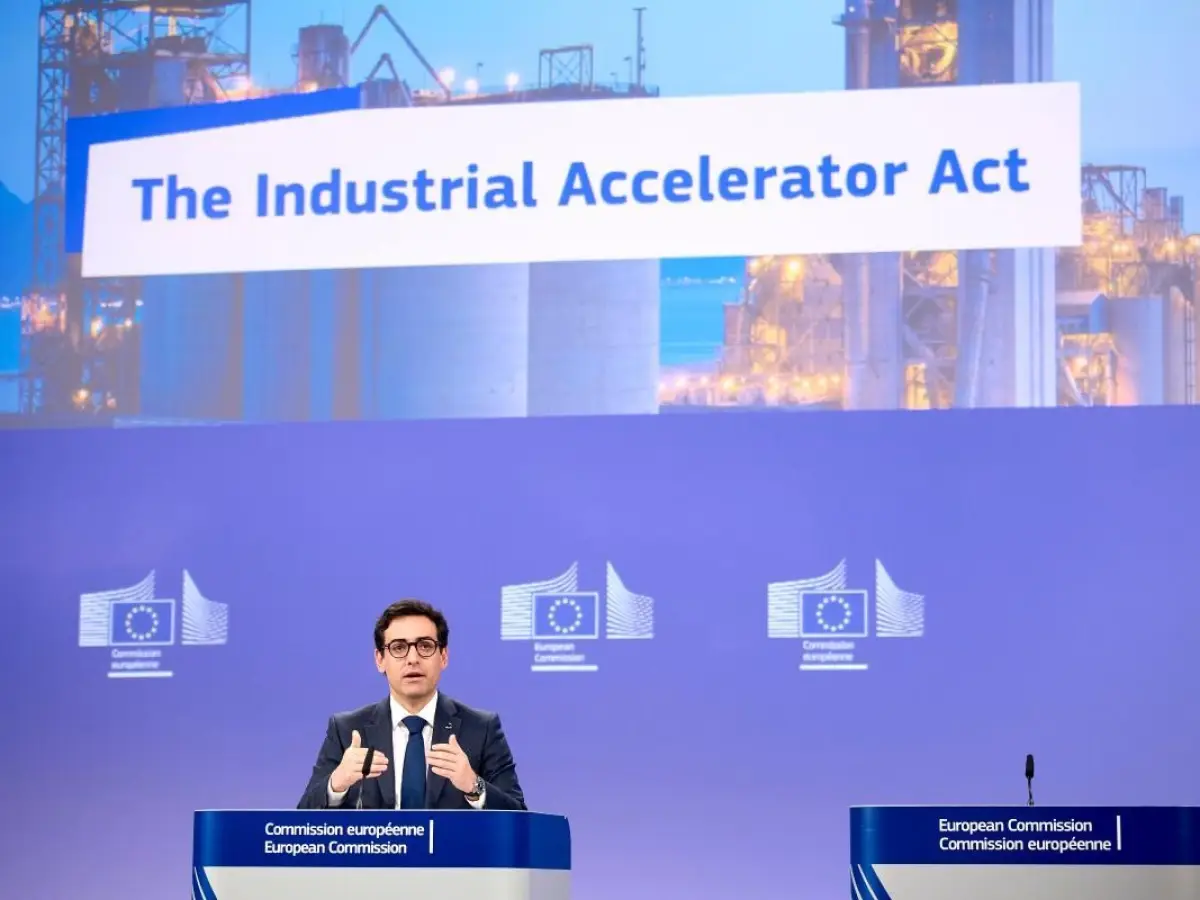

From Brussels – Today, Wednesday 4 March, the European Commission unveiled the Industrial Accelerator Act (IAA), one of the pillars of the new Clean Industrial Deal, designed to strengthen the competitiveness and decarbonisation of European industry. After a long process marked by delays, the legislation aims to reinforce the Union’s industrial base in sectors deemed strategic, from energy-intensive industries such as steel, aluminium, and cement, to the automotive sector and renewable energy technologies.
The proposed regulation seeks to ensure that public, private, and foreign investment prioritises production within Europe and helps create markets for low-emission products. In particular, when public funds are deployed through procurement, auctions, tax incentives, or state aid for these strategic sectors, a minimum share of Made in Europe content, components and value added generated within the Single Market, will be required.
The text stresses, however, that the EU’s international obligations on public procurement under the WTO Government Procurement Agreement (GPA) and relevant bilateral trade agreements of the EU must be taken into consideration. Defining the geographical boundaries of what counts as “European” − a matter debated until the last minute alongside the quota levels − could therefore extend to the United Kingdom and Switzerland, in addition to Norway, Iceland, and Liechtenstein, already included in the European Economic Area.
France has led the push for the proposal, presented by European Commission Executive Vice-President for Prosperity and Industrial Strategy Stéphane Séjourné, a former French government minister, who only weeks ago stated that it “brings about a real change in European economic doctrine”.
This statement was reiterated today during the press conference, when discussing the EU's strategic autonomy. “Our goal is clear: we want to ensure that industry represents 20% of European GDP by 2035, in contrast with 14% today. In the face of mass subsidies from some competitors and market distortions, our companies are at a disadvantage on their own playing field, which is the European market. How can we explain to our citizens that decarbonisation is an opportunity if 100% of our batteries are ultimately made in China? Who will invest in our industrial sites if our products are hamstrung by unfair dumping? We must produce more in these strategic sectors”.
Tristan Beucler, an industrial analyst at Strategic Perspectives, echoed the sentiment: “This proposal sends an important message: the EU is ready to use industrial policy to support its most strategic sectors to decarbonise and produce in Europe. Now, it is crucial that the debates in the European Parliament and Council strengthen the Industrial Accelerator Act’s main pillars”.
Made in Europe, sector by sector
The Industrial Accelerator Act will focus on the production site rather than the nationality of the company. For the most energy-intensive sectors, the IAA confirms the drafts circulated in recent days, translating the “Made in Europe” clause into specific thresholds: at least 20% low-carbon steel, minimum quotas of 5% and 25% for low-carbon aluminium produced in the EU, and a 5% share of low-emission, European-origin cement in public procurement. On the clean technology front, the legislation seeks to define which components of wind, solar photovoltaic, electrolysers, heat pumps, and nuclear must be European. Meanwhile, electric cars receiving public support must still be assembled in the EU, with at least 70% of their components, excluding the battery, manufactured in the 27 Member States.
“The EU has rightly identified wind energy as a strategic sector: industrial leadership in wind is in Europe’s strategic interest”, said Tinne van der Straeten, CEO of WindEurope, in a statement. “We welcome this important political signal. Now, a simple and harmonised implementation of the new rules is crucial.” WindEurope also highlighted how recent events have underlined Europe’s energy vulnerability: following the escalation in the Middle East on 28 February, gas prices rose by more than 40%, underscoring an excessive dependence on expensive and volatile fossil imports.
The regulation will also impose limits on foreign investment, setting a ceiling of 100 million euros for strategic sectors and in any case where the investor comes from a country controlling at least 40% of global production capacity in that sector. "Such investments must create high-quality jobs, drive innovation and growth, and generate real value in the EU through technology and knowledge transfer, as well as compliance with local content requirements. They must also guarantee a 50% minimum level of European employment, ensuring businesses and citizens benefit alongside investors from access to the Single Market”, the Commission wrote in a statement.
As part of the Commission's simplification agenda, the IAA streamlines and digitalises permitting procedures for industrial projects. This includes the introduction of a single digital “one-stop-shop” with clear time limits as well as the principle of tacit approval at intermediate stages of the permit-granting process for energy-intensive decarbonisation projects. At last, the IAA introduces Industrial Acceleration Areas designed to enable industrial symbiosis and encourage the creation of clean manufacturing project clusters.
“The single market as a tool for industrial policy”
Above all, the Industrial Accelerator Act reflects a growing awareness: Europe can no longer rely solely on competition and global trade rules while its main rivals deploy active industrial policies on a massive scale. In China, public support for industry amounts to roughly 4–4.5% of GDP, including direct subsidies, tax breaks, concessional credit, and other forms of aid that have fuelled overcapacity in sectors such as steel, electric vehicles, and renewables. In the United States, programmes such as the Inflation Reduction Act and the CHIPS and Science Act channel hundreds of billions into tax incentives and subsidies designed to bring strategic production back home, from chip facilities to gigafactories for batteries and clean technologies. The International Monetary Fund has also calculated that internal European barriers weigh like tariffs of 45% on manufactured goods and 110% on services.
“This Act is a step toward strategic reciprocity − but only if it is implemented with firmness. For the first time, the EU is explicitly leveraging the size of its Single Market as an industrial policy tool. That is a major shift, and a necessary one. Public procurement represents around 15% of EU GDP”, said Joseph Dellatte, Head of Energy and Climate Studies and Resident Fellow of the Institut Montaigne. “If Europe cannot use that demand to anchor clean industrial value chains at home, then we are voluntarily disarming in a world of strategic industrial competition. The combination of low-carbon criteria and Union-origin requirements for public support is coherent with the idea
of building European lead markets. Without demand visibility, no one will invest 500 billion euros in industrial decarbonisation”.
According to Davide Panzeri, head of Italy–EU policy at ECCO, “Using public demand to foster markets for green goods is key both for EU competitiveness and for its drive towards the transition. It is equally important, however, to give industry clear guidance as soon as possible on the criteria and on how the green segment of public procurement will develop over time.”
Cover: Stéphane Séjourné photographed by Claudio Centonze © European Union