

The European Union is increasingly under attack. To the east, a new Iron Curtain takes a hybrid and permeable form, with drones, moats and mined areas prepared to stop Russian tanks. To the west, on the other hand, lies an encumbering ally: the United States. Increasingly distant, focused on the Pacific, inflicting upon themselves the harakiri of a trade war, meanwhile asking Brussels to emancipate itself militarily, attempting to bend the Green Deal by lawfare and threatening the Old Continent with extinction.
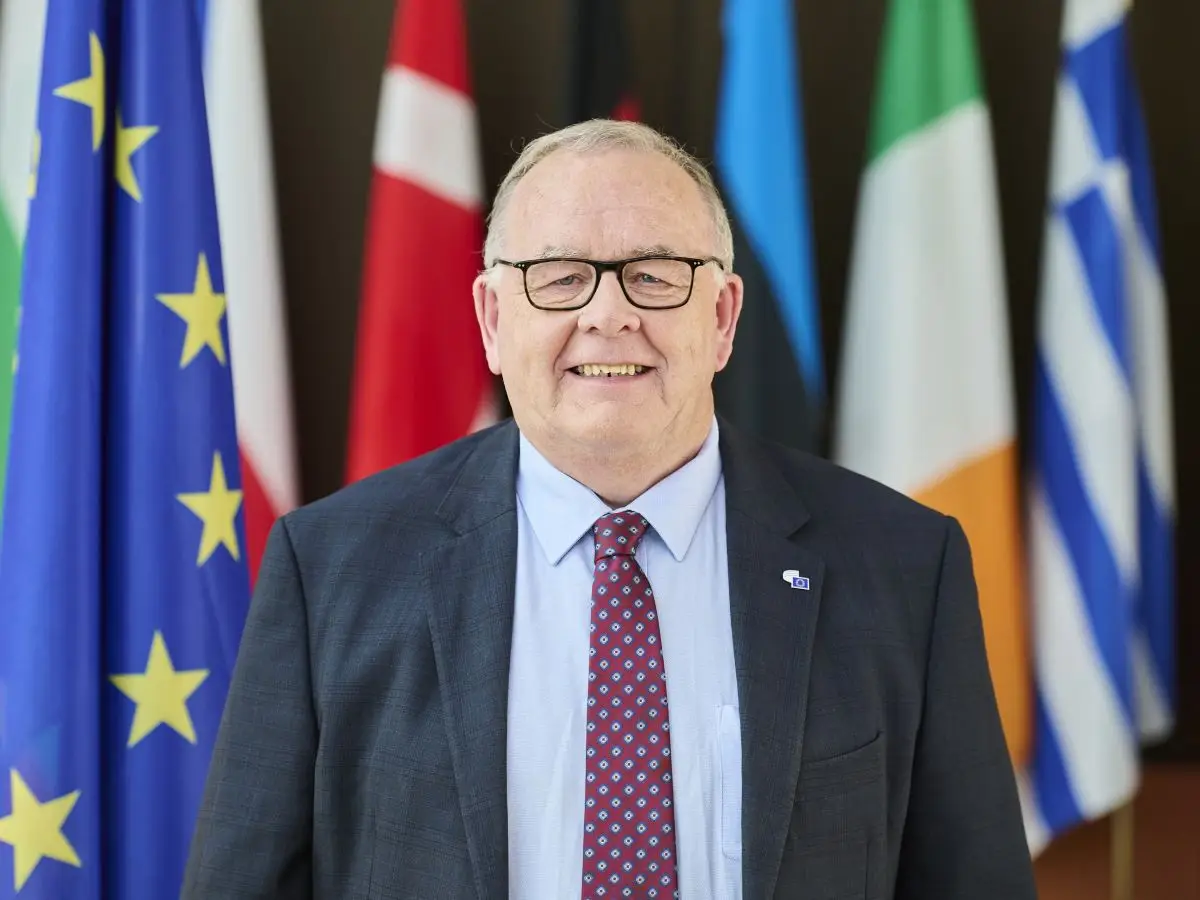
A question arises, however: what if it was cohesion, not just competitiveness, the real force preventing a body from falling apart? What if it was poverty, inequality and the draining of civic space that undermined the legitimacy of the Union? It is precisely on the recomposition of these fractures, perhaps most urgently threatening the very resilience of the European project, that the mandate of the new president of the European Economic and Social Committee (EESC), Irishman Sèamus Boland, elected in October for the 2025-2028 term, is focused. Or, in his words, admittedly without a wink of an extreme ratio, but merely with the lucidity of someone who knows how to interpret the times: “In a Europe that increasingly speaks about defence, what happens if citizens on the ground do not believe in the Europe that is being defended?”
President, you’ve made poverty eradication a top priority of your mandate. The topic is strictly intertwined with social inclusion, workers, and health as clearly emerges by the latest Eurostat figures.
Poverty has not gone away. There was a decade, from 2010 to 2020, in which the EU explicitly prioritised poverty, yet today we still have around 93 million people below the poverty threshold, roughly 21% of the population of the EU-27. Poverty continues to affect women, children, older people, individuals with disabilities and, clearly, minority groups such as the Roma. It remains a very real issue. I would also argue that it is one of the drivers of political upheaval, because people experiencing poverty are losing faith in the establishment and in its capacity to respond to their needs.
Which specific actions will you advocate for?
The first essential element is housing. Housing is generating a great deal of poverty for younger people, but also for older people and women. Single-parent families are struggling severely because of the lack of affordable housing. The second element is tackling poverty at the level of childcare and early childhood. It is frightening that a child who has not attained even basic language or reading skills by the age of five, may be destined to experience poverty for the rest of their life.
With house prices rising faster than incomes and housing, water, and energy costs consuming nearly a quarter of household budgets, what can the EU do to make housing more affordable? Does yesterday’s European Commission proposal go far enough?
In Europe, we need to recognise clearly that this is an emergency. We made this point directly when we met António Costa, President of the European Council, urging him that an affordable housing plan must be a core part of the European framework. [The European Commission proposal] is a positive announcement, and I welcome the EESC's inclusion, together with the Committee of the Regions and the European Parliament, in a European Housing Alliance to facilitate cooperation and multi-level governance on housing. I also welcome the opportunity to collaborate with other EU institutions and the Presidency of the Council of the EU to contribute actively to the first EU Housing Summit in 2026. We have also stressed the need for stronger EU measures to curb excessive rent increases and to promote social housing. When it comes to social housing, we argue strongly that existing models need to be rethought, particularly in terms of finance and financial support.
What is required?
A mix of public and private investment, focused clearly on priorities and accompanied by effective regulation of housing construction. This will require also massive investment in skills. One of the unresolved consequences of the banking crisis in Europe was the severe blow it dealt to the construction sector. We lost a huge amount of skills and have never fully recovered them. At the same time, because housing policy is directly linked to homelessness and poverty, construction must be used as an opportunity to deliver sustainable housing. The energy transition is also a key factor here, as energy poverty is increasingly part of the wider poverty problem.
You have pointed out the lack of emotional health in the youths as a “silent crisis.” What urgent steps should governments or institutions be taking?
One of the major by-products of COVID was isolation, which affected a particular generation of young people in ways we are only now beginning to understand. In countries such as Ireland, research is showing clear evidence that young people who were isolated from their peers during that period are experiencing significant mental-health impacts. From a policy perspective, there are two key points. First, it has always been the poor relation of so-called conventional health, consistently lagging in research and development. Second, there is a serious lack of what we call mental well-being programmes, especially those aimed at young people and delivered through community services. These programmes are vital because they allow for early detection, often signalled by isolation, dropping out of school, loss of motivation or involvement with groups close to crime or destructive behaviour. Mental-health care is not only about medical treatment, which certainly needs improvement; it is also about training, prevention and peer education. This brings us back to the idea of a Health Union, promised after COVID by the Commission. A genuine Health Union would integrate the lessons learned during the pandemic, including the massive increase in mental-health needs across society. We are therefore calling for renewed commitment to that objective.
Civic space is under pressure in some Member States. What practical support can the EESC provide to NGOs, activists, and journalists? Could the EU benefit from an independent mechanism to monitor and protect freedom of association, expression, and media independence across all Member States?
My mandate is centred on what I call “civil society at the heart of Europe”. This means, very clearly, that unless Europe and its Member States seriously allow civil-society organisations to participate in decision-making, civic space will shrink. Civic space is about giving democratic room to organisations that are often on the front line of poverty, disaster response, health delivery and preparedness. These organisations learn directly from what happens on the ground, including in conflict situations, and preparedness is a major focus of the EU at the moment. In practical terms, we are looking to support Commissioner Michael McGrath, who is responsible for justice and the rule of law and who also holds the Civil Society Strategy portfolio. That strategy is precisely about giving civil-society organisations the space to describe what they are experiencing and to propose solutions. The EESC can play a central role here through outreach. Our members, typically nine to twelve per country, are directly connected to organisations on the ground.
So, is the EESC the most appropriate body within the EU institutional framework to play this role?
If you want to build a civil-society strategy, you already have a committee established by the Treaties of Rome (1957) whose task is to represent organised civil society in all its forms: trade unions, employers and civil-society organisations. Fundamental rights are a core part of our mandate, and we have a memorandum of understanding with the EU Fundamental Rights Agency in Vienna. We have experience, a body of work through our opinions, and a direct link to national organisations. In effect, the structure already exists. It is a brownfield site, ready to be used.
In the upcoming Multiannual Financial Framework (MFF) negotiations, how can we make sure social investment stays a priority alongside other pressing commitments, including defence?
The MFF, the Common Agricultural Policy (CAP) and the related funds are the lifeblood of the EU. They always have been and will continue to be so, because they bring the tangible benefits of Europe to every corner of the Union. Any loss of vision in this regard would be deeply negative. Today, the MFF faces the challenge of maintaining social and economic cohesion while responding to a new defence reality. We are currently preparing an opinion on preparedness, in which we argue that preparedness is not only about the possibility of war, but also about disasters: floods in Valencia, storms in Ireland, fires in Greece and elsewhere. Civil society is always present in these situations, and preparedness means being ready to involve it. Defence spending will increase, and that will put pressure on the MFF.
What is the best way to manage this risk?
We need to build a clear role for civil society within the new funding arrangements. If preparedness funding flows through civil society, social cohesion is far less likely to be undermined. I want to raise a fundamental question: in a Europe that speaks increasingly about defence, what happens if citizens on the ground do not believe in the Europe that is being defended? In that case, it does not matter how many missiles are purchased. Without a shared spirit and attachment to Europe - such as we see in Ukraine - defence will be hollow. The MFF must therefore remain true to its roots: social and economic cohesion across regions, partnerships and inclusion.
Completing the single market has been a long-standing goal and it is probably, after the MFF, one of the most challenged areas of EU policy thinking.
It is under pressure from geopolitical change, from the widespread use of tariffs as a political tool, and from trends towards renationalisation. The single market is about free movement and open exchange, and that is increasingly constrained. Businesses are facing growing obstacles, including difficulties in cross-border travel and trade. Even within the Schengen area, security concerns are affecting free movement. The EESC has consistently produced, and will continue to produce, opinions calling for a strengthening of the single market and of free movement. We recognise that defence issues must be addressed, but we cannot accept demands - particularly from outside Europe - to curtail borders in ways that undermine the single market. EU citizens and businesses must continue to benefit from it. Europe will not survive unless it allows trade and exchange within its borders. Whether the Union remains at 27 or expands to 28, Europe must act as a single European entity.
Last, but not least, the EU Commission is preparing new circular economy and bioeconomy strategies.
The EESC was the first EU institution to pioneer work on the circular and bioeconomy. Nearly five years ago, we produced an opinion demonstrating that the circular economy and the bioeconomy can be profitable while also contributing to the achievement of the UN’s 17 SDGs. We succeeded in persuading the EU to place this at the centre of its policy agenda. Looking ahead, the link between the circular economy and the broader transition agenda is clear. The circular economy must be supported through taxation and fiscal policy. Continued subsidies for fossil fuels act as a barrier, forcing circular businesses to bear higher costs while their competitors benefit from support. We are calling for a level playing field. Despite current challenges and some denial of environmental realities, Europe has been a global leader in this area. The EESC wants Europe to continue that leadership, working in partnership with farmers, food producers, residents’ associations and local communities, so that the circular economy becomes a reality at their doorstep.
Cover: Sèamus Boland