

On Tuesday, 16 December, the European Parliament definitively approved the Omnibus I package with 428 votes in favour, 218 against and 17 abstentions, thus confirming the agreement reached on 9 December with the Council. Once again, the vote brought together the European People's Party and the far-right groups, sanctioning a substantial downsizing of European standards on sustainability reporting (CSRD) and corporate due diligence (CSDDD).
Ten months after the dossier was launched, the agreement formally concludes the legislative process and reaffirms the choices made at member state level: a radical rewriting of the CSRD and CSDDD that drastically reduces the number of companies involved, relaxes the obligations laid down and postpones the entry into force of the new regulations. Simply limiting our attention to this formal outcome, however, may prove misleading.
The Omnibus I package is not just the result of a compromise between institutions. It is rather the outcome of a succession of decisions that poses questions on the quality of the European legislative process, on the management of internal conflicts of interest and on the Union's ability to defend its regulatory system as a “global standard setter” in an increasingly conflictual geopolitical context – see the paragraph dedicated to the United States.
Internal interests, conflicts of interest and maladministration
Over the past months, the Omnibus I dossier has been fraught with strong reservations about the legal legitimacy of the measure. Back in November, more than one hundred EU law experts had already questioned the initiative and its potential effects on the democratic order of the EU, warning that it risked opening a dangerous institutional precedent for the rule of law, thus weakening the role of the legislator, democratic control and legal certainty.
To these critical issues were added new ethical overtones. On 15 December, Transparency International EU and eight other civil society organisations filed a formal complaint with the Advisory Committee on the Conduct of Members of the European Parliament against the rapporteur of Omnibus I, Swedish MEP Jörgen Warborn.
The crux of the matter is a potential conflict of interest never declared between his role as president of Small and Medium Entrepreneurs of Europe (SME Europe) – a registered lobbying organisation committed to shaping and refining EU legislation in support of SMEs across Europe – and his role as parliamentary rapporteur on the Omnibus I package. The coalition headed by Transparency International EU claims a blatant breach of the Parliament's Code of Conduct. Warborn, while leading the attempt to scale back sustainability rules, chaired at the same time an organisation whose stated mission is to “shape and refine EU legislation that supports SMEs throughout Europe” in favour of business. All this without any indication of conflict, even potential conflict, in the 20 March 2025 declaration.
In addition to the criticism of the procedure, the European Ombudsman's decision of 27 November found instances of procedural shortcomings and thus maladministration in the way the Commission drafted a number of urgent legislative proposals, including Omnibus I. According to the European Ombudsman, crucial parts of the Better Regulation rules were not respected, with cases of internal consultations reduced to less than 24 hours and no clear trace of a climate consistency assessment. “In future, a better balance needs to be struck between having an agile administration and guaranteeing minimum procedural standards for law-making. Certain principles of good law-making cannot be compromised even for the sake of urgency,” reminded the Ombudsman, Teresa Anjinho.
External pressures: USA and Qatar
Stopping here, however, would only tell half the story. On the external front, the Omnibus package is set in a context of strong geopolitical pressures. On 2 December, the US ambassador to the EU, Andrew Puzder, wrote in the Financial Times: “To recover and reindustrialise, the EU must have access to secure, reliable and affordable energy. That access will materialise only if the EU succeeds in the ongoing effort to repeal or neuter its growth-killing Corporate Sustainability Due Diligence Directive (CS3D).”
According to this view, CS3D would be a “gargantuan regulatory apparatus” that makes compliance “virtually impossible”. But to whom? ExxonMobil is reportedly already reducing its workforce in Europe, while Qatar has threatened to suspend LNG deliveries if the directive is not cleared. In response to Puzder's editorial, Lindsay Hooper, CEO of the University of Cambridge Institute for Sustainability Leadership, reacted on the same pages, claiming that the ambassador's position reflects pressure from some large US companies to weaken the EU due diligence directive by fragmenting member states and exploiting trade negotiations, with the aim of protecting interests related to European dependence on fossil fuels and limiting the liability of their supply chains.
To learn about the long-standing complaints of large US companies about EU internal market regulation, we didn't need to wait for the Trump administration's controversial National Security Strategy of 4 December. An investigation by the Dutch NGO SOMO on 3 December revealed that eleven multinationals, including large fossil fuel companies, allegedly acted in coordination to obstruct an EU energy supply law by lobbying key decision-makers in European institutions. Lastly, it should be mentioned that the first go-ahead of the Omnibus on 13 November was celebrated on X by White House spokeswoman Karoline Leavitt and Interior Secretary Doug Burgum (advisor on energy issues in Donald J. Trump's election campaign) as a victory, following the “US-led pressure campaign”.
CSDDD and CSRD: what changes with the Omnibus I
In substance, the changes are extensive and closely follow the agreement reached in the Council on 9 December. The Corporate Sustainability Due Diligence Directive (CSDDD) is drastically downsized: the obligations to implement climate transition plans disappear; the application threshold rises to more than 5,000 employees and €1.5 billion in annual turnover, reducing the scope to around 1,600 companies across the Union. Maximum penalties are lowered to 3% of global turnover, and the harmonised liability regime is eliminated. The entry into force of the new rules is postponed until July 2029.
The Sustainability Reporting Directive (CSRD) also undergoes a further restriction: only companies with more than 1,000 employees and a turnover of more than €450 million remain obliged. This results in the exclusion of around 90% of the companies currently involved, with some member states having fewer than 40 companies subject to the reporting obligations. In the sectors with the greatest environmental impact – agriculture, fishing and mining – the number of operators affected could be reduced to a few dozen across the EU.
The next steps
Once also formally adopted by the Council, the changes to the EU rules on sustainability reporting and due diligence for companies will enter into force within 20 days after publication in the EU Official Journal. Member states will have until 2028 to transpose the directive into national law.
But the “Omnibus” saga does not end here, as this was only the “first chapter”. On 10 December, the Commission presented a new environmental simplification package promising administrative savings of around €1 billion per year, bringing the total to €11 billion and approaching the target of €37.5 billion by 2029, the end of the current Commission's term of office. Six legislative proposals, under the banner of the Competitiveness Compass, to act on several key areas of EU legislation: industrial emissions, circular economy, environmental assessments and geospatial data management.
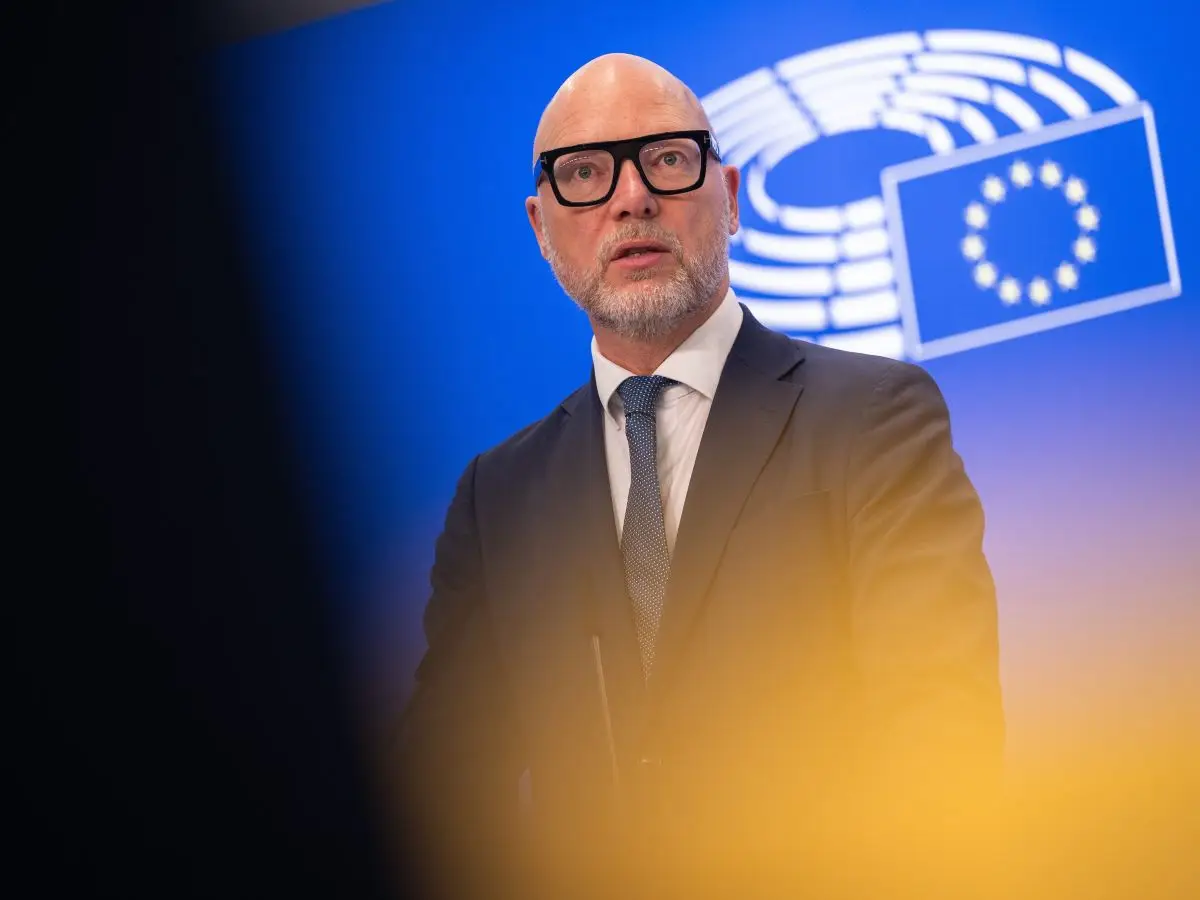
Cover: Jörgen Warborn photographed by Laurie Dieffembacq © European Union 2025