

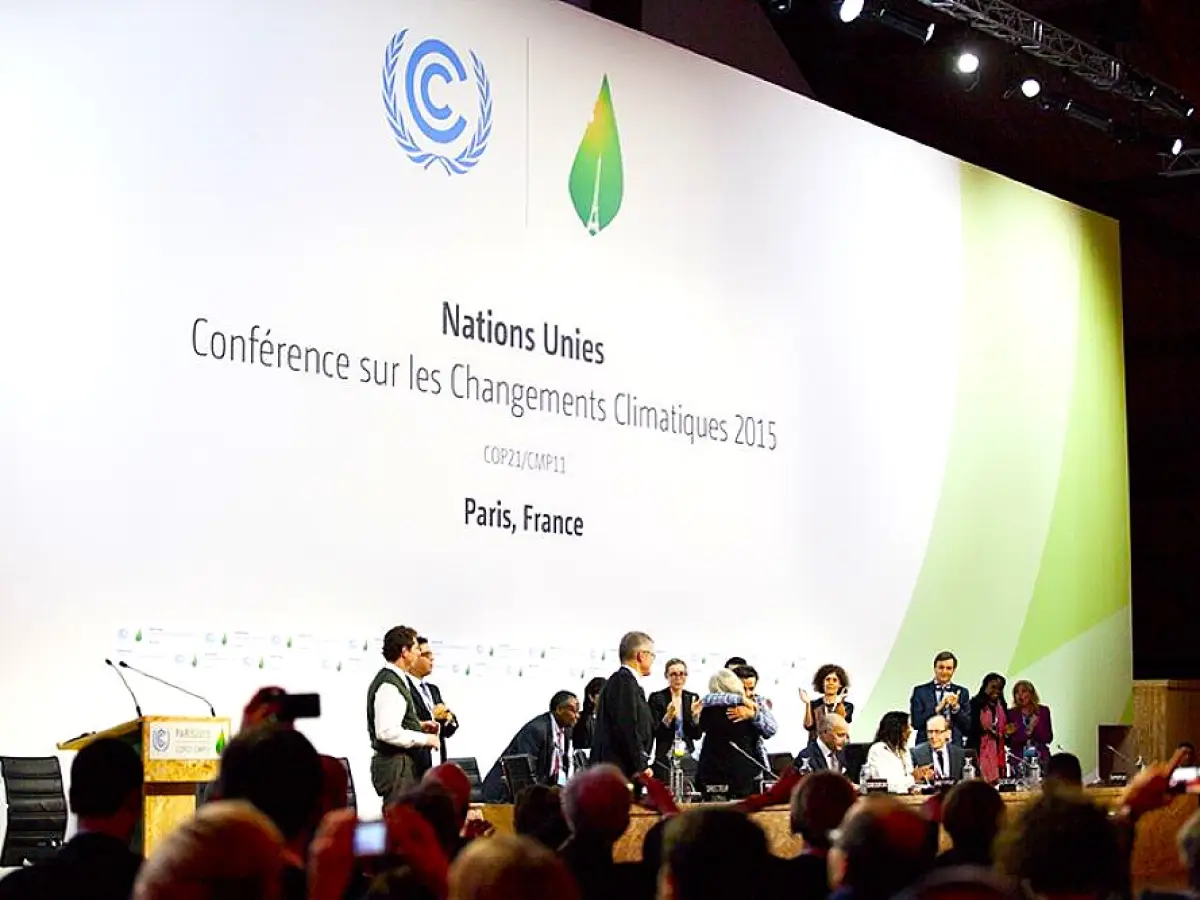

Ten years ago, the Paris Agreement united the world in the fight against climate change at the 21st United Nations Climate Change Conference. With this historic agreement, 195 countries pledged to take national measures to reduce greenhouse gas emissions to curb global warming, while at the same time strengthening adaptation to the worsening effects of the climate crisis.
I still remember the two very long, arduous weeks leading up to the most important agreement of this century. Amidst sleepless nights, croissants and French coffee, and draft texts, in a heavily guarded Paris (less than a month before, the Bataclan massacre had claimed 130 lives), thousands of people worked tirelessly to bring the agreement to fruition.
The fruit of many years of negotiations within the framework of the United Nations Framework Convention on Climate Change (UNFCCC) established at the Earth Summit in Rio in 1992, the Paris Agreement defined a worldwide framework to avert the irreversible destruction caused by climate change, and sent an unequivocal signal about the enormous economic and social benefits of climate action among all nations and peoples.
For anyone who follows the climate issue, as I have been doing for 17 years now, the tangible progress that has been made is abundantly clear. In this decade, climate has become a central discourse in politics, in finance-insurance, in industry, in defence, as we analysed in the last issue of the magazine, Infrastructure, and even in activism. For years, the climate issue has been on the civil society agenda but never at the forefront: until 2009, almost no NGOs dedicated entirely to the topic existed; 350.org was one of the first, giving birth to the Italian Climate Network. Greta Thunberg herself is a child of the Paris Agreement.
So what does the science tell us about the Paris Agreement? Before this global climate cooperation, global warming was likely to exceed 4 °C above pre-industrial levels by 2100. Today we are heading towards 2.8 °C. The most ambitious target remains 1.5 °C. Had we not signed the Agreement, the rise in average global temperatures would have had devastating effects on ecosystems, economies and societies in all countries. But thanks to collaboration between nations, we were able to reverse the trend and take the first steps towards climate resilience.
What made the Paris Agreement possible? Firstly, a progressive global context, built on economic and social growth. There was Barack Obama in the United States; Europe was represented by the wise Franz Timmermans (Vice-President of the European Commission at the time); China was led by a great negotiator, Xie Zhenhua, esteemed by the Chinese president and with excellent relations with the American Todd Stern. The United Nations was a solid institution, and international cooperation and diplomacy appeared to be enjoying a moment of grace. The Sustainable Development Goals had just come into effect. The possibility of living in a better world was in the air.
Then along came Trump, the anti-scientific populism, the keyboard rage of the lashes of frustrations of those who had not realised the potential for transformation. But also came the fear of transition, the trade and PR wars of the fossil industry, the conservative reaction of the petrostates, the new wars, the Palestinian genocide.
The 10th anniversary of the Paris Agreement, then, needs to be a moment of reflection and a call to action. Never before has it been so necessary to halt – and not only for climate's sake – the patriarchal, restorationist, petroliberal, warmongering, 20th century wave that wants to undermine lasting security and development, denying us and tomorrow's generations a future.
Between 2027 and 2029, new key rounds of elections will occur, from the US to Italy, from India to the European Union. If we want to correct the trajectory taken at the COPs, and made clear by the Brazilian failure at COP30, we need a shift in the leadership of the key countries in the G20. Above all, we need to recast US multilateralism with a new doctrine.
Finally, UN reform arrives at a critical time, when the international organisation has reached its lowest point in terms of influence. As of the 1st of January 2027, a new Secretary-General will be in place at the UN, to follow up on the outgoing António Manuel de Oliveira Guterres's heartfelt efforts to reform the negotiations on nature (the 3 COPs on climate, biodiversity and desertification) by 2030, setting up an Environment Council directly under the UN secretariat on a par with the Security Council.
It took six years of diplomatic, political, civic and journalistic work to shape the Paris Agreement from the failed COP15 negotiations in Copenhagen in 2009. Today, the time available is far less, and the context even more difficult. However, the birthday of the Paris Agreement reminds us that reaching an ambitious agreement, even when it seems impossible, a dream, an unattainable vision, if handled with acumen, political will, planning, collaboration and pressure from the grassroots, is once again within our reach.
Cover: COP21 closing, photo by Iga Gozdowska via Flickr