
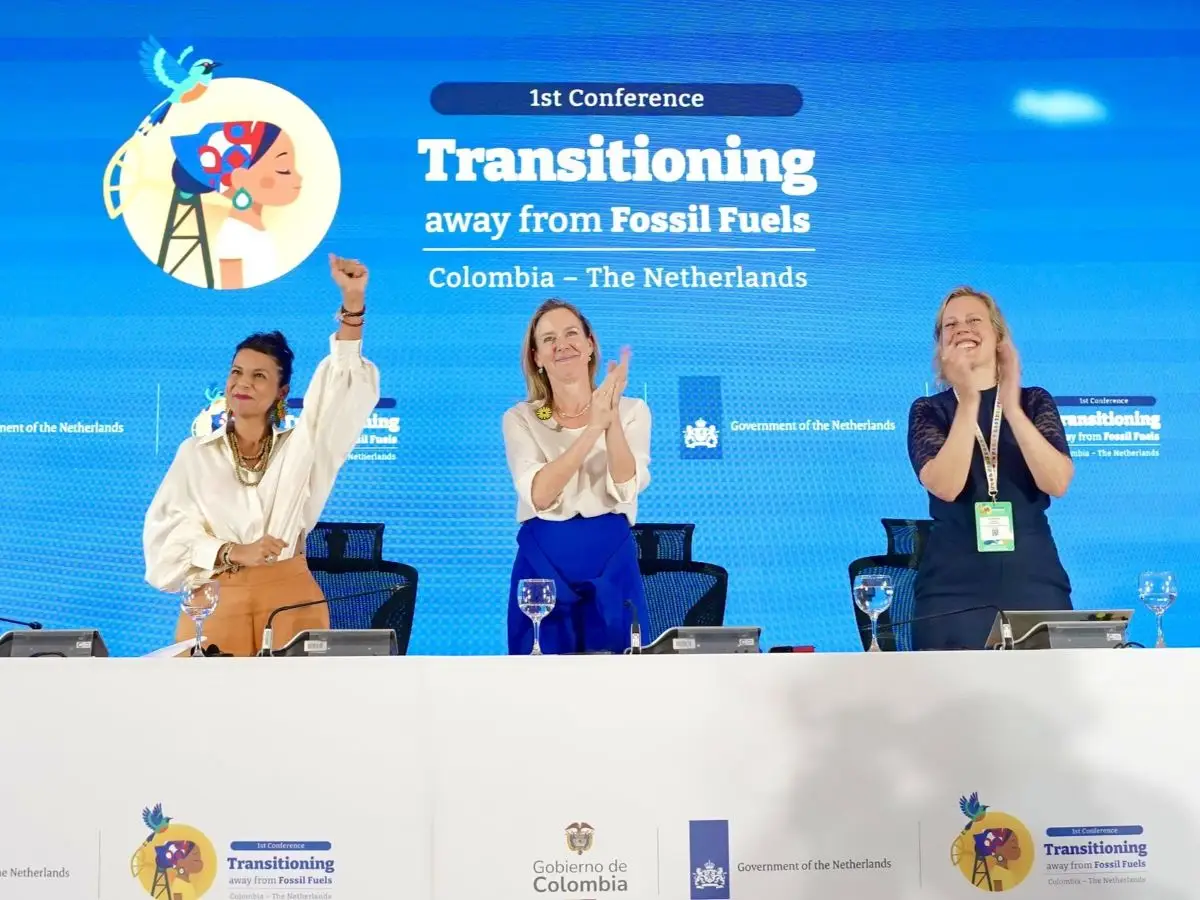

Phasing out fossil fuels is no longer just a political or economic choice—it is increasingly framed as a matter of survival. That was the central message emerging from the international conference in Santa Marta, Colombia, a gathering that, lacking binding commitments, marks a meaningful forward in the global energy transition.
From April 24 to 29, the Caribbean city—where the sea itself reflects the mounting pressure of climate change—hosted more than 1,500 participants, including policymakers, activists, scientists, and financial experts from 57 countries. Around a third of them came from Europe, forming a diverse coalition united by a shared goal: building concrete pathways to move beyond coal, oil, and gas.
A political space beyond traditional climate summits
Organized by Colombia and the Netherlands, the conference emerged partly as a response to the shortcomings of global climate negotiations. After the underwhelming outcome of COP30 in Belém, which failed to outline a clear path away from fossil fuels, Santa Marta positioned itself as a complementary arena—less constrained by consensus rules and more focused on practical progress.
Rather than a conventional negotiation forum, it functioned as a political laboratory. Free from the influence of fossil fuel lobbyists—deliberately excluded—the summit sought to center the voices and needs of countries and communities most exposed to climate impacts. It is no coincidence that it was named the People’s Summit for a Fossil Free Future.
Among the most striking interventions was that of Tuvalu’s climate minister, Maina Talia, who captured the urgency of the moment: “This is not a negotiating position for us. It is a matter of survival.” For small island states facing rising sea levels, this is not rhetoric but lived reality.
Key outcomes: roadmaps, science, and finance
While no binding agreements were signed, the conference delivered several tangible outcomes. Chief among them is the creation of an international panel of more than 500 experts—scientists, economists, and technologists—tasked with producing annual recommendations through 2035. Their work will aim to guide public policies in line with the Paris Agreement’s 1.5°C target.
Three main workstreams were also identified: designing national and regional roadmaps for phasing out fossil fuels; reforming financial systems still heavily tied to fossil investments and subsidies; improving transparency in global energy flows.
Finance remains a critical bottleneck. Many countries—particularly in the Global South—face high debt burdens and limited access to capital, slowing down their transition efforts. Some models are emerging, such as Brazil’s Espírito Santo state reinvesting fossil fuel revenues into clean energy. Yet these approaches are controversial, with Indigenous groups warning they may prolong structural dependence rather than resolve it.
Energy, conflict, and global vulnerability
The geopolitical context has made the debate even more urgent. The recent energy crisis linked to the conflict in Iran has exposed the fragility of economies reliant on fossil fuel imports. In just 60 days, the European Union spent more than €27 billion on such energy sources.
These figures highlight a deeper truth: the transition is not only an environmental necessity but also a safeguard against economic and geopolitical instability. Reducing dependence on fossil fuels increasingly appears as a strategic imperative.
Major absences and mixed signals
Despite broad participation, the summit was marked by notable absences. Key global players and major fossil fuel producers—including China, India, Russia, Gulf countries, and the United States—did not attend.
This raises questions about the initiative’s global impact. Without the involvement of the largest emitters, there is a risk that the process remains limited to a “coalition of the willing,” with constrained influence on worldwide emissions.
Still, some encouraging signals emerged. France, for instance, presented a detailed national roadmap: phasing out coal by 2030, oil by 2045, and gas by 2050. A move that could inspire similar commitments from other countries.
Toward COP31: a test of credibility
The real test will come at COP31, scheduled for November in Turkey. It is there that the ideas and frameworks developed in Santa Marta will need to translate into firmer commitments.
In the meantime, the process continues. A second summit has already been announced for 2027 in Tuvalu, co-hosted with Ireland—a symbolic choice that shifts attention toward one of the world’s most climate-vulnerable regions.
Santa Marta was not a definitive turning point, but it may prove to be a beginning. An attempt to break the inertia of a system that has long postponed decisive action. Like a small wave gathering strength offshore. The question now is whether it will grow into a tide.
Cover: courtesy of the Colombian Ministry of Environment and Sustainable Development, via Flickr