


The linear economic model is untenable not only for the environment, but also for our wallets. This is what emerges from the 2026 edition of the Circularity Gap Report, which for the first time calculates the economic losses (Value Gap) caused by the “extract, produce, dispose” approach typical of modern economies: €25.4 trillion a year, the equivalent of around a third of global GDP. In essence: for every €3 of value created worldwide, €1 is wasted.
An impressive shortfall which, according to Circle Economy – the organisation that drafted the report in collaboration with the Dutch branch of Deloitte – could only be bridged by a transition to a circular model.
“For the first time, the report includes an assessment of the Value Gap,” explained Arnold Tukker, professor of industrial ecology at Leiden University. “Although this is an inherently complex topic to tackle with full scientific rigour from a methodological perspective, it represents a strategically valuable expansion of the report’s scope. Money continues to drive most decisions in business and politics.”
The shortcomings of the linear model
The mining, processing and consumption of materials are activities intrinsically linked to the climate crisis: they emit large quantities of greenhouse gases into the atmosphere and contribute to biodiversity loss and water stress. Anthropogenic materials now even exceed the total amount of living biomass. However, this increase in material consumption no longer yields greater returns, particularly in wealthy countries. Global resource productivity (i.e., the economic output generated per unit of material used) has effectively stagnated over the past decade, and waste manifests itself primarily in five areas: underutilised processing residues, energy inefficiency, food waste, waste sent to landfill, and premature degradation of fixed assets.
According to the report, the value lost during the processing of raw materials into semi-finished or finished products due to inefficiencies, defects and yield reductions amounts to €904 billion; energy system losses cost around €8.7 trillion; edible food leaving the supply chain without being consumed – including losses during storage, transport, retail and final consumption – is worth €650 billion. Unrecovered waste (€10,000 billion) and the loss of value incurred during the year by machinery, plant, buildings and transport (€5,200 billion) round off the list of wastage under the linear model.
“Most of this value loss is not marginal or accidental, but structural and systemic,” stated Alvaro Conde, the author of the report for Circle Economy, during the launch conference. “Today’s economy is geared towards maximising economic output at whatever cost to people and planet. The results? Ever-increasing resource extraction, asset underutilisation and waste generation. This is largely because dominant value measurement frameworks and indicators incentivise these outcomes.”
GDP only tells part of the economy's story
Conventional economic indicators, particularly gross domestic product (GDP), are used to measure the monetary value of final goods and services produced over a given period, but they fail to account for many of the inherent externalities within a country’s economic structure: from waste generation and asset depreciation to the depletion of resources needed to sustain productivity. This creates a cognitive gap in terms of what actually generates value or performs well economically.
GDP remains, however, the global benchmark for comparing countries, but, according to the authors of Circle Economy, there is no equally simple and standardised alternative. For example, the deterioration and depletion of natural resources, including critical minerals, fossil fuels, soils and ecosystems, represent further losses of natural capital that are not accounted for.
The Value Gap as an alternative
In contrast to previous editions, focused mainly on the circularity rate – which fell to a new low of 6.9% – this year Circle Economy and Deloitte Netherlands applied an alternative methodology to GDP on a global scale: the Value Gap, an economic indicator that quantifies the difference between the value potentially recoverable through the circular use of materials and that which is actually lost through waste, resource degradation, pollution and underutilisation of assets. In other words, this indicator highlights where the economy “throws away” value rather than preserving it over time.
Nevertheless, it is designed as an index intended to evolve with new data, methods and definitions of value. In future editions of the report, Circle Economy argues, the Value Gap will be able to better incorporate the degradation of natural capital (soil, water, biodiversity) and physical capital (infrastructure, machinery), and overcome certain methodological limitations outlined by the authors themselves.
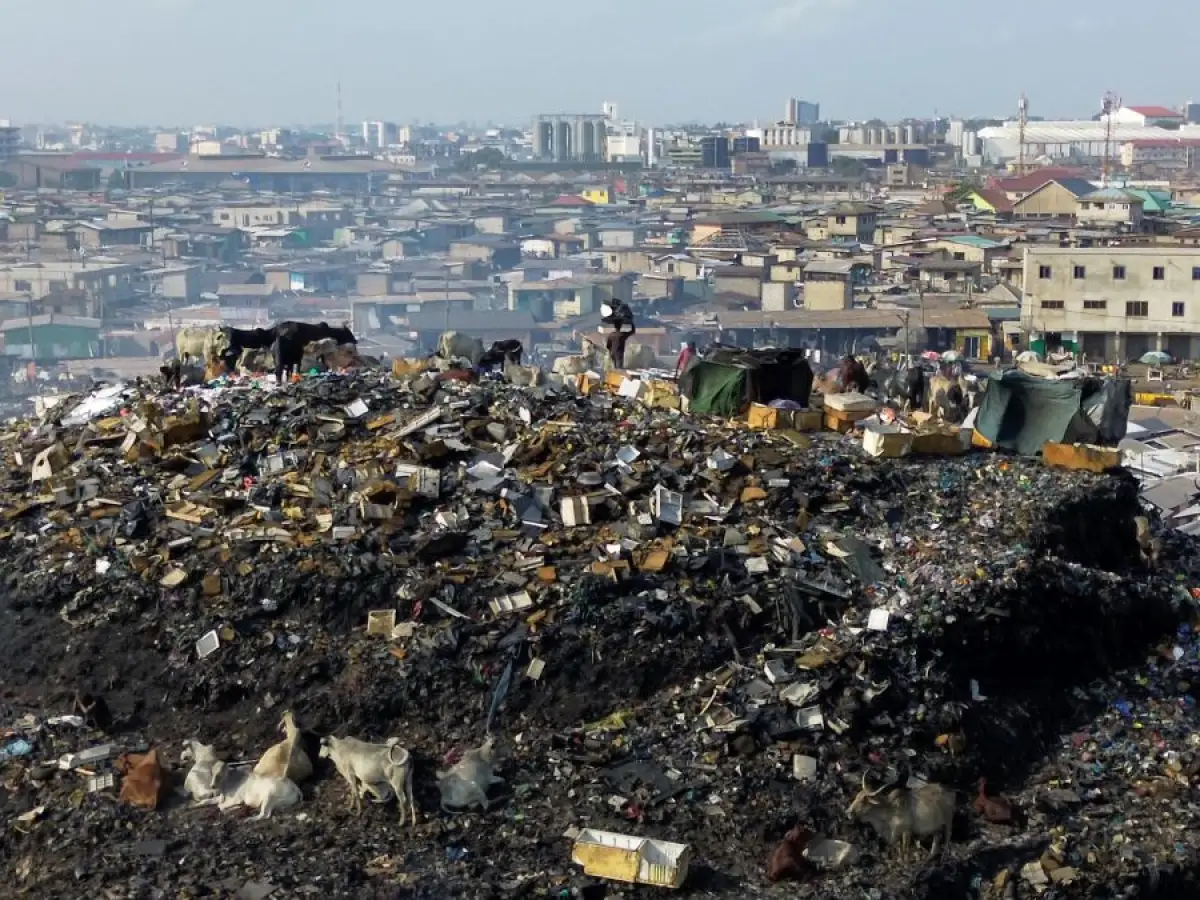
Cover: the Agbogbloshie landfill in Ghana, Africa’s largest e-waste and plastic landfill, photographed by Rich, IPA Agency