



When he first began working on these topics, Matt Jones liked to pose a challenge: name a business activity that does not, in some way, depend on biodiversity. “No one has ever managed to prove me wrong,” he says today. “Not once has anyone been able to give me an example of a business that doesn’t rely on biodiversity.” He made the remark during an episode of Nature Insights: Speed Dating with the Future, the IPBES podcast. The organisation is the world’s leading scientific authority on biodiversity and ecosystem services.
Jones is among the authors of the Business and Biodiversity Assessment Report, published on the 9th of February. The document clearly sets out a series of interwoven messages. The first is as straightforward as it is unequivocal: every economic activity depends on biodiversity, whether directly or indirectly. From global pharmaceutical giants to the hairdresser in a small provincial town, no enterprise exists without foundations in natural systems.
The second message is the other side of the coin and concerns the impact business has on biodiversity. The rapid expansion of the global economy in recent decades has come at the expense of the very natural capital on which it relies. The result has been biodiversity loss at an unprecedented pace, a crisis that is no longer solely an environmental concern, but a systemic risk to economies, financial stability, and human wellbeing.
“This report shows that nature is everybody’s business and that the conservation, restoration, and sustainable use of biodiversity is central to business sustainability and success”, Luthando Dziba, Executive Secretary of IPBES, said at the report’s launch. “Then, the report shows that although businesses have contributed to innovation that has driven the improvement of living standards, the same success has come at a cost for biodiversity. These experts have worked hard to synthesize knowledge, helping us understand the scale of the challenge and identify ways in which we can reverse the trend”.
Missed opportunities for growth
Adopted during the 12th session of the IPBES Plenary in Manchester, the Business and Biodiversity Assessment Report is the culmination of more than three years’ work by nearly 80 experts from 35 countries and a wide range of disciplines. “This Report draws on thousands of sources, bringing together years of research and practice into a single integrated framework that shows both the risks of nature loss to business, and the opportunities for business to help reverse this,” Matt Jones explains.
Between 1820 and 2022, the global economy expanded from 1.18 trillion to 130.11 trillion dollars: a staggering leap achieved without incorporating the value of biodiversity into economic and financial systems. The consequences are plain to see. Nature’s decline, long absent from balance sheets and economic decision-making, has produced mounting negative externalities and widening inequalities. Some regions have reaped far fewer rewards from economic growth, as natural capital continues to deteriorate.
Each year, trillions of dollars circulate through public and private financial systems worldwide. Yet only a sliver of that capital supports nature. A minor share is channelled into conservation, while the vast majority contributes to environmental degradation. “The current economic and financial system is not set up to ensure the sustainability of biodiversity, which in turn undermines the sustainability of businesses themselves,” notes Stephen Polasky, professor and co-author of the report.
According to the assessment, in 2023, public and private financial flows with direct negative impacts on biodiversity totalled 7.3 trillion dollars. Of this sum, roughly two-thirds (4.9 trillion) came from the private sector, while a further 2.4 trillion came from public expenditure, in the form of subsidies that incentivise environmentally harmful practices. The picture grows more troubling when set against the funds actually devoted to protecting and restoring nature. In 2023, just 220 billion dollars, a mere fraction of the capital in circulation, was invested in activities that support the conservation and sustainable use of biodiversity.
What can businesses do?
One of the study’s central findings is that companies have a crucial role to play in halting and reversing biodiversity loss. As Professor Ximena Rueda, one of the co-authors of the report, points out, “All businesses have a responsibility to act, regardless of their size, location, or sector. In our report, we set out more than 25 alternative steps that businesses can take to assume their responsibilities and move further, taking care of their impacts and dependencies.”
Furthermore, “businesses face a number of hurdles or barriers in trying to reduce their negative impacts and trying to increase their positive ones. Some of these are related to a lack of information and understanding. Others are more systemic, such as the mispricing of biodiversity and of nature”, Polasky explains. Many firms still lack the tools, data, and awareness required to measure their impacts properly or to assess the risks and opportunities associated with natural capital. Much of the scientific literature addressing these issues, meanwhile, is not written with businesses in mind. As a result, nature’s contribution to the global economy remains largely invisible in corporate accounts and strategies. The scale of this blind spot is captured in a stark statistic from the assessment: fewer than 1% publicly reporting companies mention biodiversity impacts in their reports.
“The loss of biodiversity is among the most serious threats to business”, said Prof. Polasky. “Yet the twisted reality is that it often seems more profitable to businesses to degrade biodiversity than to protect it. Business as usual may once have seemed profitable in the short term, but impacts across multiple businesses can have cumulative effects, aggregating to global impacts, which can cross ecological tipping points. The Report shows that business as usual is not inevitable – with the right policies, as well as financial and cultural shifts, what is good for nature is also what is best for profitability. To get there, the Report offers tools for choosing more effective measurements and analysis.”
Protecting and restoring biodiversity is not a task companies can shoulder alone. It demands coordinated action at every level. Progress is required across multiple fronts: policy, legal and regulatory frameworks; economic and financial systems; social values, norms and culture; technology and data; capacity and knowledge. These spheres do not operate in isolation; developments in one inevitably shape the others, influencing corporate decisions and behaviour. The report outlines the actions that different actors, depending on their context, resources, and priorities, can take to help create an enabling environment for genuinely sustainable business.
Methods and tools
Among the report’s key messages is that businesses already possess the methodologies, data, and knowledge required to take meaningful action. Credible and different tools are available, many of them adaptable to specific corporate contexts, although the choice inevitably depends on sector and strategic objectives. In recent years, a proliferation of frameworks and metrics has emerged to assess biodiversity and the impacts of business activity, developed by international organisations and public bodies as well as consultancies and startups.
The landscape, however, remains fragmented. Frameworks are often complex, overlapping, and at times even contradictory. Recalling a telling exchange with one company during the podcast episode, Jones shared an interesting anecdote: “One business told me, ‘We are spending more time trying to understand the disclosures, the frameworks, and the methods we are expected to comply with than we are actually spending working out what we need to do to address the impacts that we have.”
Added to this is the fact that studies and research do not yet offer comprehensive coverage of the relationship between the economy and biodiversity. Although much work has already been done, not all sectors are analysed uniformly, nor are the various dependencies on biodiversity or the specificities linked to geographical contexts fully represented. After all, this is a complex task that requires time, data, and collaboration.
“One of the powerful features of this Report is that it helps to decipher which methods, metrics, and policy tools are appropriate for the scope of business, helping bring clarity and coherence to how businesses measure and report on their interactions with nature,” Professor Polasky observes. “We are moving the conversation from voluntary sustainability pledges to a science-based roadmap for system change.”
There is no single yardstick for measuring corporate impact on biodiversity. Effective assessment calls for a suite of tools, selected according to sector, geographical context, and analytical purpose, and drawing not only on scientific data but also on local and Indigenous knowledge. On this point, Rueda notes that “among businesses there is also often limited understanding and recognition of Indigenous Peoples and local communities as stewards of biodiversity and, therefore, holders of knowledge on its conservation, restoration and sustainable use.”
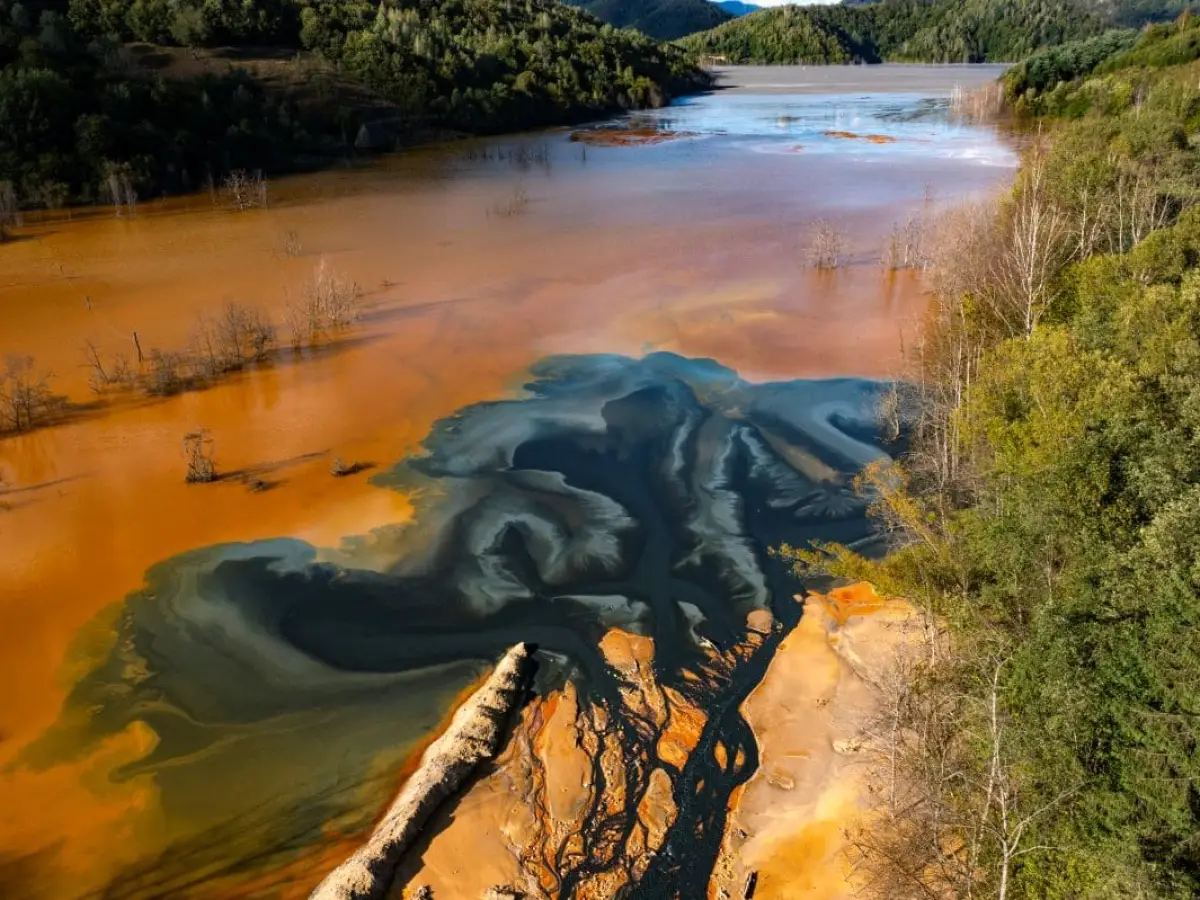
Cover: the polluted lake of Geamăna, Romania, photo Envato