


The European Sustainable Energy Week (EUSEW), Europe’s biggest annual event dedicated to renewables and efficient energy use, was held in Brussels on 9-11 June. Organised by the European Commission’s Directorate-General for Energy and the European Climate, Infrastructure and Environment Executive Agency (CINEA), the 20th anniversary edition brought together policymakers, industry leaders, financial institutions, civil society and youth representatives around the theme A clean, secure and competitive Energy Union.
The opening day featured the fireside chat Powering Change: 20 Years of European Clean Energy Transition, gathering the Energy Commissioners of the past two decades (Dan Jørgensen, Kadri Simson, Miguel Arias Cañete, Günther Oettinger, Andris Piebalgs) and moderated by former Director-General for Energy Ditte Juul Jørgensen (current Director-General for Trade and Economic Security). The exchange reflected on two decades of clean energy policies, from early market liberalisation through the Green Deal to today’s emphasis on security of supply, affordability and competitiveness as inseparable from decarbonisation.
Reflecting on 20 years of European Energy policy and EUSEW, Andris Piebalgs, former European Commissioner for Energy stated, “We have different countries, different nationalities, but there is consistency in policy – this is what makes Europe strong. Consistency not only on the level of the Commission but also on the member states, and I see good signs of us going in that direction. Twenty years ago, I would have never expected that EUSEW would be a central event in European policymaking, and that’s fantastic.”
That stocktake was complemented by the session A Letta Report for Energy: Rethinking EU Energy Governance in the Next Decade, which examined whether the current governance framework is fit for the next phase of European energy market integration.
Key threads across more than fifty sessions
The Policy Conference unfolded across more than 50 sessions around five themes: Competitive and secure Energy Union; Energy Efficiency; Energy Affordability; Decarbonisation framework in the EU and globally; and Renewable energy.
Key themes that emerged across sessions were that electrification and home-grown clean energy are at the core of the crisis response and Europe’s strategic autonomy, as well as the need for sustainable critical raw materials supply chains, energy efficiency as the “first fuel”, and the need to strengthen competitiveness.
Financing and the de-risking of investments for decarbonisation drew particular attention, with representatives from financial institutions and industry discussing how more predictable operating expenditures, including more stable energy costs for industry, depend on the right financing architecture. The policy dialogues over the days reflected a broader shift: clean energy investment is increasingly being framed not only as a climate imperative but as a precondition for industrial competitiveness.
As Jacek Truszczyński, European Commission Head of Unit for Net Zero Industries, Sustainable and Circular Products – DG GROW remarked, “We have higher energy costs than some other economies. So we have to focus on those technologies and those components where we have the structural ability to compete, [...] those that are not so energy-intensive to make.”
Electrification at the centre of the agenda
Many sessions referred to the much-awaited Electrification Action Plan, set to be presented in the coming months with the objective of increasing the share of electricity in final energy consumption to 32% by 2030. This direction was echoed by SB64 in Bonn, where the incoming COP31 presidency announced a complementary ambition to accelerate the clean energy transition by raising the global electrification rate to 35%.
This builds upon the recently presented AccelerateEU Energy Union Communication, which sets out short-term and structural measures across five areas: closer EU and international coordination; protection of consumers and businesses; accelerated deployment of home-grown clean energy; strengthened energy infrastructure; and mobilisation of public and private capital. Among its most consequential proposals are a review of network charges and taxation aimed at making electricity cheaper than gas, the phase-out of fossil fuel subsidies, a July 2026 deadline for the Energy Highways initiative, and an ETS review scheduled for the same month.
Jonathan Volt, Project Officer at the European Commission Joint Research Centre said: “We see many inspiring cases (of lowering electricity-gas price ratio) across the member states. On the EU level, we have the Affordable Energy Action Plan, AccelerateEU,, and this summer we’ll have the Electrification Action Plan as well as recommendations on lowering energy bill taxation. And with that, I just want to say: get the policy right, get the pricing right, – and we’ll see the market moving.”
Citizens, communities and recognising innovation
Several sessions focused on civil society, energy communities and energy affordability, building on the Citizens’ Energy Package presented earlier this year. Discussions unveiled persistent gaps on increasing participation in community energy initiatives, clarity on funding mechanisms and the importance of social climate plans for vulnerable households as a structural pillar of a just transition.
The 2026 Young Energy Ambassadors were announced, with a mandate running until 2027 to support the participation of young people in the European sustainable energy policy-making process and contribute intergenerational perspectives to the transition.
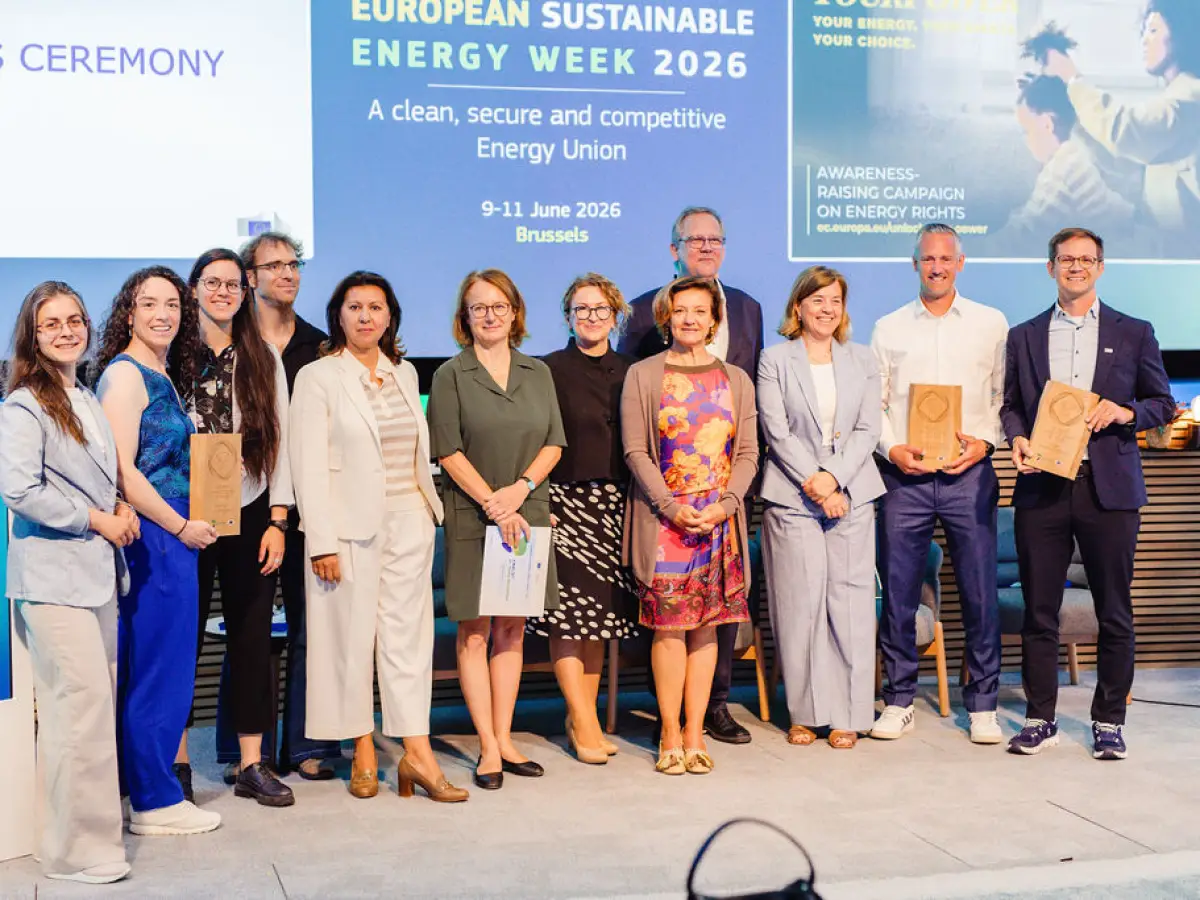
Also announced during the week were the 2026 European Sustainable Energy Awards in three categories: the Local Energy Action Award was assigned to Stefan Sattler of 100 Projects Phasing Out Gas, an initiative led by the City of Vienna's climate and innovation agency, UIV Urban Innovation Vienna, and its Energy Planning Department; Donna Gartland, head of Dublin's Energy Agency Codema, won the Women in Energy Award; and lastly, the SMEs Driving Energy Efficiency Award was achieved by Joris Piette of RE-LEAF: Affordable Renovation, a project in the Belgian province of Limburg. The newly introduced SME category is a notable signal to highlight the role of SMEs in Europe’s decarbonisation.
The 2026 EUSEW edition delivered a clear message: in a geopolitical context where energy security, industrial competitiveness and climate ambition are increasingly treated as one single equation, the dialogue between institutions, industry, finance and citizens matters more than ever. The coming year will test whether that dialogue translates into delivery, with the Electrification Action Plan, AccelerateEU measures and the ETS review all moving from communication to legislation.
Cover: photo by EUSEW