


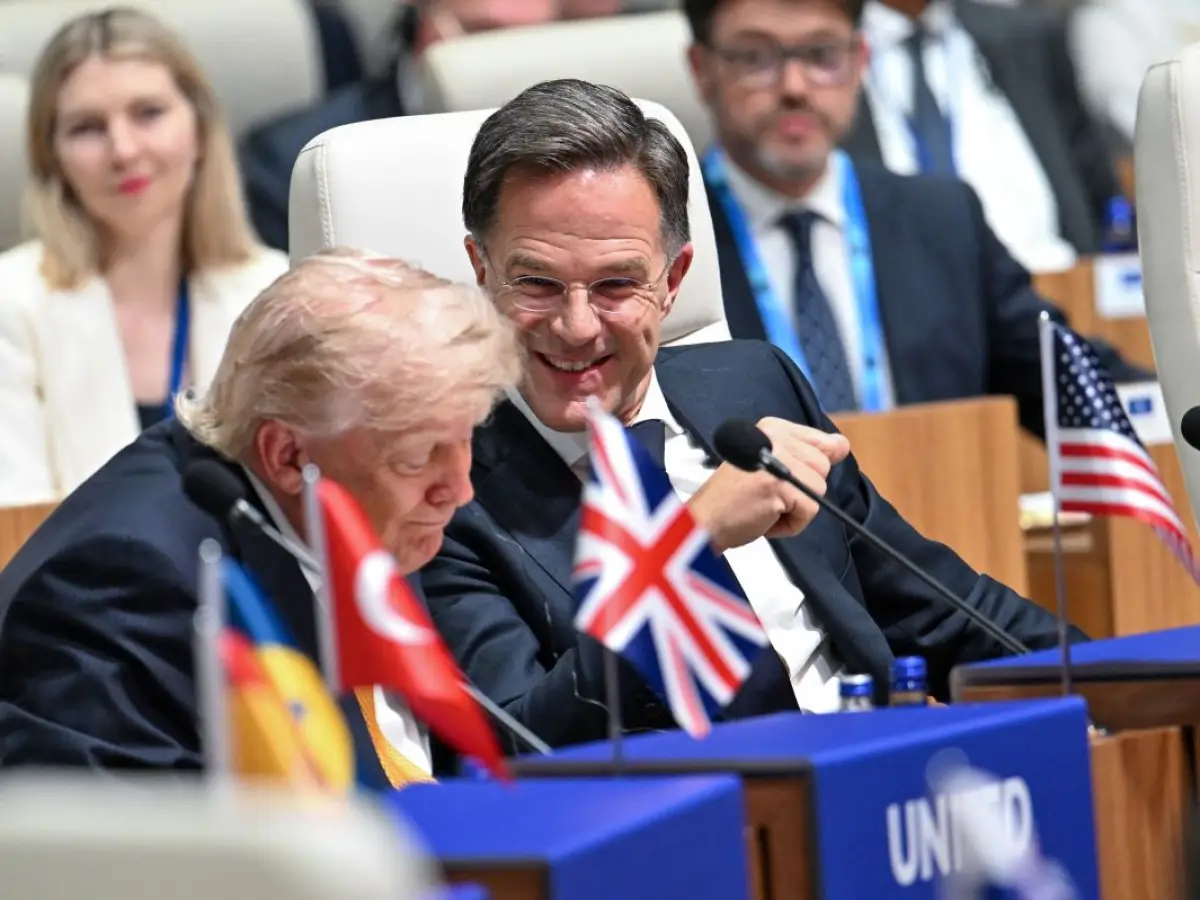

NATO leaders used the 32nd summit in Turkey’s capital, Ankara, to showcase the alliance’s growing military ambitions, reaffirming higher defence spending targets, fresh support for Ukraine and billions of dollars in defence procurement.
Ankara had been preparing for weeks. Authorities banned all rallies, demonstrations, closed major arteries to traffic and put parts of the public sector on leave for the duration. Rights groups reported that the crackdown led to the detention of more than 200 people, including activists, lawyers and journalists.
Turkish President Recep Tayyip Erdoğan met the arriving delegations with a mehter band, the Ottoman military ensemble whose marches once accompanied the empire's armies into battle. Elsewhere, the ceremony had a harder edge: with major arteries closed and tens of thousands of security personnel deployed, the summit brought much of the capital to a standstill for ordinary residents. Residents and journalists were barred from Segmenler Park during French President Emmanuel Macron's roughly hour-long run, guarded by his full security detail.
Once the pageantry cleared, the substance came down to a single document. The Ankara Summit Declaration itself is remarkably short, six paragraphs, released the day the summit closed. It reaffirms the Alliance’s core commitment under Article 5, restates the spending trajectory set a year earlier at The Hague, and credits European members and Canada with raising core defence spending by more than 139 billion dollars in 2025 alone. The declaration announces over 50 billion dollars in new procurement deals from the summit’s industry forum and commits to expanding collective manufacturing capacity. On Ukraine, allies pledge 70 billion euros in military assistance for 2026 with intentions to sustain similar levels in 2027, financed largely by European members and Canada.
On the security environment more broadly, the declaration acknowledges only in passing that the Alliance faces “strategic competition, pervasive instability, hybrid threats and recurrent shocks”. Its single line on the Middle East states that Iran must never have a nuclear weapon and calls on Tehran to fully respect freedom of navigation in the Strait of Hormuz. That is the entirety of the declaration's engagement with the energy chokepoint that had dominated pre-summit briefings: no mention of reserve-sharing, no allied storage mechanism, no reference to critical infrastructure protection, undersea cables or climate change at all.
Separately, Secretary General Mark Rutte used his closing remarks to announce a five-year, 40 billion dollars push into uncrewed systems named NATO’s Drone Edge, and a 27 billion euros investment to modernise the Alliance's fuel storage and distribution network, including new pipeline capacity towards NATO’s eastern flank, the summit's closest thing to a concrete energy-infrastructure commitment. Analysts covering the summit, speaking to Renewable Matter, described NATO’s unity as intact on paper but fragile beneath the surface, with burden-sharing, Ukraine policy and the Alliance’s approach to the Middle East all still points of friction.
The Hormuz question is still unanswered
None of that spending, however, resolved the structural gap that energy security analysts had flagged well before Ankara. The closure of the Strait of Hormuz earlier this year removed an estimated 11 to 12 million barrels of oil a day from the global system, forcing states to draw down strategic reserves to cover the shortfall, a shock that exposed how little formal machinery NATO has for exactly this scenario.
“NATO has neither a policy nor a roadmap on this,” said Mühdan Sağlam, Director of the Energy and Climate Change Studies Center at the Economic Policy Research Foundation of Turkey (TEPAV). “In a crisis, member states’ energy security essentially depends on the United States choosing, if it wants to, to share part of its reserves,” she added.
The declaration's actual language on Hormuz bears her out almost exactly: a single sentence calling on Iran to respect freedom of navigation through the strait, with no accompanying commitment on reserves, storage or crisis response. The 27 billion euros fuel-infrastructure investment Rutte announced separately addresses a different problem, modernised storage and pipeline capacity to move fuel to NATO forces, not the binding reserve-sharing or allied crisis-response mechanism.
If Ankara was supposed to shift NATO’s vocabulary towards treating energy security as collective defence, the declaration itself doesn't show it. The word “resilience” appears exactly once in the six paragraphs allies signed, attached to the defence-industrial base, not to energy or infrastructure. Allies say their investments are “delivering the capabilities we need while strengthening our industrial base and resilience”. There is no line extending that language to energy grids, pipelines or critical infrastructure more broadly.
Heinrich Kreft, a retired Ambassador and lecturer at Andrassy University Budapest and Humboldt University Berlin, did not expect a new doctrine on a par with NATO’s military concepts, since energy policy remains primarily the business of sovereign governments. Kreft argues that the Alliance already treats critical infrastructure protection, maritime-route security, cyber resilience and supply diversification as security issues in their own right. Ankara’s task was to integrate that recognition more systematically into deterrence and defence planning. The declaration’s silence on all of it suggests that integration didn't happen.
“Today, Germany sees energy resilience, critical infrastructure protection, cyber security, supply chain security and military readiness as interconnected elements of collective defence,” Kreft said, pointing to LNG terminals, undersea cables, pipelines, ports and electricity networks as assets now treated as part of the security agenda rather than purely economic concerns.
Critical undersea infrastructure was the other test case going into the summit, and one with a longer paper trail than energy storage. “Critical infrastructure security is not a totally new concept,” said Sinan Ulgen, Director of the Istanbul-based Centre for Economics and Foreign Policy Studies (EDAM). It has sat inside NATO’s hybrid-threats framework for years, he noted; what has lagged is operationalisation, the actual allocation of resources needed to protect pipelines and fibre-optic cables after a string of incidents in the Baltic and elsewhere. Ulgen framed the test for Ankara precisely: whether the final communiqué would address that gap “in a focused way,” since only sustained political attention could overcome the chronic under-resourcing of the issue.
By that measure, the test was not taken. The Ankara Summit Declaration makes no reference to undersea cables, pipelines or critical infrastructure protection as a named category at all, only the single, generic reference to “hybrid threats and recurrent shocks” in a list that also covers strategic competition and instability.
The subject did surface informally. Arriving at the summit, Polish President Karol Nawrocki told reporters that the dual-use nature of pipeline infrastructure offered a chance to build security across NATO’s entire eastern flank, framing it as an issue for both Poland and Central Europe to keep pressing. But a comment at the arrivals gate is not a commitment in a declaration, and whatever internal NATO planning continues, it did not surface in the text leaders signed off on in Ankara.
The headline figures out of Ankara, the 139 billion dollars increase, the 50 billion dollars in new procurement, and a 4%-of-GDP spending milestone, Rutte cited in his closing remarks, are exactly the kind of numbers Riccardo Gasco, foreign policy coordinator at the IstanPol Institute, warned before the summit not to mistake for the real measure of resilience. “There is a growing understanding that resilience cannot be measured simply by the percentage of GDP devoted to defence,” he told Renewable Matter. “More spending is necessary, but it is not sufficient,” he added.
The real test, in Gasco’s framing, is whether resources translate into capabilities, readiness and industrial capacity, a test Ukraine's war has already shown runs through ammunition stocks, logistics, energy security, cyber defence and the ability to sustain production over time, not just budget lines. Rutte’s own language in Ankara echoed the same shift Gasco had anticipated: from setting targets to delivering results.
Whether procurement systems, supply chains and defence industries can actually scale at the pace the new figures imply is, by Gasco’s own logic, the part no summit declaration can settle in advance.
What Ankara leaves behind
NATO leaves Ankara with more money committed, a new fuel-infrastructure investment and a political declaration reasserting the Alliance’s unity, even as reporters covering the summit described that unity as fragile beneath the surface.
What it does not leave with is a binding energy-reserve mechanism for the next Hormuz-style shock, a dedicated resourcing plan for undersea cables and pipelines, or, with Washington still outside the Paris Agreement and describing climate change in dismissive terms, any real prospect of folding climate policy into NATO’s security agenda. For now, NATO’s integration of energy and the climate transition remains discursive rather than structural.
Cover: Mark Rutte and Donald Trump at the NATO Summit in Ankara photographed by Jumeau Alexis/ABACA/Agenzia IPA