
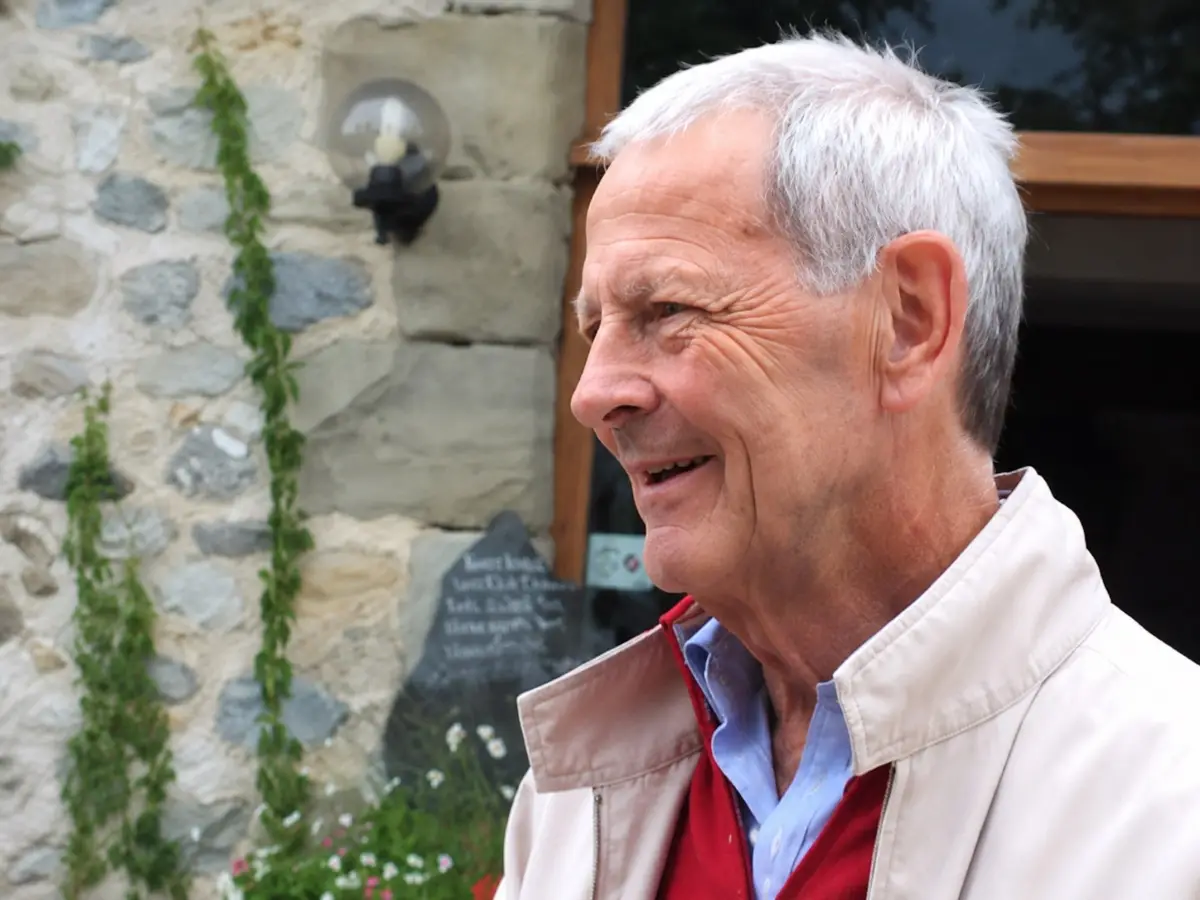

Walter Stahel is one of the founding thinkers of the circular economy. A Swiss architect and industrial analyst born in 1946, he first outlined the concept of selling performance rather than products in his 1976 research for the European Commission, crystallising it into the seminal 1982 paper The Product Life Factor. His 2006 book The Performance Economy, later expanded in 2010, remains a foundational reference for anyone working at the intersection of business innovation and sustainability. He is a pioneering member of the Product-Life Institute in Geneva and a fellow of the World Business Council for Sustainable Development.
We spoke from Geneva, where he was confined at home by the G7 security perimeter surrounding the city – and, characteristically, used the occasion to reflect on the difference between being trapped by geopolitics and being trapped by a software update.
You began reasoning about resource scarcity and product longevity after the 1973 oil shock. How did you arrive at the concept of Product-as-a-Service (PaaS)?
In 1976, the oil price shock had caused high unemployment across Europe. The logic seemed straightforward: replace energy with manpower, use more labour and less energy. But I didn’t understand at the time why this was rejected by economists. They were – and some still are – completely stuck on the linear industrial economy of production. I was talking about a service economy: repairing, reusing, recovering atoms and molecules. Then in 1982, with the paper The Product Life Factor, I mentioned for the first time the concept of products as a service. It was, however, never meant to be an absolute monopoly for manufacturers, as it is now interpreted by Big Tech, Microsoft and others. It was meant as an option: the user could choose between owning a product or renting its use. Of course, Product-as-a-Service goes much further back. Let’s take a look at transport: stage coaches across the Alps, postal coaches in the United States – these were the first alternatives to walking or riding your own horse. Transport was essentially always a service. Then came sterile textile leasing for hospitals and hotels, uniforms. And the interesting thing with textile leasing is that it takes about three years to reach the break-even point. You can only use very high-quality garments, otherwise you could never achieve a service life of three years. Compare that with Shein and Temu today: disposable clothing that will never enter a service model.
Durability of an object, a key element of circular economy, is always a requirement for PaaS.
One of the more recent examples in B2B is mattresses-as-a-service. It started with a Swiss company. The advantage is that a hotel can always guarantee a perfectly sanitised mattress, because the system monitors humidity and whether the bed was occupied. The hotel gets a service guarantee to the client and can also verify if the number of nights sold corresponds to the number of people who actually slept in the beds. The additional benefit is what makes the model work, which is the same logic as Rolls-Royce’s power-by-the-hour model: you prevent breakdowns by replacing jet engines before failure, and that requires continuously monitoring six engine parameters. Both the seller and the lessee profit, so the system functions.
But something has changed in how manufacturers exercise control in these models. You seem concerned about the direction it’s taking.
What’s happening now with John Deere, Tesla, and others is deeply troubling. Manufacturers are using the digital age to control products they’ve supposedly already sold. You think you own the product, but you are a pro-forma owner. The thing is actually controlled by the manufacturer. And there are cases where manufacturers are genuinely abusing this. Take Tesla: they have 12 cameras and countless sensors in the vehicle, recording everything. And yet, that data is provided to the court only in case the car was not at fault. If it was at fault? Suddenly all the data is not available and you cannot have access to it. Only the manufacturer has access. Artificial intelligence is becoming a new instrument for manufacturers to control their products beyond the point of sale. The owner has become a slave of the manufacturer: paying for it, but with no ownership control.
And companies also profit from the huge amount of data we freely provide.
I had a similar experience with UBS e-banking in Switzerland. They promoted it for years for smartphones, then suddenly required a software upgrade. I was told that my Caterpillar phone, about five years old, could no longer run the software. I would have to buy a new smartphone. For e-banking, I only use it to check my account balance. But they don’t give you a choice, and this is unethical. They should let you have the option to use basic functions without forcing you to change the hardware. My physiotherapist in Switzerland has a Mercedes van, and he was told he needed a service. He decided to wait, as he was short of money, and drove into the Swiss mountains. The car simply stopped. He was told he had to go to the nearest Mercedes workshop for the upgrade. This can be fatal in the mountains. Nobody told him about these limitations when he bought the vehicle. We are circumventing the entire principle of the circular economy: longer use, cascading use, repair. All of it.
The Performance Economy had a different vision back then. It was the era of open-software, open-engineering, innovative small tech start-ups. Which ideas of that book haven’t materialised? Why has PaaS never really spread among customers, but only in the B2B world?
I looked at three dimensions: producing performance, selling performance, and maintaining performance, which together constitute circular economy. Producing performance is mainly through science. Selling is Product-as-a-Service. Maintaining concerns the repair and remanufacturing economy. One sector I thought would flourish was advanced materials. The Cookson Group in London developed a powder material ideal for electric motors. You could press it into any shape, magnetise it, and after use, grind it back into powder, which would lose its magnetic properties, so it can be reformed. I thought this was brilliant. But it meant the product and material had to remain the property of the manufacturer, otherwise anyone could use it. And manufacturers of products refused to lease material, because if they did, they would also have to lease the product, otherwise they couldn’t guarantee its return. The logic was sound; the supply chain wasn’t ready.
In B2B there are many success stories of performance economy. In business-to-customers realm, including myself, people generally prefer to own. Even laundry: we went from individual households, to washing ladies, to household washing machines, laundromats, and now back to internet-connected, owned, washing machines. The B2C model is resilient to Product-as-a-Service because the convenience of ownership: if you only use a power tool one hour every three months, it may cost less to own it than to drive to a tool library.
What about the right to repair movement? Are we making genuine progress?
The biggest success story is repair cafés, precisely because they are non-monetised. They don’t register in GDP and economists barely notice them, as there is no cash flow. But they combine social elements – what I call sustainable communities – with the transfer of know-how to repair. The conversation between the owner of a broken object and the person with the knowledge to fix it is itself enormously valuable.
Social eco-spaces are so scarce, these days.
Martin Charter regularly publishes data on this. The figures are impressive. In repair cafés, 80% of broken items can typically be repaired. Now with 3D printing, they can actually print broken parts, and the success rate has climbed above 90%. This is enormous for the social and environmental dimension of the circular economy. But for the formal economy, it remains invisible: it still prefers to throw things away and buy new ones, because that’s where the money is. The problem is that modern objects are increasingly unrepairable. IoT devices, electric vehicles, anything with embedded software and sensors: the complexity is designed in, and it’s not always accidental. But I see counter-signals.
Remanufacturing is also growing
Citroën has relaunched the 2CV in an electric version, simpler and cheaper than Chinese electric cars. Renault bought up all existing R5 wrecks and opened a factory near Paris that only remanufactures R5s to a condition better than new. They discovered in the process that remanufacturing requires much simpler technology and simpler methods than original production. You can produce a cheaper remanufactured car than the original. That is now catching on. In France, the introduction of the MOT test one or two years ago means that when you buy a second-hand car, you now get a guarantee that it’s in working condition. Since then, the average service life of a car has increased by almost twelve months. New car sales have dropped. And the French car industry, rather than fighting this, is beginning to look at remanufacturing as an alternative revenue model. That’s the right direction. The same logic applies to the TGV Atlantique. The manufacturer couldn’t deliver new trains in time due to resource constraints. So, they started remanufacturing the existing fleet. These trains will now run for sixty years. Scarcity, and we have always known this, is one of the most powerful drivers of the circular economy. If you can’t get the resources, you use what you have. And crucially, you do it where the products are. You don’t send them to Vietnam for remanufacturing.
You mentioned water and electricity as the critical resources of the AI era. Can you explain this?
Everything we are building in artificial intelligence, i.e., all the data centres, requires enormous quantities of water and electricity.
And also critical raw materials.
Nobody is really asking whether these resources are available. At some point we could face genuine conflict over them. Agriculture needs water. An electrified world needs electricity. And the grid is far more fragile than people think. In early June, a transformer station in a Swiss town was damaged and the entire town was without electricity for almost a day. From an intelligent adversarial perspective, attacking a transformer station is extremely easy to do. And politics doesn’t want to discuss it, because there is no defence: you would have to accept that the grid has structural vulnerabilities, and that is an uncomfortable thing to admit publicly. The same principle applies to the Strait of Hormuz: you can blackmail large parts of the world with fuel. You can do the same with electricity. My recommendation is, therefore, intelligently decentralised energy. Solar panels, small vertical wind turbines that self-regulate and can accept wind from any direction without switching off in a storm. Even micro-nuclear, like the Kilopower reactors developed by NASA, very small units. We really must move away from the centralised, globalised energy model. The financial industry doesn’t want this, because they need scale to generate returns. But the user’s interest is independence: from supply chains, from software updates, from manufacturers who decide when your product stops working.
What single policy change would you recommend above all others?
Stop taxing labour. All caring activities are based on labour, and on skilled labour. If we stop taxing labour, then automatically all the robots and all the energy- and material-consuming things become relatively more expensive than human work. And these caring activities don’t need supply chains: they use local skilled labour. That is the opposite of everything we are currently optimising. In the European Union, the tax burden on labour is 54%. Obviously, if you reduce that, you need to compensate with revenue from elsewhere, which would mean taxes on waste, on resource extraction, on carbon. But the principle is correct. The reason we throw things away instead of repairing them is largely that labour is expensive and goods are cheap. Reverse that equation and the circular economy does much of its own work.
How do you measure your own impact after nearly fifty years of this work?
The only real measure is the compliments from students and professors, and the citation counts on my papers. And simplicity matters enormously. By far the most cited single paper is the comment in Nature on circular economy (2016). I would estimate every third citation of my work is on that piece. There is something important to be said for clear, simple, short statements. The impact I’m most pleased about is not academic at all. It’s the repair cafés, the remanufacturing factories, the textile leasing companies. It’s the Renault R5 plant near Paris and the TGV engineers who discovered they could keep a train running for 60 years. These are not concepts. They are functioning systems that can radically change the world.
Cover: Walter Stahel