
For most of its history, the recycling industry has been a business of steel and motion: conveyor belts, ballistic separators, screens, magnets. STADLER is a German family firm now in its eighth generation, with more than 600 plants installed worldwide. It built its reputation precisely on that physical excellence. Yet, something at the core of the company is now shifting, and it has more to do with information than with mechanics.
At the centre of this transformation is STADLERconnect, a cloud-based platform that currently operates across more than 40 plants worldwide. It collects and aggregates operational data and feeds it back into the machines through machine-learning algorithms. Every connected plant makes the system a little smarter: anonymised data from one facility improves the algorithms deployed in another. This cross-plant learning loop is closer to the logic of a software company than to that of a traditional plant builder. The system is underpinned by a dedicated team of fifteen – including full-stack developers, data analysts, AI and machine-learning specialists drawn from China, India, Slovenia, Spain and Germany – and a dual business model: one-time fees for hardware components (sensors), and an annual software subscription for platform access. In other words, a Software-as-a-Service (SaaS) applied to waste sorting.
This ecosystem increasingly defines STADLER’s competitive edge, and it is the thread running through Renewable Matter conversation with Willi Stadler, who has led the company for over three decades, and his daughter Julia Stadler, formerly Chief Digital Officer and now Co-CEO – the person who drove the company’s digital turn.
Willi, you have led STADLER for more than thirty years. How has the business changed, and where is it heading?
Thirty-four years ago, the main goal was simply to dispose of waste and bring it to landfill. In the 1980s and early 1990s people feared that we would produce too much waste. As a consequence, in Germany for example, many incineration plants were built. Then, from the outset of the dual system in Germany in 1992-93, people began to sort the material, collecting plastics and recycling. Throughout those years, our work was mostly about mechanical preparation and, above all, hand-sorting. Today, instead, customers want to recover high-quality raw materials. Materials are far more complex than in the past, and plants must be flexible and achieve very high sorting quality. Waste collection differs from country to country: in Germany we collect plastic in the yellow bin, then paper and cardboard, glass, and the organic fraction separately; in many other countries there is no separate collection, so everything ends up in the municipal solid waste (MSW), and we have to take out all the valuables from there. Plants have also grown enormously: if in the 1990s a plastic sorting plant handled three tonnes per hour, today it is 20 to 25. Worldwide we produce roughly two to three billion tonnes of household waste, and this is set to grow by another 50% in the next twenty years. So, there is real demand for large plants and demand is increasing for complete, digital and automated solutions that allow reaching the highest possible availability, with the lowest possible downtime.
The debate over waste sorting methods is a long-standing one. In countries without separate collection, such as India and Brazil, the question remains: is it better to build dedicated collection systems, or can AI-driven sorting make single-stream collection viable?
In highly developed countries like Germany or Italy, we have already built the systems to sort plastics, paper and glass separately, and they work very well. I would not abandon that. Replicating such a model in a country like India today, however, would be nearly impossible: you can neither hand every household in Mumbai five separate bins, nor send five trucks through the city each day, each one emptying a single bin. It would simply not work. There we must find another path. I believe that in the mega-cities of Thailand, Brazil or India – nations with hundreds of millions inhabitants –the priority must be to collect all the municipal waste in one stream, sort it as effectively as possible and recover from it as much material as we can.
Julia, the company is often described as moving towards becoming a “software-first” company. You switch role from Chief Digital Officer to Co-CEO. What does this shift mean?
I wouldn’t call it software-first: our business is rather technology-first. What we are trying to do is to use the right data in our own processes, but also in the recycling plants, so that we can make data-driven decisions and create smarter plants. Our focus remains unchanged: we want to be an excellent engineering company, that harnesses software solutions and AI to improve the engineering. In this way we can help our customers to improve plant performance, to reduce downtime, and to optimise operations, qualities and throughputs. This brings us closer to our customers, because our job is not only about building, producing and assembling the plant, but also supporting customers during operations. If we have more data on those operations, we can support them even better.
What is the business model underpinning the digital solutions? How do you retain access to the data?
It consists of two parts. Most of our digital solutions require hardware components that customers buy from us with a one-time fee. Then there is the software: access to the platform, its optimisation, and access to the newest features. That is based on a yearly subscription. So yes, it is a Software-as-a-Service system. The system is cloud-based, which is the crucial point: we collect anonymised data in each plant and we can apply it to another. Through this we continuously improve our algorithms. The more plants are connected, the smarter the system becomes. This system is now built in more than 40 plants worldwide. It is no longer a prototype, but rather a functioning, scalable product. This is the STADLERconnect platform. The most important aspect, especially for the maintenance modules, is the higher availability we can create. Customers don’t even need to be physically in the plant to check: they can access STADLERconnect from anywhere.
Which new material streams are the most challenging – and the most promising?
Nearly all materials are very interesting for the future. We try to diversify our plants and the materials we sort. For construction and demolition waste, we built one of the first AI-only sorting plants, close to our production facility: using only AI we can sort a clean brick fraction and a clean concrete fraction. These are huge quantities in terms of tonnage, because the material is heavy. New regulations will soon require the use of recycled concrete and brick in construction. As a consequence, one of our customers says he could sell ten times more recycled material than he currently produces. Similarly, textile sorting has huge potential, but the market is not ripe yet, because companies are still lacking the recycling technology. The challenge is not the sorting, but rather what to do with the sorted material, which is often a blend of polyamide, polyester and cotton. We built the first fully automated textile sorting plant years ago in Malmö, Sweden. For batteries, we have designed a household battery-sorting plant capable of handling 100 tonnes per day of alkaline-manganese, zinc-carbon, and nickel-cadmium batteries. This enables the recovery of nickel, ferrous metals, and other valuable materials. Finally, we also deal with e-waste, such as mobile phones, refrigerators and air-conditioning systems, that barely existed in Germany twenty years ago. Now, because of innovation and global warming, we had to expand our activities through weeeSwiss, a company within the STADLER Group, and built a large plant in Zurich. I would not say one single material is most interesting: all of them have real potential.
Willi, on critical raw materials: do you see an under-investment in Europe compared with the United States?
Yes, there should be far greater efforts to recover all these valuable materials. We are quite dependent on some countries – above all China – and we should mitigate that dependency. One can realise it looking at batteries in the car industry: the German car industry imports around 90% of its car batteries and it is completely dependent on Chinese technology. At least with raw materials, we should try to recover and recycle as much as possible. The potential is there, but the efforts must be greatly increased.
Are your machines designed for disassembly, reuse and recycling, that is circular design applied to the plants?
Yes. First, we use more than 80% of recycled material for steel constructions. Second, we build the plants to last: some have been running for more than 25 years. The idea is to build a system that does not need to be renewed in the short term. The construction is modular, so we frequently upgrade machines into an existing system. After disassembly, the components can be reused or recycled, if needed. These plants are not like a mobile phone you throw away after four years because the battery no longer works. They are efficient and durable, 80% is iron, that can be recycled at end of life, and the few plastics we use are, where possible, produced from recycled materials where possible.
Julia, quality of the sorted material is becoming central – sorting different grades from the same stream, like food-grade versus non-food-grade PET, is an asset. What innovations matter most here?
AI plays a huge role. To recognise specific qualities, we combine new infrared systems with AI, and this will go further. However, it is always our worldwide experience that tells us the best method to sort a given material – by size, by shape, wet or dry. In every country the composition of materials differs slightly: more dust in India, moisture elsewhere. Before building a plant, we try to get the best knowledge about the composition of inputs, sometimes running tests on site, because by knowing the material, sorting is far easier. The trend on the market goes towards higher quality. Operators want to avoid downcycling: keeping the materials at the same class it originally had is the goal. AI helps to detect what qualities are there.
Willi, to train these AI systems you need enormous amounts of data. How much have you invested in the data infrastructure?
In terms of human resources, we built a team of fifteen people fully dedicated to STADLERconnect and the digital solutions: full-stack developers, data analysts, AI and machine-learning specialists. We build the software in-house. Having the right data to make more intelligent decisions required significant R&D investments, including prototypes, tests, and internal systems. With the system now running in 40 plants, we are already seeing that the investment is paying off. Moreover, we verified that the market was ready for it, which is always crucial. In our field, we are the technology leader for digital solutions. The team Julia built comes from leading universities in four or five countries. The combination of digital solutions, engineering quality, a complete package, high plant availability and fast service on both the mechanical and the digital side will make us successful in the future.
Julia, is the data infrastructure beginning to connect different actors, acting as an industrial symbiosis of data, not only of materials?
Yes, it is starting. We are part of a working group for adopting OPC UA, which means standardised data exchange within sorting plants. This is unusual, because it involves both other plant builders and many of our suppliers. In this way, we can standardise the interfaces for data exchange. There is a large movement towards a global, connected data infrastructure. Already now we integrate different types of data – for example, from NIR sorters or from baling systems – that automatically steer the plant. Most likely, reliance on these will increase in the future. One last piece of news: we just opened a test centre in Germany, with all the machines and conveyors we produce, and every kind of digital solution installed. It allows us to run our own tests and improve our solutions. Moreover, it lets us show customers how everything works, offering training and hands-on experience to plant and site managers.
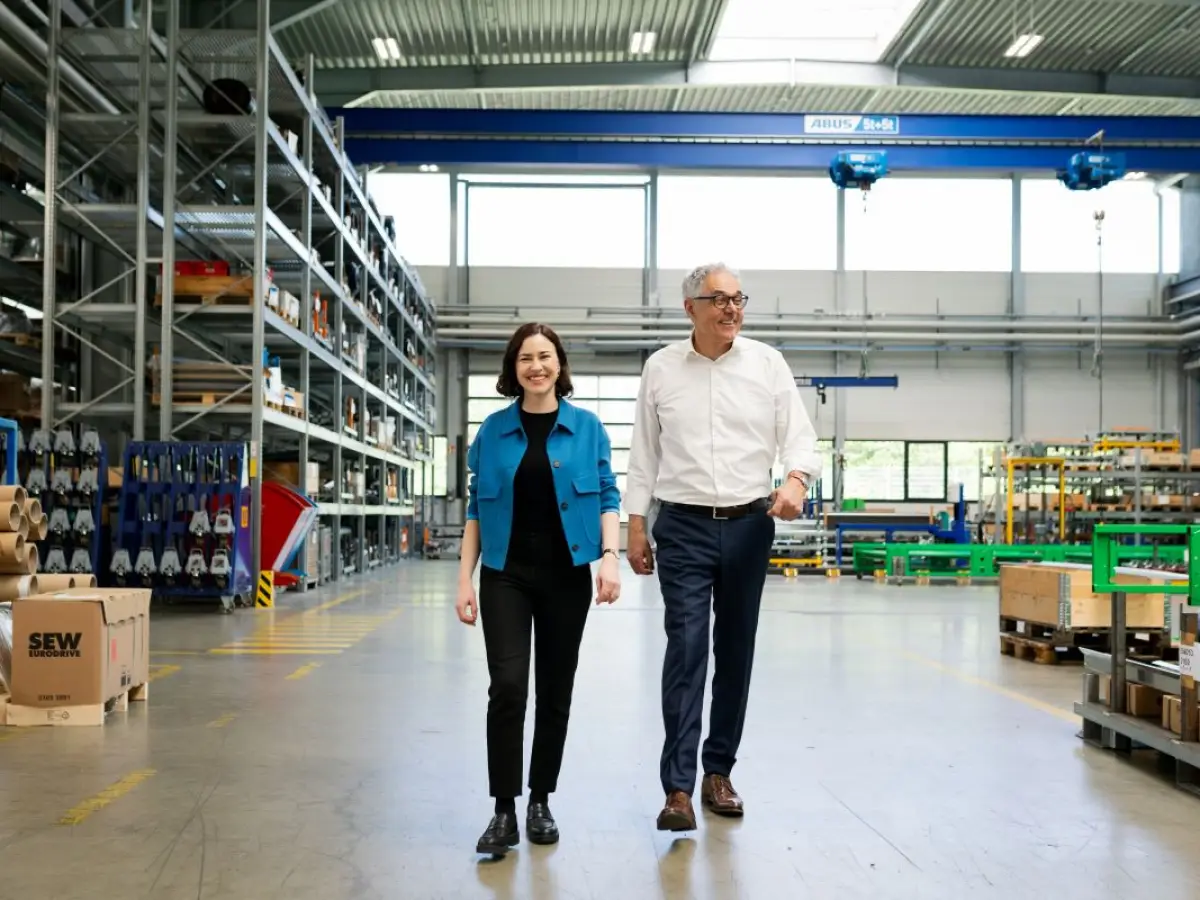
Cover: Willi and Julia Stadler in Altshausen Production Hall